Mastering Digital Marketing Insights for Growth
Let's be honest: digital marketing insights have become a buzzword. But a true insight isn't just another data point on your dashboard. It’s the story the data is trying to tell you—the clear, actionable signal that tells you exactly what to do next. It’s what turns a confusing dip in performance into a confident, growth-driving decision.
Why Digital Marketing Insights Matter More Than Ever
Trying to manage a modern ad account can feel overwhelming. You’re staring at dashboards packed with metrics, all changing by the hour, and it's easy to get lost. We've all been there, stuck in a state of data overload but insight starvation.
Think of yourself as an air traffic controller. Your screen is covered in blinking dots, each one an ad, campaign, or audience. More dots don't help. What you desperately need is a system that flags the one plane veering off course and tells you precisely how to guide it back. That’s what a real insight does.
The stakes have never been higher. Global digital ad spend hit a massive $601.8 billion in 2023 and is on track to approach $786.2 billion by 2026. This surge in competition means ad costs have jumped by about 20%, squeezing margins and demanding that every single dollar works harder. You can dig deeper into these trends in this comprehensive market analysis.
From Chaos to Clarity
In this environment, making decisions based on raw data is like trying to land a plane blindfolded. A sudden drop in your Return on Ad Spend (ROAS) might have nothing to do with your ad creative. It could be your top-selling product is running low on stock, meaning you’re just lighting money on fire advertising something people can't even buy.
A true insight isn't just knowing what happened. It's understanding why it happened and what you should do about it—or, just as importantly, what you should not do.
This guide is your path from chaotic data to actionable intelligence. We’re going to focus on what actually moves the needle. Together, we'll walk through how to:
Categorize marketing signals into clear insight types, like creative fatigue or audience saturation.
Prioritize your next move based on what will have the biggest impact on your bottom line.
Build a daily routine that replaces reactive firefighting with proactive, confident execution.
By the end, you’ll have a reliable framework for reading your marketing performance with precision. You'll finally stop drowning in data and start being powered by the clarity that only genuine insights can provide.
What Are the 5 Core Digital Marketing Insights?
If you're managing ad accounts, you know the feeling of drowning in data. It’s an endless flood of metrics, and it's easy to get lost chasing numbers that don't matter. The secret isn't tracking more data; it's learning how to sort the signals you already have into clear, actionable buckets.
Think of it as a diagnostic checklist for your ad accounts. Instead of just staring at a falling ROAS, you can start asking smarter questions. Is the ad itself worn out? Or is the audience just tired of seeing it? The answer completely changes what you do next.
Here are the five essential insight categories I use to make sense of it all.
1. Performance Insights
This is your 30,000-foot view. Performance Insights tell you whether the big-picture business metrics are heading in the right direction. It’s the simple, top-line health check that answers one question: "Are we making more money or less money than we were before?"
We're looking for significant shifts in your main KPIs, like Return on Ad Spend (ROAS), Cost Per Acquisition (CPA), or total conversions. A real insight isn't that your CPA ticked up 5% yesterday. It’s noticing a sustained, statistically meaningful trend—like a 25% drop in ROAS over three days on your biggest campaign—that demands your attention.
2. Creative Insights
If performance insights tell you what is happening, creative insights often explain why. These are the report cards for your individual ads, telling you which ones are working, which ones are dying, and which specific elements are driving success.
Two ideas are critical here: creative fatigue and winning element identification.
Creative Fatigue: This is what happens when your audience sees an ad so many times they start tuning it out. You'll see the classic signs: your Cost Per Click (CPC) creeps up while your Click-Through Rate (CTR) starts to slide.
Winning Elements: This is about pinpointing what actually works. Is it the user-generated content (UGC) hook? The specific shot of the product? The direct call-to-action? You might find, for example, that your raw, unpolished UGC ads are crushing your slick studio videos.
Acting on these insights means swapping out tired ads before they drag down your entire campaign and pouring more budget into the styles and angles that are proven winners.
3. Audience Insights
Your ads aren't just floating in cyberspace; they're being shown to real people. Audience Insights tell you how those groups of people are responding. They help you spot when you've worn out your welcome with a particular segment or stumbled upon a new goldmine of customers.
The biggest killer here is audience saturation. This is the point of diminishing returns, where you’ve shown your ads to the same group so many times it becomes wildly inefficient. You’ll feel it as your ad frequency skyrockets but your reach and results go flat.
Once you spot saturation, you know it's time to act. You can either expand your targeting to new lookalike audiences, test different interest groups, or try a completely new message to re-engage that exhausted audience.
4. SKU-Level Insights
For any e-commerce brand, this is an absolute must. SKU-Level Insights connect your ad performance directly to your physical (or digital) products. It’s amazing how many marketers unknowingly pump money into campaigns promoting products that are almost—or completely—out of stock. Every dollar spent there is a dollar wasted.
These insights give you clear answers to critical inventory questions:
Did my campaign's ROAS suddenly crash because my best-selling product just went out of stock?
Am I about to spend thousands advertising a product with only three units left?
When you link your ad data to your inventory platform like Shopify, you add a powerful layer of real-world context. This simple connection stops you from burning cash and makes sure your ad budget is always pushing products people can actually buy.
5. Volatility and Fatigue Signals
Finally, this last category is all about stability. Volatility Signals help you tell the difference between normal daily fluctuations and a real performance fire you need to put out. Essentially, it answers the question, "Is this dip a real problem, or is it just noise?"
This also covers something called edit fatigue. This happens when you tweak a campaign too often, too quickly. Constant changes prevent ad platforms like Meta and Google from ever finishing their "learning phase," which creates chaos and tanks performance. Sometimes, the most powerful insight is a signal for strategic inaction—letting you know the best move is to simply let the algorithms do their job.
To pull this all together, here is a quick summary of the five insight categories, the main question each one answers, and the key metrics you should be watching.
The Five Core Digital Marketing Insights
Insight Category | Core Question It Answers | Key Metrics to Monitor |
|---|---|---|
Performance | "Is my overall performance getting better or worse?" | ROAS, CPA, Conversion Volume, Revenue |
Creative | "Is this ad working, and why?" | CTR, CPC, Hook Rate, Hold Rate, Spend/Impression Trends |
Audience | "Are we reaching the right people effectively?" | Frequency, Reach, First-Time Impressions, Audience Overlap |
SKU-Level | "Is ad spend aligned with product availability?" | Ad spend vs. Inventory Levels, Out-of-Stock Flags, SKU-specific ROAS |
Volatility/Fatigue | "Is my account stable, or is this change just noise?" | Performance Volatility, Edit Frequency, Pacing vs. Goals |
Having a mental framework like this allows you to quickly diagnose problems and, more importantly, act on the right things to keep your accounts healthy and growing.
Turning Insights Into Daily Action
It's one thing to see your ad performance take a nosedive. It's another thing entirely to know exactly what to do about it. This is where most marketers get stuck, drowning in data but starved for clear, confident direction. After all, an insight is just a fun fact until it triggers a specific action.
The secret isn’t just about spotting problems; it’s about having a system to act on them intelligently. It's time to stop playing reactive whack-a-mole, where every alert sends you scrambling. A structured approach helps you focus your limited time and energy where it will actually make a difference. You need a way to quickly decide what needs your immediate attention, what can wait, and what’s just statistical noise you should ignore.
This simple decision tree maps out the journey from raw data to a real, actionable insight—the kind that truly warrants making a change.
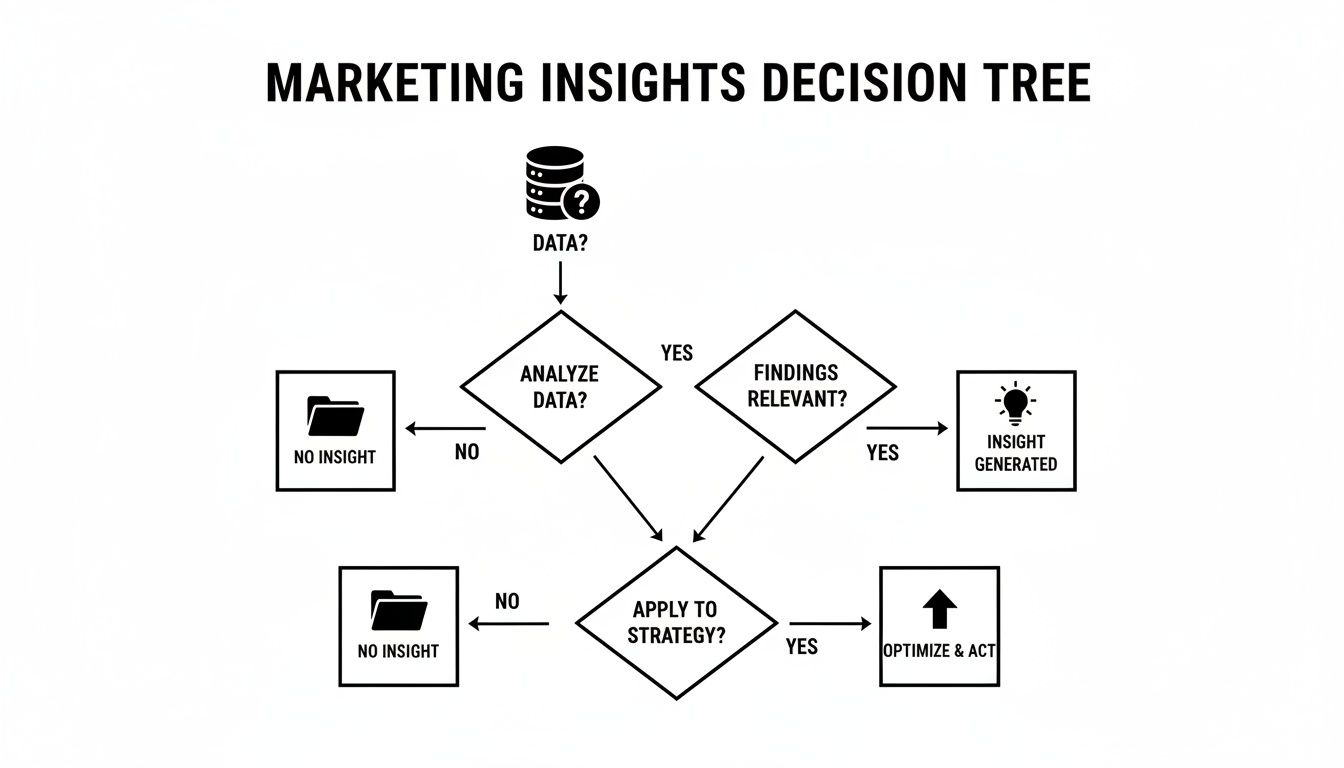
The key takeaway here is that most data points don't become insights. Your job is to filter for the signals that are both significant and actionable enough to justify stepping in.
A Prioritization Matrix for The Real World
To put these digital marketing insights to work every day, you need a mental filter. I call it the Prioritization Matrix. Every potential task that crosses your desk can be sorted by two simple criteria: its potential Impact on your goals (like revenue or ROAS) and the Effort it takes to get it done (your time, your team's resources, or the risk involved).
This matrix becomes the foundation for your daily to-do list:
High-Impact, Low-Effort: These are your quick wins and your first priority. Think: pausing a campaign that's suddenly blowing cash on an out-of-stock product, or shifting budget from a clearly fatigued creative to a proven winner. Get these done first, every single day.
High-Impact, High-Effort: These are the game-changers. We're talking about strategic projects like launching a campaign for a whole new audience segment or producing a fresh batch of creative assets from scratch. They need planning and can't be rushed, but they are absolutely essential for growth.
Low-Impact, Low-Effort: These are the little tweaks and minor optimizations. It might be changing a few words in your ad copy. They're easy to do, but they rarely move the needle in a big way. Be careful these don't fill up your entire day.
Low-Impact, High-Effort: Welcome to the danger zone. These are the time-sucking tasks with almost no payoff, like manually building a complex report no one ever reads. Learn to spot these and avoid them like the plague.
Your Daily Execution Routine
With this matrix in mind, you can build a disciplined, effective daily routine that favors consistency over chaos. A simple, repeatable process ensures you focus on what truly matters without getting pulled into the weeds by noisy data.
Here’s what a powerful daily workflow looks like:
Review Your Ranked Actions: Start the day with a list of potential actions, already sorted by impact. This list should be generated automatically from the types of insights we’ve been discussing—performance dips, creative fatigue signals, or audience saturation alerts.
Inspect the "Why": For each high-priority item, dig into the rationale. If the system suggests pausing an ad set, you should be able to instantly see the data that backs it up, like a 40% drop in ROAS over the last three days combined with a CPA that has shot through the roof.
Execute with Confidence: Once you’ve confirmed the reason, pull the trigger. Make the change. Of course, to measure if your fix actually worked, your tracking has to be flawless. If you need a refresher, you can find everything you need in our guide to building effective UTMs for Google Analytics.
The most overlooked—and often most valuable—daily action is strategic inaction. Many performance swings are just statistical noise. One of the hardest skills to learn is knowing when a campaign is just going through its learning phase or experiencing normal volatility. Jumping in and "over-editing" can reset the algorithm and do far more harm than good.
Sometimes, the best move is no move at all. This takes discipline and a system of guardrails that helps you tell a real problem from a temporary blip. By combining a clear prioritization framework with a simple execution routine, you can finally turn abstract digital marketing insights into a proactive daily workflow that consistently delivers results.
How Real Marketers Use Insights To Win
Frameworks and theories are a great starting point, but the real test is what happens in the trenches. The gap between a good marketer and a great one is how quickly they can spot a signal in the noise and turn it into a smart decision. It’s all about moving from looking at a dashboard to knowing exactly what to do next.
To show you what this looks like, let's walk through a few common, high-stakes problems that digital marketers run into every single day. In each case, a specific insight didn't just fix a campaign—it protected the bottom line. These aren't just hypotheticals; they're the kind of fire drills that define modern marketing.
The DTC Founder and the Fading Creative
First up, a classic DTC scenario. Imagine Sarah, who runs a direct-to-consumer skincare brand. She has a monster campaign running on Meta, driven by a UGC-style video that’s been crushing it for weeks. Then, the numbers start to slip. Her Cost Per Acquisition (CPA) creeps up by 15%, and her Click-Through Rate (CTR) begins to nosedive.
A quick glance might point to a targeting issue or a bad bid, but Sarah knows to look deeper. Focusing on creative insights, she quickly diagnoses the real problem: creative fatigue. The ad’s frequency is climbing, which tells her the same audience is seeing the same video over and over. They’re simply tired of it.
Insight Applied: Sarah spotted the tell-tale signs of creative fatigue—a dropping CTR and rising CPA on an ad with high frequency. Instead of blowing up the whole campaign, she surgically addressed the one piece that was failing.
Her move is fast and precise. She doesn't shut down the campaign, as it’s still profitable. Instead, she duplicates the winning ad set and swaps in a fresh creative—a new video with a different hook but that same authentic, user-generated feel. The effect is almost instant. The CTR bounces back, the CPA stabilizes, and the campaign gets a new lease on life without forcing the algorithm to start learning all over again.
The Agency Manager and the Stalled Account
Let's look at another common headache. Tom is an agency manager working with a client in the hyper-competitive home goods market. For a solid month, their Google Ads account has hit a wall. The spend is steady, but growth has flatlined. Simply throwing more money at it isn't working; it just makes the CPA climb.
Tom has a hunch the problem isn't the ads themselves, but who's seeing them. He digs into his audience insights, and the data confirms his suspicion. His primary audience segments are showing classic signs of audience saturation. Reach is totally flat, while frequency has gone through the roof. He’s just hammering the same exhausted group of people.
Problem: Growth has completely stalled, and increasing the budget just hurts profitability.
Insight: The data screamed audience saturation—sky-high frequency with no new reach.
Action: Tom pauses the burnt-out audience segments. He immediately launches new campaigns targeting fresh lookalike audiences built from recent high-LTV customers. He also carves out a small test budget for a new, adjacent interest category he’d been meaning to try.
Within two weeks, the account roars back to life. The new audiences are responding with much higher engagement and a healthier CPA, finally breaking through the performance plateau and getting the client’s growth back on track.
The Shopify Operator and the Invisible Inventory Issue
This last one is a silent killer for e-commerce brands. Maria manages marketing for a popular Shopify store selling athletic apparel. She comes in on a Monday morning to a full-blown disaster: her top-of-funnel campaign ROAS has fallen off a cliff, dropping by 50% over the weekend. The ads seem fine, the targeting is the same, and there are no obvious errors in Ads Manager.
Instead of getting lost in platform-level data, Maria goes straight to her SKU-level insights. By connecting her ad performance directly to her live Shopify inventory, the problem becomes painfully obvious. The campaign was pushing their best-selling leggings, but an unexpected sales rush over the weekend meant the most popular sizes (S, M, L) were now completely sold out.
She was burning thousands of dollars sending eager customers to a product page where they couldn't buy anything. This is a problem that, without connected data, could have gone unnoticed for days.
Maria immediately pauses the ad set for the leggings and shifts that budget to a campaign promoting a different, fully-stocked product line. The bleeding stopped instantly, and her ad spend was put back to productive use, saving the week's performance.
How SpendOwlAI Puts Your Marketing Insights Into Action
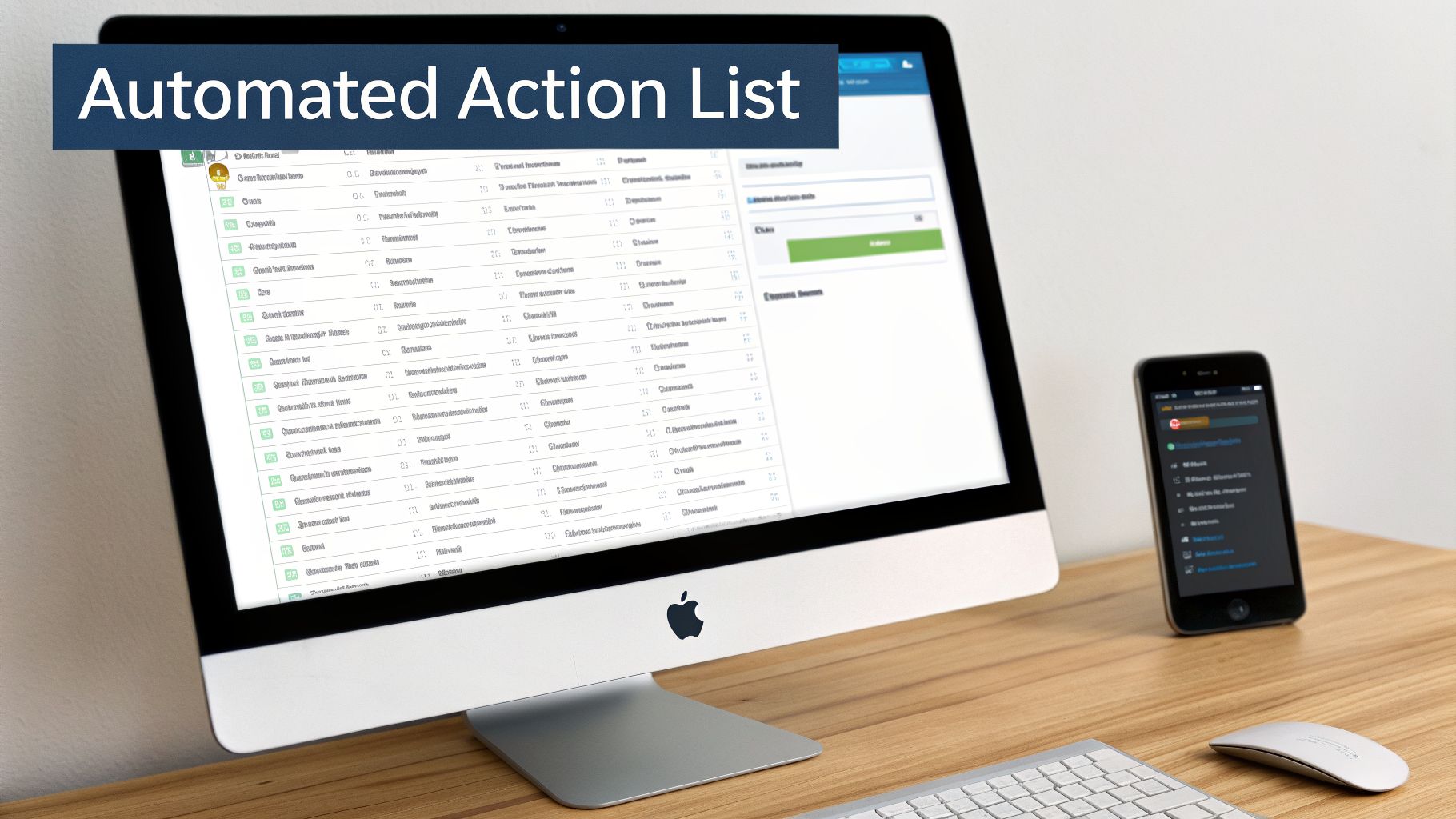
We've talked a lot about frameworks and theories. Now, let's get practical. This is the part that turns all that data into a clear, daily plan of attack.
Knowing what to do in theory is one thing. Actually executing it, day in and day out, under the constant pressure of hitting targets? That's a completely different ballgame. It’s in that gap between knowing and doing where money gets wasted, opportunities are missed, and good marketers burn out.
A good system doesn't just throw more data at you; it helps you get the right things done. That's precisely what SpendOwlAI is built for. It isn’t another dashboard you have to spend hours trying to figure out. Think of it as your automated analyst—and your partner in getting things done. It’s designed to replace those gut-feel decisions with a data-driven workflow.
Your Daily Ranked Action List
Every single morning, SpendOwlAI gives you a simple, ranked to-do list for your ad accounts. This isn't just a stream of random alerts. It's a carefully curated list that uses the Prioritization Matrix we covered earlier, scoring every recommendation by its potential impact. You’ll always know you're working on the most important task first.
This flips the script from reactive firefighting to proactive management. Instead of you spending your morning hunting for what’s broken, the system surfaces the most critical issues and opportunities, complete with the context you need to make a fast, confident decision.
It automatically pulls in all five of the key insight types we've discussed:
Performance Insights: Get flagged on significant, sustained drops in ROAS or spikes in CPA for your most important campaigns.
Creative Insights: Know the exact moment a top-performing ad is starting to show signs of fatigue, so you can swap it out before it drags down your account.
Audience Insights: Receive alerts when an audience is getting saturated, telling you it’s time to find new customers instead of annoying your old ones.
SKU-Level Insights: Connect directly to your Shopify inventory and automatically stop ad spend on out-of-stock products. No more wasted clicks.
Volatility Signals: Finally understand if a performance dip is a real problem or just normal, everyday statistical noise.
Guardrails That Prevent "Over-Editing"
Sometimes, the most valuable digital marketing insights tell you to do nothing at all. As media buyers, we have a tendency to want to "fix" things. But constant tinkering, or "over-editing," can be just as damaging as ignoring a real problem. Every time you make a major change, you risk throwing the ad platform's algorithm back into its learning phase, creating even more instability.
SpendOwlAI was built with this reality in mind. It has "Guardrails" baked in to encourage strategic patience.
Guardrails are automated checks that tell the difference between a real performance fire and normal statistical volatility. They stop you from making knee-jerk, noise-driven changes that disrupt the algorithm and hurt your long-term results.
For example, the system might see a one-day dip in performance but recognize it’s within the normal range of fluctuation for that campaign. Instead of sending a panic-inducing alert, it advises you to simply monitor the situation. This saves you from making a premature edit that would have done more harm than good. That explicit restraint is just as powerful as an alert to take action.
From Vague Hunches to Clear Actions
Ultimately, the goal is a system for managing your ads that is both incredibly efficient and brutally effective. By translating messy data streams into a clear, actionable format, SpendOwlAI closes the gap between analysis and execution. It gives you the "what" and the "why," so you can confidently handle the "how."
This kind of operational discipline is what ensures your marketing efforts are always pushing your business forward. To see this daily workflow in action, you can explore the platform and learn more about SpendOwlAI's approach to simplifying ad management. It's about spending less time buried in spreadsheets and more time making the high-impact decisions that truly drive growth.
Blending Paid Ads With a High-ROI Organic Strategy
Too many marketers treat their paid and organic strategies like they live on different planets. The real magic happens when you stop seeing them as separate channels and start using them to create a powerful feedback loop, where each one makes the other smarter and more effective.
Think of your paid ad budget as your own private R&D lab. For a relatively small spend, you can quickly test what really works. You're not just buying clicks; you're buying data. This is where you find out which keywords actually lead to sales, what headlines people can't resist clicking, and which customer pain points get the most emotional response. These aren't just ad metrics—they're a battle-tested blueprint for your content and SEO teams.
Turning Ad Spend Into SEO Gold
This integrated approach means your ad spend isn't just an expense; it's an investment in a more intelligent organic game plan. Instead of throwing darts in the dark, wondering what blog topics to create or which keywords to chase, you're using real performance data to make every move count.
High-Performing Ad Keywords: If you discover a long-tail keyword in your Google Ads account with a fantastic return on ad spend (ROAS), that's a massive green light. It tells you exactly what to build your next pillar page or in-depth blog post around.
Winning Ad Copy: That ad variation with the sky-high click-through rate? You've just found a pre-validated, high-performance headline. Use those proven hooks as titles for your blog posts, email subject lines, and meta descriptions to immediately boost your organic engagement.
Audience Pain Points: When a specific creative or video ad gets a ton of shares and comments, pay close attention. It’s a direct window into what your audience genuinely cares about, helping you create content that solves their problems and builds your authority.
On the flip side, a strong organic presence acts as the bedrock for your entire marketing ecosystem, reducing your long-term reliance on paid ads. SEO is an asset that you build over time, one that lowers your customer acquisition costs and compounds in value. Paid ads give you that instant traffic boost, but SEO delivers sustainable growth. When they work together, your marketing becomes far more resilient. And if you're looking to squeeze more value from every visitor, our guide on improving your website conversion optimization has some practical steps you can take.
SEO is still the undisputed king of digital acquisition. Some reports show it's the starting point for 93% of all online activities. With 49% of marketers claiming it delivers their highest ROI, it’s a channel you simply can't afford to deprioritize. You can dig deeper into these numbers with the latest digital marketing industry statistics.
A Few Common Questions About Marketing Insights
When you're swimming in data, it’s easy to feel like you’re drowning. Let's clear the air and answer some of the most common questions we hear from marketers trying to turn all that information into real-world wins.
How Do I Know Which Insights Matter and Which Are Just Noise?
This is the million-dollar question. The secret is to anchor every insight back to your bottom line—think revenue and profit. Forget about chasing every little metric.
Instead, zero in on the signals that have a direct impact on your business. Are your ROAS trends dropping on your top-performing campaigns? Is your best creative starting to burn out for your top-selling products? Are you hitting a wall with your go-to audience in your main markets? These are the questions that matter. A great system will even surface and rank these for you by how much money they’re costing you (or could make you).
Should I React to Every Little Daily Dip in Performance?
Probably not. In fact, one of the biggest mistakes marketers make is reacting to daily volatility. Most of those little ups and downs are just statistical noise, not a real trend.
Jumping on every dip leads to what we call "over-editing." You end up constantly tweaking your campaigns, which just resets the ad platform's learning algorithm and torpedoes your long-term performance.
The disciplined approach is to act on significant trends, not daily blips. You need guardrails in place to help you tell the difference between a real five-alarm fire and a temporary flicker.
Can I Actually Find These Insights Without an Expensive Tool?
Honestly, yes, you can. But the real question is, what's your time worth? Manually pulling reports from Google, Meta, and Shopify, then trying to stitch them together in a spreadsheet is a massive time sink and extremely prone to error.
The hidden cost isn't just the hours you lose; it's the opportunities you miss while you're bogged down in data entry. Automated tools that deliver clear, prioritized recommendations in minutes usually pay for themselves by preventing just one bad decision or freeing up your team to focus on strategy.
Ready to trade gut feelings for a clear, data-driven game plan? SpendOwlAI gives you a daily, ranked list of actions so you can stop guessing and start growing. Begin your free trial and see for yourself.