A Guide to Customer Retention Management for E-commerce Growth
Customer retention management isn't some passive metric you glance at once a quarter. It's the daily, hands-on work of making sure the customers you fought so hard to win actually stick around. It’s a core discipline focused on one thing: increasing the lifetime value of every single customer you've already acquired.
What Is Customer Retention Management, and Why Does It Matter?
Think of your business as a bucket. Every day, your acquisition team is hustling to pour new customers—water—into that bucket. But what if the bucket is full of holes? All that effort (and ad spend) just leaks out the bottom. That leakage is customer churn.
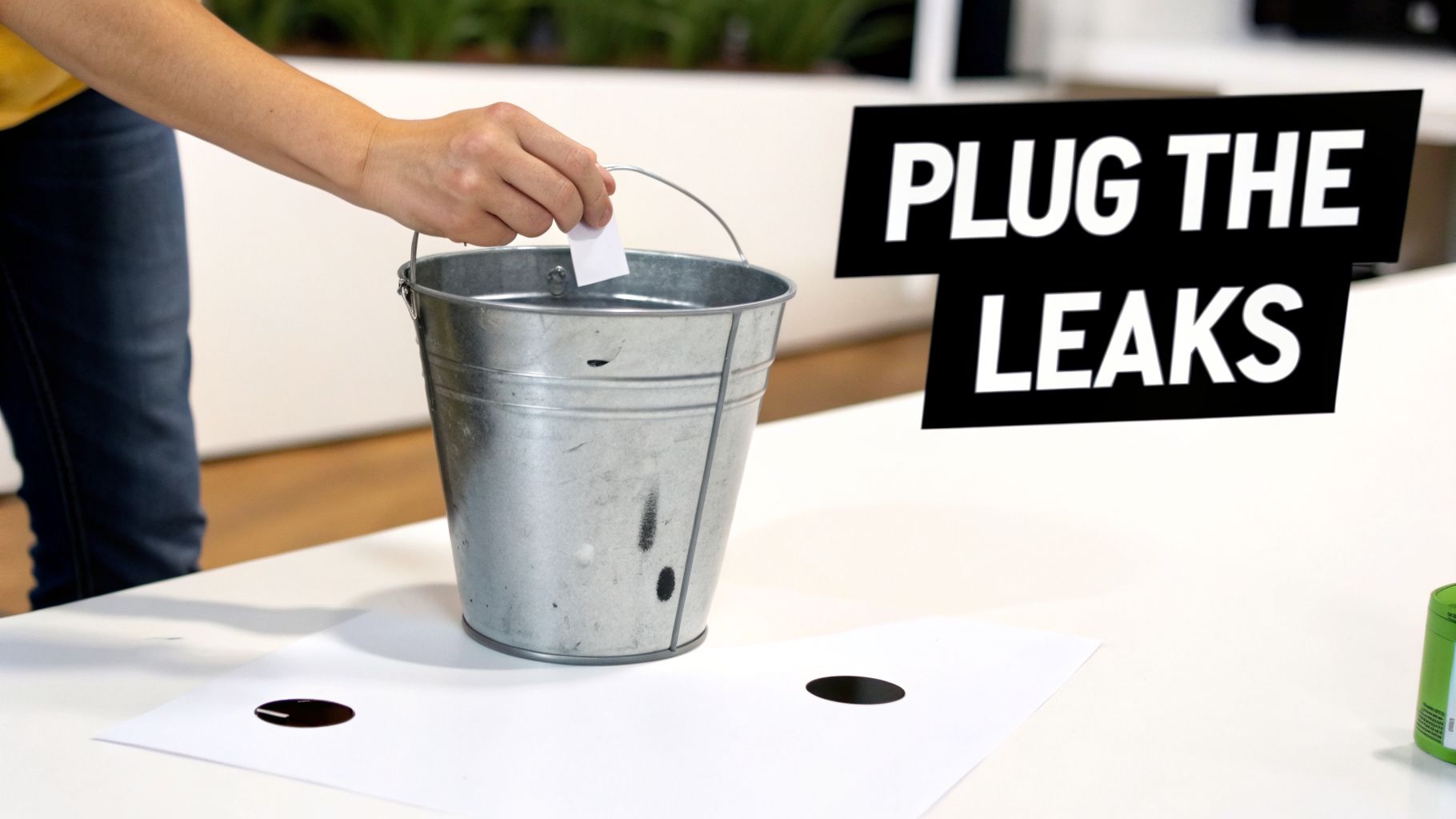
Customer retention management is simply the act of finding and plugging those leaks.
Instead of getting stuck on the hamster wheel of pouring more and more water into a leaky bucket, this approach focuses on keeping the water you already have. For any modern e-commerce or DTC brand navigating sky-high ad costs, this shift isn't just smart—it's essential for survival.
The Stark Reality for E-commerce Brands
The numbers paint a pretty clear picture. In the hyper-competitive world of e-commerce, the average customer retention rate is a staggering 38% globally. Shoppers have endless options and are incredibly price-sensitive, which drives this constant churn.
Recent data shows e-commerce retention improved by just 2% year-over-year. When you compare that to industries like SaaS (77%) or banking (75%), it’s clear that e-commerce has a massive, costly retention problem. You can explore more industry retention rates to see the full picture.
This gap between e-commerce and other industries isn’t a weakness; it’s a huge opportunity. And the financial upside of closing that gap is incredible.
The classic research from Bain & Company still holds true: a mere 5% increase in customer retention can boost profits by 25% to 95%. That's a powerful multiplier effect that turns small, consistent efforts into game-changing growth.
It’s More Than Just a Loyalty Program
When people hear "retention," they often think of simple punch cards or points systems. But modern customer retention management is so much more. It's a full-funnel strategy that weaves together marketing, customer service, and the product experience itself. It’s about using data to understand your customers and give them what they need, right when they need it.
An active retention discipline really comes down to a few key areas:
Nailing the onboarding: You have to make sure customers get immediate value and a great feeling from their very first purchase.
Smart lifecycle messaging: This means talking to customers based on their actual behavior, not just blasting them with generic promotions.
Operational excellence: A smooth, predictable experience from checkout to unboxing is non-negotiable.
Data-driven decision-making: Using real metrics to guide your ad spend, product roadmap, and customer service improvements.
For anyone running an e-commerce business, getting a handle on customer retention isn't just a "nice-to-have." It's the difference between a brand that's constantly burning cash to find new buyers and one that builds a stable, profitable foundation of true fans. The goal is to turn every new customer into a long-term asset, not just a one-off transaction.
The Numbers That Actually Matter for Customer Retention
If you want to get a real handle on customer retention, you need to look past the flashy top-line sales numbers. New customers are great, but the metrics we're about to cover are the ones that tell you if you're building a lasting business or just stuck on a customer acquisition treadmill. These are the numbers that should be front and center on any retention dashboard.
Let's dig into the four core metrics that every e-commerce and performance marketing team should be tracking obsessively.
To give you a quick reference, here's a snapshot of the key metrics we'll be exploring.
Key Customer Retention Metrics at a Glance
Metric | How to Calculate It | What It Tells You |
|---|---|---|
Churn Rate |
| The percentage of customers who stop buying from you in a given period. It's a direct health check on customer satisfaction. |
Customer Lifetime Value (LTV) |
| The total revenue you expect from a single customer over their entire relationship with you. It defines your growth ceiling. |
Repeat Purchase Rate (RPR) |
| The percentage of customers who come back for a second purchase. It’s an early signal that you’ve earned their loyalty. |
Retention Rate by Cohort |
| How well you're retaining specific groups of customers over time. It helps you measure the impact of your actions. |
These metrics work together to paint a full picture of your customer base, moving beyond single data points to tell a complete story.
Churn Rate: The Leaky Bucket Problem
Your Churn Rate is the percentage of customers who don't come back to buy from you within a certain timeframe. Think of it as a leak in your business's bucket. It doesn't matter how much you pour in through acquisition if it's all draining out the bottom. A high churn rate is a flashing red light that something—your product, your shipping, or your post-purchase experience—is falling short.
The calculation is simple:
(Customers at Start of Period - Customers at End of Period) / Customers at Start of Period
So, if you began a quarter with 1,000 customers and ended with 950, your quarterly churn is 5%. The main job of any retention strategy is to plug that leak and get this number as close to zero as possible.
Customer Lifetime Value: Your North Star for Growth
Customer Lifetime Value (LTV) is the total amount of money you expect a customer to spend with you over their entire time as a customer. This isn't just a metric; it's a mindset. It shifts your focus from winning the transaction to winning the long-term relationship.
A high LTV is your permission slip to spend more to acquire customers. When you know a customer will pay back their acquisition cost (and then some) over time, you can invest in growth with confidence.
A basic way to figure out LTV is:
Average Purchase Value x Average Purchase Frequency x Average Customer Lifespan
Ultimately, every single thing you do in customer retention management—from your welcome series to your loyalty program—is about driving this number higher.
Repeat Purchase Rate: The Pulse of Customer Loyalty
The Repeat Purchase Rate (RPR) shows what percentage of your customers have come back to make a second purchase. It’s the quickest, most direct way to check the pulse of your customer base. While LTV is the long game, RPR tells you right now if you gave people a compelling reason to return.
The formula is just as straightforward:
Number of Customers Who Purchased More Than Once / Total Number of Customers
A healthy RPR is often the first concrete sign that your retention marketing is actually working. It's proof that you delivered on your promise and earned another sale.
Retention Cohorts: Telling the True Story of Your Customers
This is where things get really insightful. A retention cohort is just a group of people who all became your customers around the same time—for example, everyone who made their first purchase in January. Cohort analysis means you watch these specific groups over months or even years to see how they behave.
Imagine each month's new customers as their own "graduating class." You can track the January class, the February class, and so on, to see if their loyalty improves or declines over time. This approach is so effective because it lets you see cause and effect.
Did that new onboarding sequence you launched in March actually make the March cohort stick around longer than the February cohort?
Did a price increase in July cause more of that month's new customers to drop off after their first purchase?
By analyzing customers in these discrete groups, you get away from vague, company-wide averages. You can see the real-world story of how your decisions—good and bad—are impacting customer behavior for the long haul. It's the most accurate way to measure whether your retention efforts are truly paying off.
Proven Frameworks for E-commerce Retention
Knowing your retention numbers is one thing. Actually improving them is another. You can't just throw random marketing campaigns at the wall and hope something sticks. The best performance teams use a structured framework—a playbook, really—that guides how and when they talk to customers based on where they are in their journey.
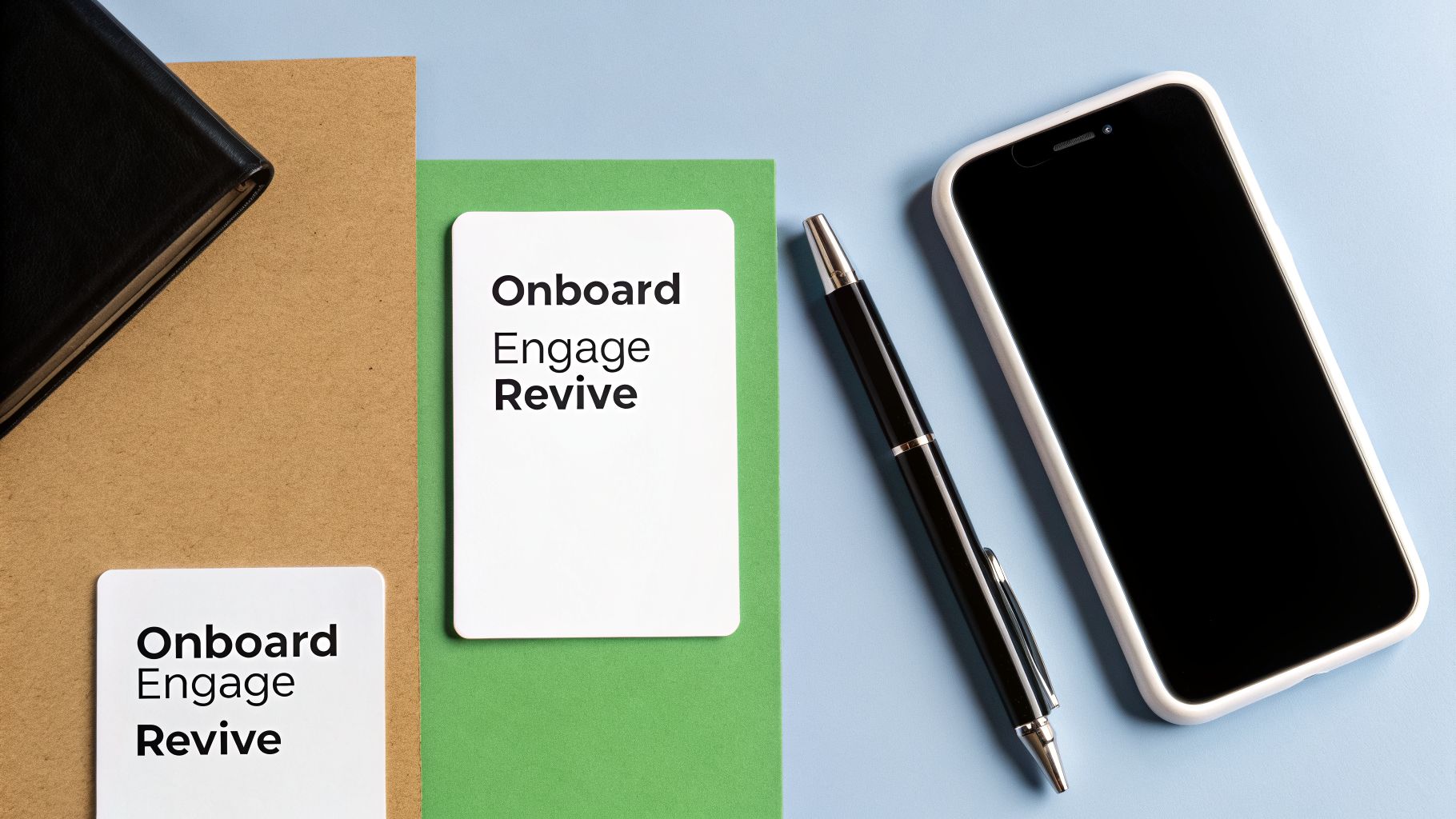
Smart customer retention management is all about being proactive. It's about anticipating what customers need and building a real relationship across three distinct phases: Onboarding, Engagement, and Revival. When you systematize your efforts, you stop playing defense and start building genuine, long-lasting loyalty.
Phase 1: The Onboarding Sprint
The first 30 days after a customer makes a purchase are make-or-break. This is your golden window to either cement the relationship or lose them for good. One bad experience here can completely undo all the hard work and ad spend that went into acquiring them in the first place. Onboarding isn't just about shipping a product; it’s about proving their purchase was a smart decision.
Here's where to focus your energy:
A Killer Welcome Series: This needs to be more than a single "thank you" email. Think of it as an automated sequence designed to educate, build excitement, and set expectations. Use it to tell your brand story, share tips for getting the most out of their new product, and invite them into your community. To get started, you can check out our guide on how to build a powerful email drip campaign.
First-Purchase Follow-Ups: Don't just rely on the standard shipping notification. A week or two after the product arrives, send a personal-feeling email asking for feedback or offering help. It’s a simple touch that shows you care about their experience, not just their wallet.
Educational Content: Context is everything. If they bought a complex skincare product, send them a guide on how to layer it into their routine. If they bought home gym gear, point them toward a library of workout videos. This makes the product more valuable and positions you as a helpful expert.
Phase 2: Ongoing Engagement
Once you've nailed the onboarding, your job shifts to keeping the conversation alive and staying top-of-mind. This entire phase is about nurturing the relationship between purchases. If you go silent, even your happiest customers will eventually forget about you.
Now, your focus turns to creating long-term value:
Personalized Lifecycle Messaging: Use purchase data to send offers that actually make sense. Did a customer buy a 30-day supply of coffee? Send a re-order reminder around day 25. Did they buy a summer dress? Show them new fall arrivals as the season changes.
Community Building: Give your customers a place to connect with each other and with your team. This could be a private Facebook group, a VIP Slack channel, or exclusive access to digital events. A strong community turns paying customers into passionate brand advocates.
Surprise and Delight: Small, unexpected gestures can have a huge impact on loyalty. This could be anything from a free gift with their second order to a special discount on their birthday. It shows you see them as a person, not a transaction.
While many e-commerce brands are still fighting for every repeat purchase, SaaS and IT services have practically perfected proactive retention, with rates holding strong between 77-83%. Their secret? They lean heavily on tactics like predictive churn detection and automated onboarding—strategies that DTC brands can absolutely steal. Meanwhile, a staggering 44% of businesses admit they don't even look at retention, which is a massive oversight when 82% of leaders agree it’s cheaper to keep a customer than to find a new one. Find more details on how different industries handle retention.
Phase 3: The Revival Campaign
Let's be realistic: no matter how great your product or service is, some customers will drift away. The revival phase is all about winning back those at-risk or churned customers before they’re gone forever. This calls for a targeted and empathetic game plan.
First, identify customers who haven't bought anything in a specific timeframe, like 90 or 120 days. Then, launch a dedicated win-back campaign. This is not the time for a generic "we miss you" email.
Instead, try a multi-touch approach:
Acknowledge Their Absence: Send an email that shows you’ve noticed they've been gone. Ask for feedback with a simple survey—you might uncover exactly why they stopped buying.
Make an Irresistible Offer: Give them a real reason to come back. This could be a steep discount, a free product with their next purchase, or early access to a new collection.
Remind Them What They're Missing: Show off your best-selling products or highlight new features and improvements you've made since they were last active.
By following this three-phase framework, you’re not just managing customers—you’re building a complete system for customer retention management. You'll be nurturing buyers at every single stage, maximizing their lifetime value and building a much more resilient business.
Practical Tactics to Boost Customer Loyalty and LTV
Having a great retention strategy on paper is one thing, but the small, consistent actions you take every day are what truly build a loyal customer base. Think of customer retention management as a toolbox of practical, low-cost tactics that any e-commerce team can start using immediately. The goal is to move beyond one-off promotions and create a cohesive experience that makes customers want to return.
The payoff for getting this right is massive. A small 5% increase in retention can boost profits by as much as 75%. This isn’t just a nice-to-have stat; it’s a reality reflected in the numbers. For many companies, up to 65% of their business comes directly from existing customers. For DTC brands, the story is even more compelling: repeat buyers not only spend 67% more, but the chance of them buying again skyrockets to 62% after their third purchase. You can find more eye-opening customer retention stats that drive home the impact.
So, what does this look like in practice? Let's dig into the tactics that actually move the needle.
Rethink Loyalty and Rewards Programs
Forget the simple "earn points, get a discount" model. Today’s best loyalty programs make customers feel like they're part of an exclusive club—turning casual shoppers into genuine brand advocates. The key is offering value that goes way beyond a simple coupon.
Try these approaches:
Tiered Programs: Gamify the shopping experience by creating levels like Bronze, Silver, and Gold. Customers unlock new tiers by spending more or engaging with your brand in other ways. Each tier should come with better perks, like free shipping, early access to sales, or exclusive products. It gives them a clear path to follow and a reason to stick around.
Exclusive Access: Reward your best customers with perks money can't buy. This could be an invitation to a private Slack community, access to limited-edition merch, or a behind-the-scenes look at your product design process. Exclusivity makes people feel like insiders, which is a powerful driver of loyalty.
Weave Retention into Your Product and Pricing
Sometimes the most effective retention strategies are baked right into what you sell and how you sell it. With a few smart moves, you can naturally encourage repeat business and increase the lifetime value of every customer you acquire.
The goal isn't just to make the next sale; it's to become an indispensable part of your customer's routine. When you consistently solve their problems, coming back to your store becomes the easiest, most natural choice.
Here are two powerful tactics:
Smart Bundling: Dive into your purchase data. What products do people buy together? Use that insight to create curated bundles that offer a slight discount. This not only bumps up your average order value but also helps customers discover other products they'll love.
Subscriptions and Auto-Replenishment: For any consumable product—coffee, skincare, supplements, you name it—a subscription model is the ultimate retention engine. It puts reordering on autopilot, locking in recurring revenue for you and removing all friction for the customer. A small discount, usually 10-15% off, is often all it takes to get them to subscribe.
Sharpen Your Creative and Audience Strategy
Your advertising strategy shouldn't stop after the first sale. In fact, your existing customer base is by far your most valuable and efficient audience to market to. But you can't talk to them the same way you talk to cold prospects.
This is where sharp segmentation is non-negotiable. If you're new to this, you can learn more about why segmentation is important for building campaigns that actually connect with people.
Creative That Speaks to Customers, Not Strangers
Please, stop showing your loyal fans the same 10% off introductory offer. Your retention-focused creative needs to deepen the relationship.
New Arrivals & Back-in-Stock Alerts: Make them feel special by giving them the first heads-up when new products launch or a popular item is back. It’s a simple way to reward their loyalty.
Upsell & Cross-Sell Content: Did someone buy the beginner’s running shoe? Show them an ad for your advanced model. Did they purchase a coffee machine? Feature your best-selling coffee beans.
Brand Storytelling: Use your ad creative to remind them why they chose you in the first place. Reinforce your brand's mission, values, and the people behind it. This builds an emotional connection that discounts can't compete with.
Audiences for High-Efficiency Campaigns
Your first-party data is pure gold. Use your customer lists to create custom audiences on ad platforms like Meta and Google. You can build hyper-specific segments—like one-time buyers, VIPs, or customers who haven't purchased in 90 days—and tailor your messaging to each group. This level of precision makes every ad dollar work harder, driving profitable growth from the people who already know and trust your brand.
Operationalizing Retention Signals into Daily Ad Management
All the retention reports in the world don’t matter if they just sit in a folder. True customer retention management comes to life when you use those insights to guide your day-to-day advertising. This is where your retention data stops being a report card on the past and starts being a crystal ball for your future ad spend.
It’s about making your CRM and ad platforms talk to each other, so every dollar you spend is smarter than the last. We’re moving beyond just chasing a simple ROAS (Return on Ad Spend) and starting to read the subtle clues that tell us when performance is about to drop.
From Reactive to Proactive Ad Management
Let’s be honest: most ad management is reactive. Performance dips, a sense of panic sets in, and we start pulling levers—slashing bids, swapping out creative, or hitting refresh on our audiences. More often than not, this just makes things worse by resetting the ad platform’s learning phase and muddying the waters.
A retention-focused approach flips the script. It’s proactive. You’re not just reacting to a bad day; you’re spotting the underlying issues before they can sink your campaigns.
Watch out for these common "retention decay" signals:
Creative Fatigue: Your best customers have seen that ad 10 times. It’s not working anymore; it’s just getting annoying and chipping away at the goodwill you’ve built.
Audience Saturation: You’ve reached most of your target audience, and now you’re paying more to reach the few who are left—people who are probably less likely to buy anyway.
SKU-Level Performance Drops: A single product is tanking, maybe because it’s going out of stock or out of season, and it's dragging an entire campaign down with it.
When you monitor these signals, your actions become precise. Instead of nuking a whole campaign, you can spot that one ad is tired and swap it out, saving the rest of the ad set from your "help."
The Power of Data-Backed Restraint
One of the hardest skills for any media buyer to learn is knowing when to do nothing. Ad platforms are built to handle small, daily ups and downs. Constantly fiddling with the controls often prevents them from finding a stable, profitable groove. This is a concept I call Data-Backed Restraint.
It’s about fighting that twitchy urge to react to random noise. Instead, you use data to build the confidence to let your campaigns run when they’re actually performing within an acceptable range. True excellence is often about making fewer, more meaningful changes.
This is where specialized tools can be a game-changer. Platforms like SpendOwlAI act as intelligent “guardrails” for your ad accounts. They monitor metrics like learning stability and edit frequency to give you a clear signal: leave this ad set alone, it’s working.
Here’s what a dashboard providing these kinds of guardrails might look like, translating a mountain of complex data into simple, actionable guidance.
Clear alerts on what needs your attention—versus what's just business as usual—help you avoid over-editing and stop wasting money. If you're curious about the tech behind this, our guide on choosing the right marketing attribution software digs into how better measurement fuels smarter decisions.
Creating a Virtuous Cycle of Growth
When you finally connect your retention data to your customer acquisition efforts, you kickstart a powerful growth loop. The patterns you find in your best long-term customers become the blueprint for finding new ones.
Here’s how that plays out in the real world:
Set Intelligent CPA Targets with LTV: Ditch the one-size-fits-all CPA (Cost Per Acquisition) target. You can confidently pay a higher CPA to acquire a customer who looks just like your high-LTV cohort, because you know they’ll be more valuable over time.
Refine Audiences with Churn Data: Noticing that customers from a certain audience are leaving faster? It might be time to lower your bids for that group or even exclude them entirely, shifting your budget to acquire customers who are more likely to stay.
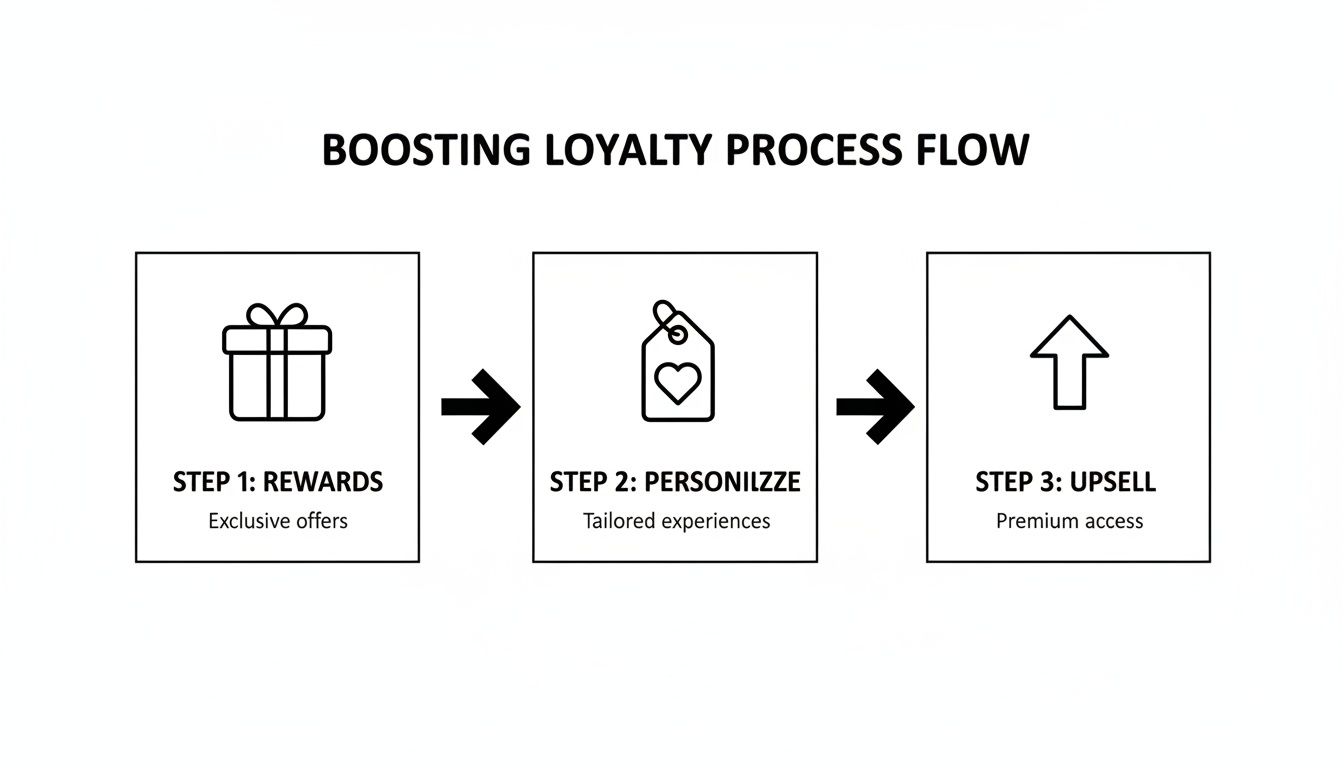
This simple flow shows how to build loyalty that feeds back into the system: you reward customers, personalize their experience, and find smart upsell opportunities.
Every step gives you more data, which in turn helps you make a better ad decision for the next customer you acquire. This is the discipline that separates the brands that just get by from the ones that build sustainable, profitable growth.
Frequently Asked Questions About Customer Retention
Even with the best game plan, putting customer retention into practice always brings up a few tricky questions. It's one thing to talk theory, but another to get it working in the real world.
Here are some of the most common hurdles I see e-commerce operators and performance marketers face, along with some straight-to-the-point answers to help you clear them.
How Long Does It Take to See Results From a Customer Retention Strategy?
This is probably the most common question, and the answer is: it depends on what you're looking for. Some tactics, like a well-timed win-back campaign, can give you an immediate sales bump. But real, sustainable retention is a long game. It's less like a switch you flip and more like a flywheel you're trying to get spinning—it starts slow but builds incredible momentum over time.
You'll see early signs of life pretty quickly. Within the first 30-60 days of launching something like a solid customer onboarding flow, you should see leading indicators like Repeat Purchase Rate and email engagement start to tick up. Those are your green shoots.
But for the big, foundational metrics like Customer Lifetime Value (LTV) and a meaningful drop in your overall churn rate, you need to be more patient. Meaningful changes there usually take 3-6 months to show up clearly in the data. Why? Because you need enough time for cohorts to mature and for the compounding effects to really kick in. Consistency is everything; the major financial payoff comes after you've run through a few full customer lifecycles.
What Is the Single Most Important Metric for a Small E-commerce Store?
For a new or small e-commerce store, my advice is always the same: focus on your Repeat Purchase Rate (RPR). It's simple, easy to calculate, and gives you an immediate pulse on whether your customers see enough value to come back for more.
While LTV is the ultimate north star, it can be misleading with limited historical data. Focusing on moving your Repeat Purchase Rate from 15% to 20%, for example, provides a clear, achievable goal that directly proves your retention efforts are paying off and builds the foundation for higher LTV later.
A healthy RPR is the first real proof point that you're building a brand, not just a transaction machine. It tells you your customer retention efforts are on the right track.
Can I Improve Retention Without a Formal Loyalty Program?
Absolutely. In fact, you should. Loyalty programs can be powerful, but they are just one tool in the toolbox—and they aren't a substitute for a great core experience. You can make huge strides in retention by simply nailing the fundamentals first.
Think about focusing on operational excellence:
A seamless post-purchase experience: This is non-negotiable. It means crystal-clear order confirmations, proactive shipping updates that don't leave customers guessing, and a return process that isn't a headache.
An engaging onboarding series: Don't just send a receipt. Use your first few emails to teach customers how to get the most out of their purchase, which reinforces the value of their decision.
Personalized lifecycle messaging: Stop batch-and-blasting. Send people relevant messages based on what they've bought, instead of one-size-fits-all promos.
Exceptional customer service: Fast, empathetic support can single-handedly turn a frustrating problem into an opportunity to create a customer for life.
Nailing these things builds trust and genuine satisfaction. Those are the real drivers of loyalty, with or without a points system.
How Does Ad Creative Fatigue Affect Customer Retention?
Creative fatigue is a silent killer of customer retention, especially in your remarketing campaigns. When your loyal, existing customers see the same 101-level "introductory offer" ad over and over, it does more than just get ignored—it gets annoying. You're actively chipping away at the brand affinity you worked so hard to build.
A smart customer retention management strategy segments creative for different stages of the customer journey. You should never show a loyal repeat buyer the same ad you'd serve to a completely cold prospect. It's just bad manners.
Instead, create ads specifically for them. Show them content about:
New products you just dropped
Stories that build your brand's mission
Complementary items that go perfectly with their last purchase
This approach keeps the conversation fresh and respectful. You're deepening the relationship with your most valuable customers, not burning it out.
Ready to stop reacting to ad performance and start proactively managing it? SpendOwlAI delivers clear, data-backed actions every day, helping you avoid waste and execute with confidence. Start your free trial and see the difference.