Unlock Winning Creatives Facebook Ads
If you're still managing creatives for Facebook ads like it's 2020, you're leaving a massive amount of performance on the table. The single biggest lever you can pull for better results isn't your audience targeting anymore—it’s the ad creative itself. Let's walk through why this shift happened and how to build a system to consistently churn out winning ads.
Why Ad Creative Is Your New Targeting

Are you still spending hours meticulously layering interest-based audiences or building out complex lookalike structures for your Meta ads? If so, it’s time for a major strategy update. You're playing yesterday's game.
Meta's algorithm has become incredibly sophisticated, especially with its latest machine learning advancements. It no longer needs advertisers to hand-hold it to the perfect audience. The system is now smart enough to find the right people all on its own, even within a very broad audience.
Your creative is now the primary signal you send the algorithm. It's the instruction manual that tells the system exactly who this ad is for and what problem you're solving for them.
The Strategic Shift In Meta Ad Priorities 2020 Vs 2026
The balance of power has completely flipped. What used to be a targeting-first platform is now a creative-first ecosystem. This table shows just how dramatically things have changed for media buyers and advertisers over the past few years.
Factor | Importance in 2020 | Importance in 2026 |
|---|---|---|
Ad Creative | Moderate | Dominant |
Audience Targeting | High | Low to Moderate |
Bidding Strategy | High | Moderate |
Campaign Structure | Moderate | Low (Simplified) |
As you can see, the emphasis is no longer on who you tell Meta to target, but on what you show them. Your creative does the targeting for you.
How Weak Creative Gets Left Behind
This evolution has a direct impact on your campaign delivery. The algorithm now filters and ranks creatives before they even get a real shot in the auction. If your ad doesn't immediately signal value and relevance, Meta's system will simply deprioritize it.
It doesn't matter how perfect your audience setup is. A weak creative will die on the launchpad, struggling for impressions while your winning ads get all the budget.
This isn’t just a theory; it's backed by performance data across the platform.
We're at a point where ad creative now drives a staggering 56% of all auction results. That's more than targeting, bidding, and placement combined.
This reality makes a data-driven, systematic approach to creative an absolute necessity. If you want to dive deeper into the numbers, you can review the latest findings on ad performance and see why average-looking ads just don't make the cut anymore.
Winning in a Saturated Feed
The other piece of the puzzle is the sheer noise in a user's feed. People are bombarded with content, a lot of which is now AI-generated and feels soulless. To actually stop the scroll, your ads need to feel authentic and connect on a human level.
Guesswork and recycling the same three ad formats is a surefire way to burn through your budget with nothing to show for it.
To win in 2026 and beyond, you need an engine—a repeatable process for generating, testing, and optimizing your creatives for Facebook ads. A solid system allows you to:
Ideate with purpose, focusing on hooks and angles that actually resonate with your audience.
Produce a wide variety of assets, from raw, user-generated content to polished studio shots.
Test methodically to find winning ads based on cold, hard data.
Optimize and scale with confidence, knowing every decision is informed by performance.
Forget about random acts of creativity and hoping something sticks. We're here to build a strategic flywheel that produces high-performing ads on demand, turning your creative process from a cost center into your most reliable growth engine.
Building a System for Creatives That Actually Work
Let's get practical. A great ad strategy on paper means nothing if you can't consistently churn out creatives that actually sell. This isn't about making a few beautiful, polished ads. It's about building a production engine that feeds the Meta algorithm what it wants: authentic, performance-focused content.
Right now, the clear winner for most brands, especially in the D2C space, is User-Generated Content (UGC). These raw, real videos and photos from actual customers feel native to the feed, and they just plain work. They cut through the noise of slick, corporate ads because they build immediate trust.
Think about it. A skincare brand can show a perfectly lit product photo, or it can show a real customer's grainy-but-authentic morning routine video. The latter is what stops the scroll and gets the click.
Sourcing and Briefing for Winning Content
Your creative engine needs fuel, and that fuel is a constant stream of new content. If you only rely on one or two creators, or just your in-house team, you’ll hit creative fatigue fast. The key is variety—different people, different settings, different styles.
Here are the most reliable ways I’ve found to source high-quality UGC at scale:
Creator Marketplaces: These platforms are goldmines. They connect you with tons of creators, letting you filter by specific demographics or the exact aesthetic you’re going for. It takes the guesswork out of finding the right people.
Your Own Customers: Your happiest customers can become your best marketers. We often run simple campaigns asking for video reviews or photos in exchange for a discount, free product, or even a cash payment. It's a win-win.
Targeted Creator Seeding: Find micro-influencers whose vibe already matches your brand and just reach out. Send them some free product with a clear, simple brief. The key is to guide them without being overly restrictive.
Speaking of the brief, this is where so many brands go wrong. A vague request gets you unusable footage. Your brief needs to be a solid framework that gives creators direction but still leaves room for their personality to come through.
A great creative brief doesn't kill creativity—it aims it. Give them the hook, the main talking points, and the call-to-action you want. Add a few visual "do's and don'ts," but don't script every line. You're looking for guided authenticity, not a robotic ad read.
Scripting for the First Three Seconds
On social media, you have a tiny window to grab someone's attention. The success of your creatives for Facebook ads, especially video, almost always comes down to the first 3 seconds. That’s your hook. If it doesn’t stop the scroll, you’ve already lost.
The most effective hook I see working over and over is the "Problem/Agitation" angle. You start by calling out a pain point your ideal customer knows all too well.
A Hook Structure That Converts:
The Hook (Seconds 0-3): Hit them with a relatable problem or a question that makes them stop. For example: "I was so sick of my makeup completely melting off by lunch."
The Solution (Seconds 3-8): Immediately introduce your product as the answer. Example: "Then I found this setting spray, and it was a total game-changer."
The Demo & Benefits (Seconds 8-15+): Show, don't just tell. Use the product on camera while calling out 2-3 key benefits. Example: "It’s not sticky at all, and as you can see, my makeup is completely locked in for the rest of the day."
This simple formula works because it creates instant tension and then provides a quick, satisfying resolution.
Designing for Different Ad Formats
Don't be lazy with your formats. A single creative resized for every placement just won't perform as well. Your production system has to create assets that are tailor-made for how people actually use the app. And always, always design for mobile-first and sound-off.
Static Images (1:1 Ratio): Perfect for showcasing a product in a hero shot or for a bold, simple offer. Use big, clear text overlays so the message gets across even without someone reading your ad copy.
Carousel Ads (1:1 Ratio): Use these to tell a multi-part story, show off different features, or display a collection of products. Every card needs a purpose to encourage that next swipe.
Video for Reels & Stories (9:16 Ratio): Full-screen vertical video is non-negotiable in 2026. These ads need to be fast, punchy, and loaded with text or captions for sound-off viewing. That hook structure we just talked about? It’s absolutely critical here.
Getting this production engine running takes some upfront work, but it creates a flywheel that pays off big time. To help generate more ideas and variations for testing, you might look into an AI ad creative generator to supplement your workflow.
By building a repeatable process for sourcing, briefing, and producing a mix of formats, you stop seeing creative as a bottleneck. Instead, it becomes your single most powerful tool for growth.
A Practical Guide to Systematic Creative Testing
So, you've got a pipeline of fresh, authentic creatives ready to launch. Now for the moment of truth. The way you test these creatives is what separates the advertisers who consistently win from those who just burn through their budget. Simply tossing random ads into a campaign and crossing your fingers is not a strategy. What you need is a structured, repeatable workflow to find your true winners without wasting cash.
The goal isn't to find one single "perfect" ad. Instead, it's about building a system that constantly unearths high-potential concepts, refines them for maximum impact, and then scales them intelligently. A phased approach is the only way I’ve found to do this effectively.
This process essentially breaks down into three core stages: briefing, sourcing, and production.
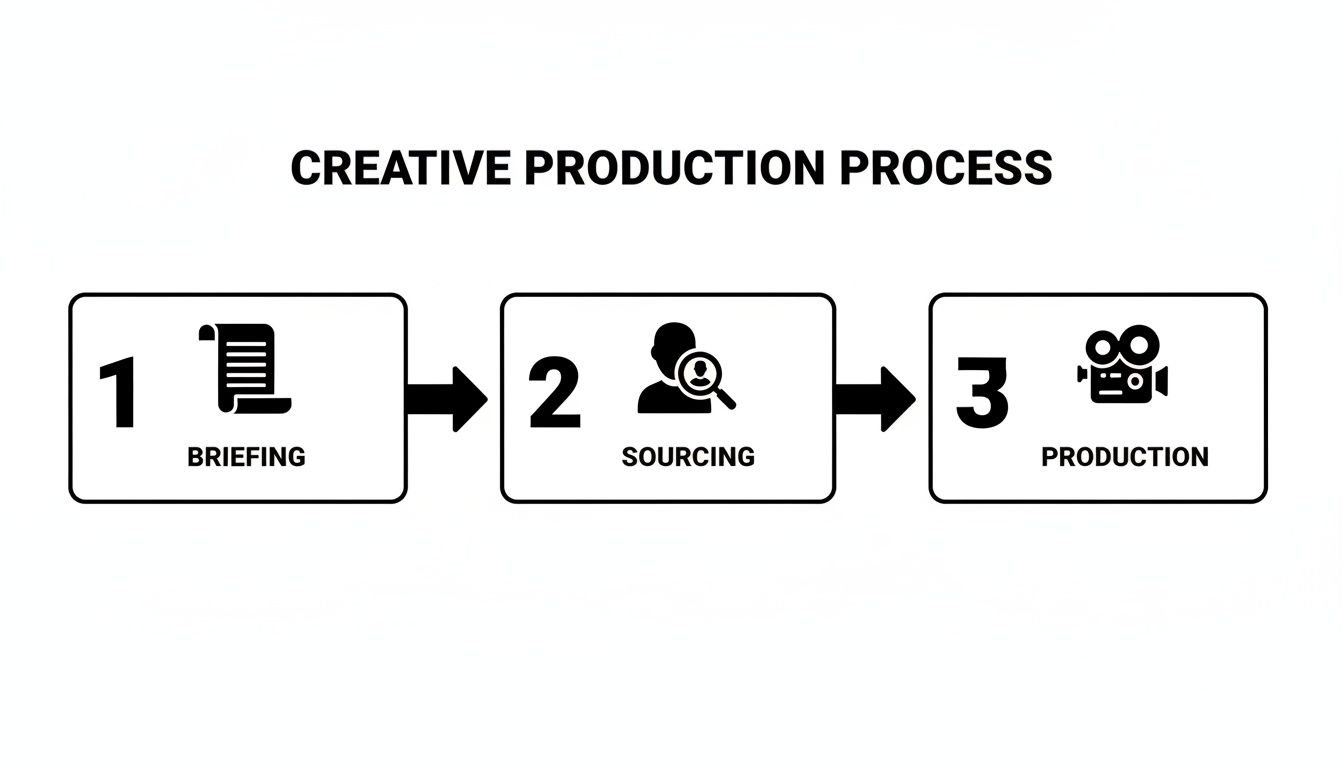
Nailing this flow ensures you always have a steady supply of new assets to feed into your testing machine.
The Seeding Phase: Find Early Winners
First up is what I call the "seeding" phase. The objective here is simple: test several completely different creative concepts against each other to see what actually grabs your audience's attention.
It is absolutely crucial to test new creatives only against other new creatives. Pitting a fresh ad against a battle-tested winner that’s already loaded with social proof and pixel data is an unfair fight from the start.
Imagine a supplement brand testing three distinct angles:
Concept A: A fast-paced UGC video showing someone mixing the supplement into their morning smoothie.
Concept B: A clean static image featuring a powerful quote from a 5-star customer review.
Concept C: A short, animated video that explains the science behind a key ingredient.
By placing these into separate ad sets within a single ABO (Ad Set Budget Optimization) campaign, you give each concept an equal and fair chance to prove itself. Let them run until each ad set has spent at least your target Cost Per Acquisition (CPA) before you even think about picking a winner.
The Iteration Phase: Refine Your Concepts
Once the seeding phase points to a clear winner—let's say Concept A had the best initial CPA and engagement—you move into the "iteration" phase. Here, you stop testing broad concepts and start drilling down on what made the winner work.
The single most important rule here is to isolate one variable at a time. If you change the hook, the visuals, and the call-to-action all at once, you'll have no idea what actually made performance better (or worse).
For a winning video ad, you could test three different hooks in the first three seconds while keeping the rest of the video identical. This clean test will tell you exactly which opening line is most effective at stopping the scroll.
This disciplined approach gives you clean data and real, actionable learnings. You're not just finding a better ad; you're learning why it's better. This insight is gold, and it should inform all your future creative development. It's a foundational step when you want to optimise your Facebook ads effectively.
The Scaling Phase: Allocate Budget to Proven Winners
Finally, once you have a thoroughly tested and iterated winner, it's time to scale. This just means strategically increasing the budget to maximize its reach and results. The trick is to do this without shocking the algorithm and resetting its learning phase.
Here are a few reliable rules for scaling that have served me well:
Introduce the winner to main campaigns: Move the new, proven creative into your existing, high-performing "business as usual" ad sets.
Increase the budget gradually: Never make drastic budget changes. A good rule of thumb is to increase the ad set or campaign budget by no more than 20-30% every 48 hours.
Monitor performance obsessively: Keep a close eye on your key metrics like CPA and ROAS to ensure the ad continues to perform as you push more spend behind it.
This "Seed, Iterate, and Scale" system turns creative testing from a chaotic guessing game into a predictable, data-driven process. It ensures you're always putting your budget behind ads that have truly earned it, creating a powerful flywheel for sustained growth.
Decoding Your Ad Data: What the Numbers Really Mean
So, your tests are running. Data's flooding in, and your dashboard is a dizzying sea of numbers. Now what? The biggest mistake advertisers make is staring at one number: Return on Ad Spend (ROAS). It's a fast track to getting the wrong idea about your performance.
To get a real read on how your creatives for Facebook ads are working, you have to look at the full story—not just the final chapter.
Most advertisers get obsessed with what we call lagging indicators. These are the end-of-the-line metrics like Cost Per Purchase (CPP) or ROAS. Don't get me wrong, they're absolutely vital for knowing if you're profitable. But they only tell you what happened, not why.
The real story starts with leading indicators. These are the top-of-funnel metrics that tell you if your creative is strong enough to even stop someone's scroll in the first place.
Reading the Early Signals
Think of your ad's journey like a conversation. The leading indicators tell you if someone is even willing to listen to your opening line. If they scroll right past, the rest of your pitch doesn't matter.
Here's what I look at first, before anything else:
Thumbstop Rate: This is your holy grail. It’s the percentage of people who stopped scrolling for at least three seconds on your video. It’s a raw measure of your hook’s magnetic pull. If this is low, your ad is basically invisible.
Hook Rate: This is a close cousin, measuring how many people watch the first three seconds. A solid hook rate tells you the first impression landed.
Click-Through Rate (CTR): The old classic. This tells you what percentage of viewers actually clicked. A high CTR means your creative, copy, and offer all aligned to spark genuine interest.
Looking at these metrics first helps you diagnose issues instantly. For example, if you've got a killer Hook Rate but a dismal CTR, something is breaking down between your strong intro and the call to action. We have a whole playbook on fixing that in our guide on how to improve click-through rate.
Setting Performance Guardrails to Stay Disciplined
To stop making emotional, gut-based decisions, you need to set "performance guardrails." These are your non-negotiable thresholds for action. They turn ad management from a guessing game into a clear system.
For context, one industry report that analyzed $28.7 million in ad spend found an average 14.92% thumbstop rate and a 0.50% CTR. Your numbers will be unique to your account, but this shows how important it is to have your own benchmarks. You can explore more insights on current advertising benchmarks to get a feel for what’s working now.
Here’s a simple guardrail system you can adapt for a new creative test:
Metric | Threshold | Action |
|---|---|---|
Thumbstop Rate | Below 15% | Pause Creative. The hook isn't working. Time for a new one. |
CTR (Link Clicks) | Above 2% | Monitor Creative. This is promising. It’s getting attention and clicks. |
Cost Per Purchase | 20% over target | Review Creative. Is the ad's promise matching the landing page? |
Ad Spend | Exceeds Target CPA | Pause & Analyze. The ad is burning cash without converting. |
This creates a simple "if-then" workflow. If a new ad spends past your target CPA without a single purchase, it's paused—no questions asked. If an ad has an incredible CTR but zero sales, the creative is probably fine. The problem is likely your landing page.
I see this all the time: a creative gets a fantastic Thumbstop Rate and a high CTR, but the conversion rate is in the gutter. This is a golden opportunity. It means your ad is doing its job perfectly. Don't kill the ad—go fix your post-click experience.
By separating your leading and lagging metrics and sticking to firm guardrails, you shift from being a reactive advertiser to a strategic one. You won't just know what is happening with your creatives for Facebook ads; you'll know exactly why—letting you make faster, smarter decisions that protect your budget and scale your winners.
How To Spot And Combat Creative Fatigue

Even your top-performing creatives for Facebook ads have a shelf life. The ad that brought in record sales last month can become background noise this month. That’s creative fatigue, and if you’re not looking for it, it will quietly eat away at your ROAS.
It’s a totally normal part of an ad’s lifecycle, but how you handle it is what separates the pros from the rest.
It's also crucial to know the difference between fatigue and full-blown saturation. Creative fatigue is when your current audience has seen an ad too many times and just scrolls past. Saturation is worse—it means the creative is tapped out across all potential audiences and it's time to retire it for good.
The goal is to catch fatigue long before it ever gets close to saturation.
Early Warning Signs And Key Metrics
The first hint of fatigue isn't usually a massive drop in sales. The problem starts at the top of the funnel, and the metrics will tell you the story if you know where to look. I always recommend watching these within a rolling 7-day window to catch the trend before it does real damage to your budget.
Frequency: This is your most direct signal. In a prospecting campaign, if your frequency starts creeping above 3.0, you’re showing the same ad to the same people way too often. It’s a major red flag.
Click-Through Rate (CTR): A sliding CTR is often the canary in the coal mine. People are seeing the ad, but they aren't interested enough to click anymore.
Cost Per Click (CPC): When CTR drops, CPC almost always goes up. You're simply paying more to get someone to your site, which is a direct hit to your bottom line.
If you see these metrics trending in the wrong direction for a week straight, it's not a fluke. It's time to take action.
Creative fatigue is a silent killer of profitability. An ad that was once a winner can quickly become a drain on your budget if you aren't watching for the signs of declining engagement and rising costs. Pausing it isn't failure; it's smart management.
An Actionable Creative Refresh Workflow
Once you've identified a fatigued creative, you need a system to swap it out without blowing up your entire campaign. Making panicked, random changes will only make things worse.
First things first, pause the fatigued ad immediately. Don't wait. The second an ad trips one of your "guardrail" metrics—for example, a 20% drop in CTR over 7 days—it gets paused. Every dollar you spend on it after that point is a waste.
Next, you'll introduce a new creative variation into that exact same ad set. This is a critical step. By keeping it in the same ad set, your new creative gets to piggyback on all the learning and optimization Meta has already done. You're not starting from scratch.
From there, the new ad gets put under the microscope. For the first 48-72 hours, keep a close eye on its leading indicators. Is it reversing the negative trend? Is the CTR climbing back up and the CPC dropping?
This disciplined cycle keeps you from needlessly killing entire ad sets or campaigns that are otherwise working perfectly well. You're just replacing a tired part with a fresh one.
This strategy is especially powerful when you have a steady stream of authentic, relatable content ready to go. We've seen User-Generated Content (UGC) work wonders here, often delivering 4x higher CTRs than ads that look too polished or corporate. UGC just feels more real and does a better job of stopping the scroll. This is precisely why having different UGC videos with unique hooks is so vital for stable performance. If you want to see how your own numbers compare, you can explore detailed benchmarks for Facebook ads.
When you build a bank of high-potential creatives for Facebook ads, fatigue stops being a crisis. It just becomes a routine maintenance task that keeps your campaigns fresh and, most importantly, profitable.
Scaling Winning Ads and Building Your Flywheel
So, you’ve done the hard work. You’ve tested, iterated, and finally found a winning creative that’s bringing in consistent results. This is the moment where a lot of advertisers trip up. They either get too aggressive or too timid, and honestly, both can be costly mistakes.
The real secret to scaling is feeding Meta’s algorithm more budget without spooking it. If you make a sudden, massive change to your budget, you’re basically hitting the reset button on the entire learning phase. The algorithm sees it as a shock to the system and starts over, which almost always means your performance tanks.
The golden rule for scaling is simple: make small, steady increases. A 20% budget hike every 48 hours is the sweet spot. This gradual approach gives the system time to adjust and find more customers efficiently without panicking and sending your costs through the roof.
Following this disciplined method is what keeps your campaign stable and profitable as you start to spend more.
Vertical vs. Horizontal Scaling
Scaling isn't a one-size-fits-all game. There are two main ways to grow your budget and reach, and knowing when to use each one is what separates the pros from the amateurs. I like to think of it as growing up versus growing out.
Vertical Scaling (More Budget)
This is the most direct method. You’re simply increasing the daily or lifetime budget on an ad set or campaign that’s already proven to work.
When to Use It: Go with vertical scaling when your ad is crushing it with its current audience. If you feel there's still plenty of room to find more people within that same group, this is your move. It’s perfect for your main "business-as-usual" campaigns where performance is solid and steady.
Horizontal Scaling (New Audiences)
This is where you duplicate your winning ad set and start targeting a completely new audience. You might test a different lookalike percentage, a new interest group, or even go broad with no specific targeting at all.
When to Use It: Horizontal scaling is your go-to when you suspect an audience is getting saturated or when you’re curious if your winning creative will work with a different demographic. It’s a great way to diversify your efforts and unlock entirely new pockets of customers. You can dive deeper into this with our detailed guide on scaling Facebook ads.
The Creative Flywheel: An SOP for Growth
The ultimate goal here is to move beyond one-off wins and build a self-sustaining system—what I call a "Creative Flywheel." This is just a documented Standard Operating Procedure (SOP) that turns your whole creative process, from brainstorming to scaling, into a predictable, repeatable engine for growth.
A good flywheel means your team always knows exactly what to do next. It gets rid of the guesswork and panicked decisions. Your SOP should be a straightforward checklist that covers the entire lifecycle of your creatives for Facebook ads.
This system is a lifesaver when you're managing multiple accounts or products. For instance, we know that fresh creatives used in retargeting can deliver 10x better conversion rates than stale ads you’re showing to cold prospects. A flywheel ensures you have a steady stream of that fresh content.
A huge part of this, especially for long-term growth, is knowing how to turn shoppable UGC into always-on conversions, which creates a fantastic, sustainable loop of effective ads.
A simple flywheel checklist might look something like this:
Briefing: Nail down the core hook, angle, and required shots.
Production: Source the UGC or create the assets based on that brief.
Testing: Launch the new creatives in a dedicated testing campaign.
Analysis: Check leading indicators (like Thumbstop Rate and CTR) after 48 hours.
Decision: Pause the underperformers based on your preset guardrails.
Iteration: Take the winning concepts and test variations (like a new hook or intro).
Scaling: Move the proven winners into your main campaigns and scale the budget by 20%.
Monitoring: Keep an eye out for ad fatigue and be ready to refresh when needed.
By systemizing your approach, you transform creative development from a chaotic art project into a reliable science. This is how you build a resilient advertising strategy that doesn't just survive—it thrives.