The E-Commerce Guide to Consumer Lifecycle Management
Consumer lifecycle management is really just a structured way of thinking about the entire relationship a customer has with your brand. It’s not about that first sale. It's about seeing the full journey, from the moment they first hear about you to the day they’re telling their friends to check you out. This is the blueprint for building a business that lasts.
Why Lifecycle Management Is Non-Negotiable
Not too long ago, growing an e-commerce brand felt a lot simpler. The playbook was to just pour more money into ads, get new customers, and do it all over again the next day. Those days are gone.
Now, brands are caught in a perfect storm. Ad costs are climbing, competition is everywhere, and customers are incredibly savvy and hard to keep. Just getting someone to make that first purchase isn't a victory anymore. The real, sustainable growth happens after that initial click and conversion.
Consumer lifecycle management gives you a roadmap. It's a deliberate plan to turn those one-time buyers into loyal, high-value customers. You start focusing less on volatile, short-term metrics like daily ROAS and more on the long-term health of your business, like customer lifetime value (LTV).
The New Reality for Marketers
The pressure to evolve is real. Recent industry data shows that a massive 77% of consumer products marketers know they need a complete overhaul of how they engage with customers. This isn't just talk; it's a direct response to some serious challenges.
So, what’s fueling this shift?
Rising Operational Costs: Everything is more expensive, from running ads to shipping products.
Intense Competition: New brands pop up constantly, all fighting for the same eyeballs.
Fading Loyalty: Shoppers have endless options. If you don't give them a great experience, they'll find someone who will.
This new environment requires a much smarter strategy. And marketers are feeling it, with 76% believing they have to adapt faster than ever. To keep up, many are looking to technology. In fact, another 76% of marketers are convinced that AI will be critical for engaging new customers effectively. You can read the full research about these marketing trends to see just how much the ground has shifted.
At its core, consumer lifecycle management is about recognizing that the customer journey doesn't end at checkout. It's an ongoing cycle of engagement, value delivery, and relationship-building that separates thriving brands from those that merely survive.
By mapping out and managing this journey, you build a more resilient business—one that isn't entirely at the mercy of unpredictable ad auctions. It means using your data to communicate thoughtfully at every stage, from the first ad they see to their tenth order. Of course, to do this well, you have to know your audience inside and out, which is exactly why segmentation is so important.
The Five Stages of the E-Commerce Customer Journey
If you want to get serious about consumer lifecycle management, you have to start by understanding the path your customers take. This isn't a simple A-to-B journey; it's a cycle, a relationship that evolves over time through five key stages. Each phase has its own goal and requires a different playbook to successfully move someone from a curious stranger to a die-hard fan of your brand.
Mapping this out is the difference between guessing and guiding. It lets you put the right message in front of the right person, on the right channel, at just the right time. These five stages are Acquisition, Activation, Retention, Upsell, and Advocacy. Let's break them down.
Stage 1: Acquisition
This is where it all begins. Acquisition is your first impression, your chance to grab the attention of people who might be a great fit for your brand. The goal is simple but tough: bring in qualified traffic and turn those visitors into leads or, even better, first-time buyers. Think of it as your brand's handshake—a clear introduction to who you are and what you offer.
Common channels to get this done include:
Paid Social Ads: Platforms like Meta (Facebook and Instagram) are goldmines for finding hyper-specific audiences based on their interests, demographics, and online behavior.
Search Engine Marketing (SEM): With Google Ads, you can get in front of high-intent customers who are literally searching for a solution you provide.
Content Marketing and SEO: Creating valuable blog posts, guides, or videos helps you show up organically, attracting customers without paying for every single click.
A customer enters this stage the moment they first interact with you—clicking an ad, landing on your site, or signing up for your email list. Your job is to make that first touchpoint so compelling they can't help but take the next step.
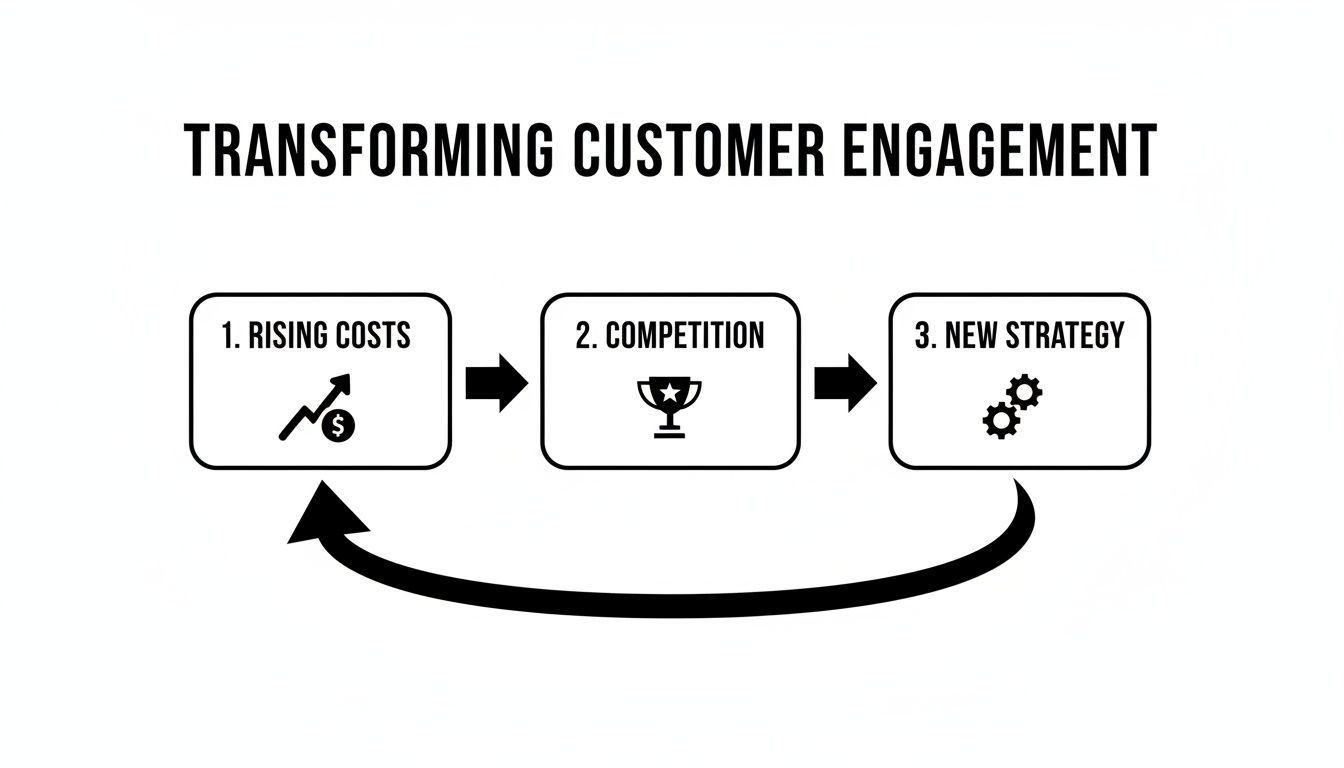
As you can see, rising ad costs and fierce competition are pushing brands away from a pure acquisition-at-all-costs model. The focus has to shift toward building a sustainable, holistic relationship with customers.
Stage 2: Activation
Once someone makes that first purchase, they enter the Activation stage. This is a make-or-break moment. Your goal is to deliver a killer initial experience that makes them feel great about their decision. This is where a one-time transaction starts to feel like the beginning of a real relationship.
The defining moment here is that first order. A silky-smooth checkout, a clear order confirmation email, and on-time shipping updates are non-negotiable. For a DTC skincare brand, activation happens when the customer gets their package, has a fantastic unboxing experience, and immediately feels they made the right call.
Stage 3: Retention
With a successful activation in the books, your focus pivots to Retention. Now, the goal is to earn their second purchase, their third, and beyond. This is where real, sustainable profitability comes from, because keeping a customer is always cheaper than finding a new one.
This is especially true today. Customer acquisition costs are soaring, and ad performance is all over the place. The old playbook of just pumping money into Meta and Google to buy growth is broken. For a deeper dive on this, check out this in-depth analysis of lifecycle marketing trends explaining why retention is becoming the most important channel for modern brands.
Key retention channels include:
Email Marketing: Welcome flows, post-purchase check-ins, and personalized campaigns are perfect for keeping your brand on their radar.
SMS Marketing: Great for time-sensitive offers and shipping alerts that demand immediate attention.
Retargeting Ads: Gently remind past buyers about new arrivals or products that pair well with their original purchase.
A healthy repeat purchase rate is the ultimate sign you’re getting retention right.
Stage 4: Upsell
The Upsell (or Expansion) stage is all about increasing the lifetime value of your happy, loyal customers. The goal is to encourage them to spend more with you, whether that means buying a more premium product, ordering more frequently, or adding complementary items to their cart.
This only works because you've already built trust. For instance, a coffee subscription company might invite a regular customer to upgrade from a standard house blend to a premium, single-origin bean. Or, they might offer a bundle deal on a new grinder with their next coffee shipment. These offers land well because they’re made to customers who already know and love the brand.
Stage 5: Advocacy
Finally, we reach the holy grail of the customer journey: Advocacy. Here, the mission is to turn your best customers into your most powerful marketers. These brand advocates drive growth organically through word-of-mouth, glowing reviews, and social media shout-outs.
An advocate doesn't just buy from you; they believe in you. They are the customers who leave glowing reviews without being asked and recommend your products to friends and family. This is the most valuable and sustainable form of marketing.
You can nurture advocacy with a few key tactics:
Referral Programs: Give customers a real incentive for bringing new people into the fold.
Loyalty Programs: Treat your top customers like VIPs with exclusive perks and rewards.
User-Generated Content (UGC) Campaigns: Encourage customers to share photos and videos of them using your products.
By thoughtfully managing all five stages, you build a powerful engine for sustainable growth. This consumer lifecycle framework is about moving beyond one-off sales tactics to build a resilient brand with a fiercely loyal customer base.
A Snapshot of the Five Consumer Lifecycle Stages
To help tie all this together, here’s a quick overview of each stage, its primary objective, and how you can measure success. Think of this as your cheat sheet for building a customer-centric growth strategy.
Lifecycle Stage | Primary Goal | Key Channels | Example Metrics |
|---|---|---|---|
Acquisition | Attract new visitors & convert them into customers | Paid Social, SEM, SEO, Content Marketing | CPA, CPL, ROAS, New Users |
Activation | Deliver an amazing first experience | Website UX, Onboarding, Post-Purchase Emails | First Purchase Rate, Time to First Purchase |
Retention | Encourage repeat purchases & build loyalty | Email, SMS, Retargeting, Loyalty Programs | Repeat Purchase Rate, Customer Churn Rate |
Upsell | Increase customer lifetime value (LTV) | Product Recommendations, Bundles, Email Offers | Average Order Value (AOV), LTV |
Advocacy | Turn loyal customers into brand promoters | Referral Programs, Reviews, UGC Campaigns | Referral Rate, Net Promoter Score (NPS), Reviews |
Mastering the transitions between these stages is what separates good brands from great ones. It's an ongoing process of listening, learning, and optimizing every single touchpoint.
Tracking Metrics That Actually Matter

To really get a handle on the consumer lifecycle, you have to look past the surface-level data that floods your ad platforms every day. Sure, metrics like Return on Ad Spend (ROAS) are useful, but they only tell you part of the story—usually the short-term part.
Building a truly resilient business means tracking the signals that reveal the actual health of your customer relationships at every single stage. It’s all about connecting the dots between your ad performance and real business outcomes, understanding not just what a campaign costs, but the long-term value it creates. This shift lets you make smart, proactive decisions instead of just reacting to the daily rollercoaster of performance metrics.
Acquisition Metrics That Reveal True Value
When you're in the Acquisition stage, the goal isn't just to get a new customer. It's to get a profitable one. Just staring at your Customer Acquisition Cost (CAC) by itself is a classic rookie mistake. A high CAC might look scary, but it could be perfectly fine if those customers stick around and spend a lot more over time.
To get the real picture, you need to tie your acquisition costs to long-term value.
CAC Payback Period: How long does it take to earn back the cash you spent to get a new customer? The faster you get that money back, the sooner you can pump it back into growth. A shorter payback period is your engine for scaling.
Cohort-Based Lifetime Value (LTV): Don't just look at one blended LTV number for your entire customer base. Break it down by acquisition cohort. Are the folks you acquired from your May Google Ads campaign more valuable six months later than the ones from your June Meta campaign? This is how you find out which channels are really bringing in your best customers.
Keeping an eye on these metrics gives you a much richer, more accurate read on your ad spend’s efficiency. The name of the game is optimizing for channels that deliver high-LTV customers with a payback window you can live with.
Signals for Activation and Retention
The moments right after that first sale? They're absolutely critical. This is where real profitability is built, through a smooth activation process and a solid retention strategy. The metrics here are less about ad spend and more about customer behavior and happiness. If these numbers start to dip, it's often an early warning sign of bigger problems down the road.
A sudden drop in your repeat purchase rate isn't just a retention problem—it can be a direct signal that an acquisition channel is bringing in low-quality, one-and-done buyers. The data is all connected.
Here are the key metrics to watch:
Time-to-First-Purchase: How long does it take for a new lead to finally pull the trigger? If it's taking ages, you might have friction in your welcome emails or a confusing website experience that needs fixing.
Repeat Purchase Rate (RPR): What percentage of your customers come back for a second, third, or fourth purchase? This is one of the most honest indicators of product-market fit and genuine customer loyalty.
Customer Churn Rate: This is the percentage of customers who stop buying from you over a given time. By figuring out what behaviors happen before someone churns, you can jump in with re-engagement campaigns before it's too late.
Seeing these connections is where the magic happens. For example, if you notice a low repeat purchase rate from a specific Meta audience, you've learned that while the initial CPA might look great, the long-term value is junk.
That's the kind of insight that leads to truly smart budget allocation. For teams wanting to get this granular, digging into different types of marketing attribution software can provide a solid framework for connecting ad spend to these deeper, more meaningful business outcomes.
A Tactical Playbook for Performance Marketers

Knowing the theory behind the consumer lifecycle is one thing. Actually putting it to work inside the ad platforms is where the real magic happens. For those of us in the trenches of performance marketing and ad ops, it means we have to graduate from a pure acquisition mindset. The job now is to build a day-to-day tactical approach that connects every campaign choice to the bigger picture: long-term customer value.
This isn’t just a marketing trend; it’s a fundamental business shift. Across the board, managing complex customer relationships is becoming more critical. You can see it in the numbers—the global Product Lifecycle Management market is expected to jump from $41.28 billion in 2025 to $59.31 billion by 2029. That tells you just how seriously modern businesses are taking lifecycle thinking, from massive tech companies to nimble e-commerce brands.
Here’s a practical, four-part playbook to help your team turn consumer lifecycle theory into real-world results.
Build Lifecycle-Aware Budgeting Strategies
One of the most common pitfalls is dumping your entire ad budget into one big bucket labeled "new customers." A smarter approach mirrors the customer journey itself, allocating spend across the different stages. This stops you from overspending on pricey, top-of-funnel traffic while ignoring the goldmine in your existing customer base.
Acquisition Budget: This is your war chest for prospecting on channels like Google and Meta. Your spend here should be tied directly to your CAC payback period goals. The whole point is to acquire customers who become profitable within a specific timeframe.
Re-engagement Budget: Carve out a dedicated slice of your budget for retargeting campaigns. The goal here is to nudge customers from activation to retention—think targeting one-time buyers with an offer that gets them to make that all-important second purchase.
Splitting your budget like this gives you a much clearer picture of what’s working. You can judge acquisition campaigns on their ability to bring in quality new customers, while your retention efforts are measured by their direct impact on repeat purchase rates and LTV.
Create Audience Segments by Lifecycle Stage
Your audience strategy should be a direct reflection of the customer journey. Ditch the broad, generic retargeting pools and start building granular segments based on where people are in their lifecycle with your brand. It's the only way to talk to them with genuine relevance.
A customer who just made their first purchase doesn't need to see the same "10% off your first order" ad as a brand-new prospect. Tailoring your message to their current stage is the key to building a relationship, not just driving a transaction.
Here are a few examples of lifecycle-based audiences you can build today:
First-Time Buyers (Activation): Create an audience of everyone who purchased in the last 30 days. Your goal is to welcome them, maybe with ads that show them how to get the most out of their new product.
At-Risk Customers (Retention): Segment customers who haven't bought in, say, the last 90 days. You can hit this group with a specific "we miss you" offer to bring them back into the fold. A well-structured drip campaign definition is a great way to execute this.
VIPs (Advocacy): Isolate your most loyal, high-LTV customers. These are the people you can target with sneak peeks of new products or invite to a referral program, effectively turning your best customers into your best marketers.
Combat Creative Fatigue with Journey-Specific Messaging
We’ve all seen it: a campaign starts strong, then performance nosedives. That's creative fatigue. It happens when an audience sees the same ad so many times they just tune it out. A lifecycle framework gives you a built-in way to solve this. When you align creative to each stage, your messaging naturally evolves as the customer relationship deepens.
For an apparel brand, this might look like:
Acquisition: Hit cold audiences with broad, eye-catching videos that show off the brand's unique style.
Activation: After their first purchase, retarget them with user-generated content (UGC) of other happy customers wearing the exact item they just bought. Social proof is powerful.
Retention: For repeat buyers, show them ads featuring new arrivals that pair perfectly with their past purchases.
This layered approach keeps your creative feeling fresh and relevant, which helps you avoid banner blindness and keeps engagement high across the entire journey.
Implement Performance Guardrails
Finally, to make all of this work without chaos, your team needs a set of performance guardrails. Think of these as automated rules and alerts that act as a safety net. They’re designed to prevent the kind of expensive, reactive mistakes that can completely derail a well-planned strategy, letting your team operate with speed and confidence.
These guardrails can monitor for critical issues like:
Premature Scaling: An alert that fires if you try to pump more budget into a campaign before it’s out of the learning phase, preventing wasted spend.
Over-Editing: A warning that flags campaigns with too many recent changes, which can reset platform algorithms and kill momentum.
Audience Saturation: An alert that tells you when ad frequency is creeping too high for a specific audience, signaling that it’s time to either refresh your creative or target a new segment.
By building these operational habits into your daily workflow, you close the gap between high-level strategy and in-platform execution. This is how you turn consumer lifecycle management from a buzzword into a powerful engine for profitable growth.
Common Lifecycle Management Mistakes to Avoid
A great consumer lifecycle plan is one thing, but execution is everything. Even the smartest brands can see their efforts fall flat by stumbling into a few common, and often quiet, traps. The good news? Recognizing these missteps is the first step toward building a customer journey that's both resilient and profitable.
Let's break down some of the most frequent mistakes we see.
Siloed Channel Thinking
This is a classic one. It’s what happens when your paid social team and your email marketing team live in completely separate worlds. They might both be crushing their individual channel goals, but because they aren't talking, the customer experience ends up feeling disjointed and confusing.
A customer doesn't see your brand in channels; they just see one brand. When they get conflicting messages or offers—a discount on Instagram that doesn't match the one in their inbox—it chips away at their trust. The whole journey starts to feel transactional, not like a real relationship.
Ignoring the Post-Purchase Experience
Another huge error is treating the purchase confirmation page as the finish line. So many brands pour a ton of resources into getting that first sale, only to completely ghost the customer the moment their credit card is charged. This is a massive missed opportunity, because the post-purchase window is a make-or-break moment in the activation stage.
Think about it: a clunky shipping process, radio silence on order status, or a return policy that feels like a puzzle can instantly ruin an otherwise great first impression. It sends a clear message: "We got your money, now we're done with you." That’s a surefire way to make sure they never come back for a second purchase. The relationship should just be starting, not ending.
The whole point of consumer lifecycle management is to create a seamless, cohesive journey. When departments work in isolation or focus only on getting the first sale, the customer is the one who suffers through a fragmented and frustrating experience.
So, how do you steer clear of these issues? It all comes down to creating a unified strategy.
Force Cross-Channel Collaboration: Get your paid media, email, and customer service teams in the same room (virtual or otherwise) regularly. Make sure messaging is aligned and campaigns work together, not against each other.
Map the Entire Customer Journey: Don't let your journey map end at checkout. Detail every single touchpoint, from the order confirmation email and shipping notifications all the way to the unboxing experience and first use.
Invest in Post-Purchase Communication: Use automated email and SMS flows to do more than just sell. Use them to educate, welcome, and build genuine excitement for the product that’s on its way.
Making Reactive, Noise-Driven Decisions
Finally, a big one: teams derailing their own success by overreacting to daily blips in performance data. A sudden dip in ROAS for a single day doesn't automatically mean a campaign is a failure. What if that campaign is acquiring customers with a massive LTV who will pay back their acquisition cost over the next six months?
Making impulsive, knee-jerk changes based on this kind of "noise" can throw platform algorithms for a loop and kill your long-term momentum. Instead, solid consumer lifecycle management relies on data-driven guardrails and a steady focus on the metrics that actually matter—like your CAC payback period and cohort-based LTV. When you prioritize long-term value over short-term panic, you build a much more stable and predictable growth engine.
Your First Steps to Better Lifecycle Management
Jumping into a full-scale consumer lifecycle strategy can feel like trying to boil the ocean. But it doesn't have to be that complicated. The secret is to start small, score one clear win, and then build momentum from there. This isn't about tearing down your entire marketing operation overnight; it's about making smart, deliberate moves that build a more resilient and profitable business.
Let’s demystify this whole process. You can start putting a powerful lifecycle framework in place today. Here's a simple, four-step checklist to get you on the right track.
1. Audit Your Customer Data
Before you can manage the customer journey, you need a map. Your first task is to dive into the data you already have in your e-commerce platform (like Shopify) and figure out where your customers actually are in their lifecycle. You don't need a fancy analytics setup for this first pass.
Just start by asking some basic questions:
How many customers have only bought from us once? These are your Activation stage customers.
How many have come back for a second, third, or fourth purchase? These folks are in the Retention stage.
Who are my top 10% of customers by lifetime value? These are your potential Advocates.
This simple exercise gives you a foundational snapshot of your entire customer base.
2. Define One Key Metric per Stage
Resist the temptation to track a dozen different metrics right away. For now, just pick one critical KPI for the first few stages. This single metric will be your north star, telling you whether you're moving in the right direction and keeping your focus razor-sharp.
A great starting point is your Repeat Purchase Rate. It’s one of the most powerful health indicators for an e-commerce business. It directly shows how well you’re turning one-time buyers into loyal customers—which is the most critical and profitable leap in the entire consumer lifecycle.
3. Build Your First Lifecycle Segments
Now that you've looked at your data and picked a metric, it's time to create a couple of basic audiences. You can build these right inside your ad platforms (like Meta) and your email service provider (ESP).
Segment A: First-Time Buyers: Make a list of every customer who has made exactly one purchase in the last 60 days.
Segment B: Lapsed Customers: Create a list of customers who bought once but haven't been back in over 90 days.
These two groups represent totally different stages of the lifecycle, and they need to be spoken to in very different ways.
4. Launch a Simple Automated Flow
Finally, it's time to take action with a single, straightforward campaign. A welcome series for new email subscribers is the perfect place to start. It’s a classic activation tool, designed to do one thing: guide a new lead toward making that all-important first purchase.
By walking through these four steps, you take the mystery out of lifecycle management and prove its value—fast. Modern tools like SpendOwlAI are built to make this journey even easier, helping your team execute with more confidence, cut down on wasted ad spend, and build a brand that lasts.
Frequently Asked Questions
As you dive into consumer lifecycle management, you're bound to have questions. Here are straightforward answers to some of the most common ones we hear, designed to help you sharpen your strategy.
How Is Consumer Lifecycle Management Different From a Sales Funnel?
The main difference comes down to the finish line. A classic sales funnel is a one-way street; its entire purpose is to get a customer to that first purchase. Once the sale is made, the funnel's job is done.
Consumer lifecycle management, on the other hand, is a continuous loop. That first purchase isn't the end—it's the beginning of a long-term relationship. The whole point is to keep that customer engaged through retention and loyalty, turning them into a repeat buyer and, ideally, a vocal advocate for your brand. A funnel stops at the transaction; the lifecycle is what happens after.
What Are the Essential Tools for Managing the Consumer Lifecycle?
You need a tech stack that lets data move seamlessly between platforms. The specific tools can vary, but a solid setup usually includes these four pillars:
Ad Platforms: This is how you find people. Think of platforms like Meta and Google Ads as your engine for acquiring new customers.
An E-commerce Platform: This is your home base, like Shopify, where all your customer and transaction data is stored.
Email & SMS Platforms: Tools like Klaviyo are the lifeblood of your retention marketing, letting you talk directly to your customers.
An Analytics & Execution System: This is the brain that connects everything, translating messy performance data from all your tools into clear, actionable next steps for your team.
How Soon Can I Expect to See Results From This Strategy?
You can get some quick wins right out of the gate. For instance, launching a well-crafted welcome series or a post-purchase email flow can bump up your activation metrics in just a few weeks. It's a great way to build momentum.
But the real, game-changing financial impact of a full lifecycle strategy takes time—think months and quarters, not days.
The ultimate goal here is to fundamentally shift long-term metrics like customer lifetime value (LTV) and repeat purchase rates. The most powerful benefits, like higher overall profitability and less dependency on costly ads, build on themselves as you cultivate a more loyal customer base.
Modern tools like SpendOwlAI are built to make this entire process easier, helping your team act with more confidence, cut down on wasted ad spend, and build a more durable brand. Learn how to turn noisy data into clear daily actions.