Master Channel Strategies in Marketing for Unrivaled Growth & ROI
At its core, a marketing channel strategy is your roadmap for reaching and converting your audience. It goes far beyond just having a presence on a few platforms. A real strategy answers which channels you should use, why you're on them, and how they all fit together to create a predictable growth machine.
It’s the blueprint that transforms scattered marketing efforts into a single, powerful engine for your business.
Why Your Channel Strategy Is Your Most Important Growth Lever
If you're running a business, you know the feeling. You're juggling Meta ads, a Google campaign, and maybe trying to figure out TikTok, all while drowning in a sea of noisy data. You’re constantly second-guessing where to put your next dollar. A campaign looks great one day and falls flat the next. This kind of reactive, gut-driven marketing is not only exhausting—it’s a huge drain on your budget.
This is exactly where a clear channel strategy makes all the difference. It's not just another item on your marketing to-do list; it's the fundamental system that powers predictable growth. By having a well-defined strategy, you can finally move from a series of disconnected experiments to a structured, data-backed operation. It gives you a framework for picking the right channels, measuring what actually moves the needle, and executing with confidence every single day.
Moving From Reactive Decisions to Proactive Growth
Without a strategy, most marketing decisions are driven by fear or guesswork. You see a competitor pop up everywhere, so you crank up your budget. A campaign has one bad day, so you panic and pause it. These knee-jerk reactions are the enemy of long-term, sustainable growth.
A solid strategy provides the guardrails to help you avoid these common traps. It gives your team a clear, daily action plan that’s grounded in performance data, not fleeting emotions. This is precisely what modern systems like SpendOwlAI are designed for—they translate complex performance signals into a simple, prioritized list of tasks. Instead of wondering what to do next, you know exactly which levers to pull to get results.
Think of your channel strategy as your north star. It ensures every dollar spent is a deliberate investment toward a specific goal, not just a random shot in the dark. It’s the difference between merely hoping for growth and actively engineering it.
The numbers don't lie. Companies that get this right see a massive difference in their bottom line. Recent data shows that businesses with integrated omnichannel strategies achieve an average revenue growth of 13.2%. That completely eclipses the 2.9% growth seen by their less-organized competitors.
And with 84% of shoppers now using four or more channels to make a purchase, a unified approach isn't just a "nice-to-have" anymore. This consistency also pays off in loyalty, as brands with a seamless cross-channel experience see retention rates that are 91% higher. You can explore more channel marketing statistics to see the full impact.
This guide is designed to go beyond the theory and give you practical, actionable advice. You'll learn not just what channel strategies are, but how to build, measure, and execute them effectively. The goal is simple: to give you the tools you need to turn performance data into confident, profitable decisions.
Building Your Channel Strategy Framework
Crafting a winning channel strategy isn't about chasing every new platform or following a rigid, academic formula. It's much more like building a championship sports team. Every channel you choose is a player, each with a specific position and a unique set of skills they bring to the game.
You wouldn't expect your goalie to be your top scorer, right? In the same way, you can't expect a top-of-funnel awareness channel like TikTok to close high-ticket B2B deals. A solid framework stops you from just picking popular channels and instead forces you to think about strategic fit. The goal is to build a team where every player works together to win—and in marketing, winning means profitable growth.
The Four Pillars of Channel Evaluation
To build that winning team, you need a simple but powerful way to scout your players. I've found that the best way to do this is to assess every potential channel against four core questions. This ensures you’re not just picking channels at random, but building a marketing system where every part has a clear job to do.
Audience-Channel Fit: This is the most fundamental question: Where do your ideal customers actually hang out? A brand targeting Gen Z has to be on platforms like TikTok and Instagram. But if you're selling to CFOs, your time is much better spent on LinkedIn and in niche industry publications.
Funnel Stage Alignment: What specific job does this channel need to accomplish? Some channels are brilliant for building brand awareness at the top of the funnel. Others, like search ads, are designed to capture existing demand and drive conversions at the bottom. You need both.
Offer Suitability: Does your product make sense in the context of the channel? Trying to sell a complex, high-consideration enterprise software on a platform known for impulse buys is an uphill battle. On the other hand, a visually appealing, low-cost product is a natural fit for social commerce channels.
Unit Economic Viability: Here's the bottom line: Can you actually make money on this channel? A channel is only a long-term solution if your Customer Acquisition Cost (CAC) is sustainably lower than your Customer Lifetime Value (LTV). If the math doesn't work, nothing else matters.
This all comes together in what we call The Growth Framework, where strategy, channels, and data are the bedrock of any successful operation.
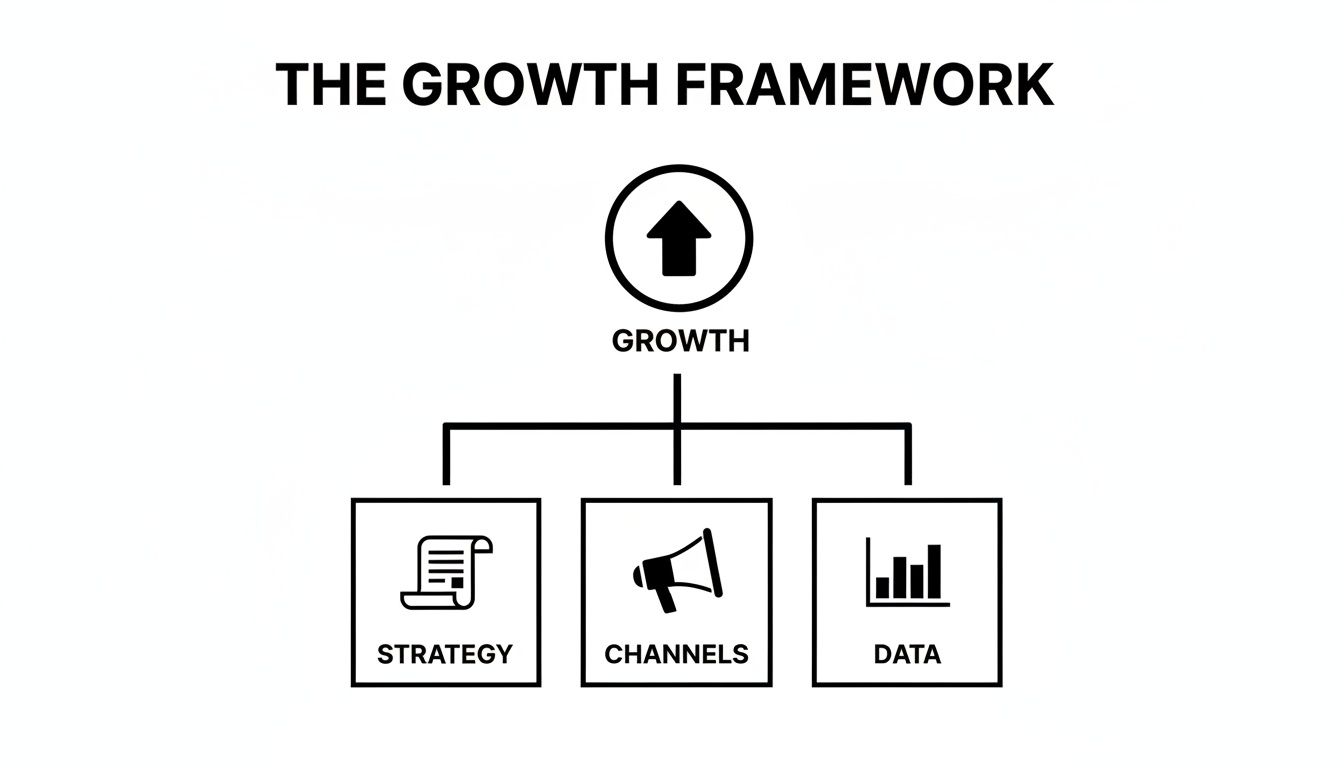
As you can see, sustainable growth isn't an accident. It's the direct result of a clear strategy that informs your channel selection, all powered by clean, reliable data.
By running every channel through this four-pillar evaluation, you move past guesswork and start building a predictable marketing engine. You end up with a portfolio of channels where each one is hand-picked for a specific role.
This disciplined thinking is the foundation for effective data-driven marketing solutions that turn confusing performance metrics into clear, actionable next steps. When you use a framework like this, every dollar you invest has a purpose. You can confidently choose channels that not only reach your audience but do so in a way that respects your product, your funnel, and most importantly, your profitability.
Alright, you've got your strategy sketched out. Now for the tricky part: actually choosing where to invest your time and money. When you're staring at a dozen different marketing channels, it’s easy to get paralyzed by choice or, even worse, try to do a little bit of everything.
The goal isn't to be everywhere. It's to be in the right places, doing exceptional work. This all starts by figuring out where your ideal customers actually spend their time. Don't guess. Look for the real-world signals. Are they discovering new brands while scrolling through Meta, or are they heading straight to Google with a problem they need to solve right now? This is the foundation of effective channel strategies in marketing.
Start Small and Master Your Core Channels
One of the biggest mistakes we see brands make is trying to launch on five channels simultaneously. It's a recipe for burnout and mediocre results. Spreading your team and budget too thin means you never truly figure out what works on any single platform.
The smarter move? Start with one or two core channels. Go deep, learn the nuances, and get them humming along profitably. Only then should you start methodically expanding.
A great starting combination is often one channel for creating demand (like Meta or TikTok) and another for capturing it (like Google Search). This lets you introduce your brand to new people while also being there when someone is actively looking to buy.
Comparing Your Top Channel Options
To get from a long list of possibilities to a focused short list, you need to see how they stack up against each other. Every platform has its own unique DNA—a different user mindset, cost structure, and creative language. Knowing these differences is what separates a winning strategy from a frustrating one.
To make this tangible, let's compare some of the most popular channels for direct-to-consumer brands.
Marketing Channel Comparison for DTC Brands
This table breaks down the core characteristics of each platform to help you see where your brand might fit best.
Channel | Primary User Intent | Typical Cost Model | Best For Funnel Stage | Creative Demand |
|---|---|---|---|---|
Meta (FB/IG) | Discovery & Social Proof | CPM (Cost Per 1,000 Impressions) | Top & Mid Funnel | High & Fast-Paced |
Google Search | Problem Solving & Buying | CPC (Cost Per Click) | Bottom of Funnel | Low (Text-Based) |
TikTok | Entertainment & Trends | CPM | Top of Funnel | Very High & Authentic |
Email/SMS | Nurturing & Retention | Per Subscriber/Send | Mid & Bottom Funnel | Medium (Templates) |
Affiliate/Influencer | Trusted Recommendations | CPA (Cost Per Acquisition) | All Stages | Varies by Partner |
As you can see, a one-size-fits-all approach is doomed to fail. A text-heavy ad that crushes it on Google Search will die a swift death on TikTok, where users expect authentic, entertaining video. Getting this right means understanding who you're talking to on each platform, which is exactly why segmentation is so important for your overall marketing success.
The real objective isn’t to find the single “best” channel in the world. It's to find the best channel for your product, your audience, and your specific business economics right now.
By starting small and making these informed choices, you build a powerful, profitable foundation. You prove what works on a core set of channels before you pour more money in or add complexity. This disciplined approach ensures your channel strategies in marketing are built for long-term, sustainable growth, not just a few weeks of busywork. Once that engine is running smoothly, you can scale with confidence.
How to Measure Performance and Allocate Your Budget Wisely

Picking your channels is just the start. The real magic happens when you figure out how to measure what’s working and where to put your money. Get this wrong, and you end up feeding the channels that look good on paper while starving the ones quietly driving your growth.
Let's be honest: measurement and budgeting are two of the biggest hurdles in any channel strategy. They're two sides of the same coin—you can't set a smart budget if you don't actually know what’s driving results.
Moving Beyond Last-Click Attribution
For too long, marketers have been stuck in the last-click attribution trap. This model gives 100% of the credit for a sale to the final touchpoint a customer interacts with. It’s like giving all the glory for a game-winning goal to the scorer, completely ignoring the midfielders and defenders who made the brilliant passes to set it all up.
Think about a real customer journey. Someone might see your brand for the first time in a TikTok video (the first pass), then search for you on Google and read your blog (the assist), and finally click a retargeting ad on Meta to buy (the shot on goal). Last-click only credits the Meta ad, making it seem like TikTok and your blog did nothing. That's a dangerously incomplete picture.
A much smarter approach treats every channel like a player on a team. Each touchpoint has a role, and good measurement gives credit to the assists, not just the final goal. This is the only way to see the true impact of your entire marketing funnel.
Getting a handle on how all these pieces fit together is critical. Exploring what a modern marketing attribution software can do will show you just how much more of the customer journey you can actually see.
A Simple Rule for Smarter Budgeting
Once you have a clearer picture of performance, you can stop guessing and start allocating your budget with confidence. A simple but incredibly effective framework for this is the 70/20/10 rule.
This isn't about rigid accounting; it's a guide for balancing today's wins with tomorrow's growth.
70% on What Works: The lion's share of your budget goes to your proven winners. These are the workhorse channels—like Google Search or your core Meta campaigns—that deliver reliable, predictable returns day in and day out.
20% on What’s Promising: This slice is for channels that are showing signs of life but aren't yet proven workhorses. Maybe a Pinterest campaign is getting traction or an influencer partnership is looking good. This is the budget to see if you can scale them into core channels.
10% on What’s New: This is your experimentation fund. It’s for testing completely new channels, wild creative concepts, or untapped audiences. Most of these bets will fail, and that's okay. The few that hit will become your next "promising" channels.
This framework protects your baseline performance while forcing you to innovate. By keeping a close eye on daily metrics, you can quickly move money from a failed experiment in the 10% bucket over to a winner in the 70% bucket. This kind of agility is what stops you from wasting money and ensures every dollar is pulling its weight.
Executing with Precision and Avoiding Common Mistakes
You’ve built a brilliant channel strategy. You know your audience, your funnels, and your economics. But a great plan is only half the battle. The real test comes in the day-to-day execution, where a single bad ROAS report can trigger panic and derail weeks of progress.
This is where perfectly good strategies fall apart. It’s not a failure of planning but a failure of nerve. Human nature takes over, and we react to the daily noise instead of sticking to the long-term vision. The secret to consistent growth isn't just knowing what to do—it's knowing what not to do.
The Four Traps That Wreck Your Channel Strategy
Most marketers, even seasoned pros, fall into the same handful of traps. These aren't rookie mistakes; they're gut reactions that feel right in the moment but quietly sabotage your profitability and make it impossible to know what’s actually driving results.
Reactive Over-Editing: This one’s the classic. Performance dips for a few hours, and suddenly you’re in the ad account, frantically tweaking bids, pausing campaigns, and changing creative. All this nervous energy resets the platform’s learning algorithm, making performance even more volatile. You end up creating the very chaos you were trying to fix.
Premature Scaling: You hit a hot streak. A campaign has a fantastic first couple of days, and the temptation to triple the budget is overwhelming. But scaling too fast, before you have stable data, is like going all-in after one good hand. Your Customer Acquisition Cost (CAC) often skyrockets, and your unit economics are left in ruins.
Blanket Optimization: You find an ad that’s crushing it with one audience, so you decide to run it everywhere. The problem? This approach completely ignores context. An ad that works wonders for a cold, top-of-funnel audience is almost guaranteed to feel out of place and ineffective for a warm retargeting segment that already knows your brand.
Context Blindness: This is tunnel vision in action. You're laser-focused on a single metric like ROAS, but you miss the warning signs flashing all around it. You might not notice that your ad frequency is creeping up (hello, audience saturation!) or your click-through rates are dropping (a classic sign of creative fatigue). By the time your main metric finally tanks, it's often too late for a simple fix.
From Gut-Feel to Confident Action
So, how do you avoid these self-inflicted wounds? You need a system—a set of guardrails that keep you from making emotional, impulsive decisions. This is where a daily execution framework becomes your most valuable asset.
The goal isn't to remove human judgment but to augment it. A great system provides the data-backed restraint to turn a "gut feeling" into a confident, explainable action—or inaction.
Instead of guessing, you get a clear, prioritized list of what truly needs your attention. This is exactly what a tool like SpendOwlAI is designed to do. It sifts through the daily performance data, flagging meaningful trends and risks before they become full-blown problems.
Here’s a glimpse of how SpendOwlAI helps you stay disciplined:
This dashboard doesn't just throw numbers at you; it gives you a clear to-do list. By flagging issues like creative fatigue or budget pacing risks, it provides the evidence you need to act decisively. Just as importantly, it gives you the confidence to let things run when you’re just seeing normal, everyday fluctuations.
It’s this disciplined approach that protects your budget from emotional reactions and ensures your channel strategy actually has a chance to work.
Your Channel Strategy Questions Answered
Even with a great framework in place, the day-to-day work of managing a channel strategy in marketing is full of questions. Let's tackle some of the most common challenges I see founders and marketers run into. These are clear, direct answers to help you handle the realities of getting things done.
How Many Marketing Channels Should I Start With?
For almost every business, especially if you're working with a tight budget, the answer is simple: start with just one or two core channels. The goal isn't to be everywhere at once. It's to get really, really good at a couple of platforms and make them consistently profitable before you even think about adding another.
Trying to run five channels from day one is a classic mistake. It stretches your focus, your budget, and your creativity way too thin. The result? Mediocre performance everywhere, because you never get the deep reps needed to make any single channel sing.
A powerful starting pair I often recommend is:
A demand-generation channel: This is how you get in front of people who don't know you exist yet. Think Meta (Facebook and Instagram) or TikTok, where you can introduce your brand to new audiences.
A demand-capture channel: This is for snagging customers who are ready to buy. Google Search is the undisputed king here, letting you show up the moment someone is actively looking for what you sell.
Once you have a stable, money-making system with those core channels, you can start methodically testing a third.
What Is the Difference Between Multichannel and Omnichannel?
People use these terms interchangeably all the time, but they describe two totally different ways of thinking about your channel strategy. Getting this distinction right is the key to building a modern customer experience that actually works.
Multichannel marketing just means you're using more than one channel. The problem is, they operate in their own silos. A customer might see an ad on Instagram, get an unrelated email promo a week later, and then visit your site—and none of those experiences are connected. It's like having three separate conversations.
Omnichannel marketing, on the other hand, weaves those channels into a single, seamless journey for the customer.
The core shift is moving from a brand-centric view ("What are our channels?") to a customer-centric view ("What is this customer's journey?"). It's about making sure the context and conversation follow the user from one touchpoint to the next.
For example, in a true omnichannel setup, someone browsing a specific product on your website might trigger the exact retargeting ad they see on Facebook a few hours later. This connected experience is why omnichannel strategies produce a 91% higher year-over-year customer retention rate for brands that get it right.
How Do I Know When to Stop Investing in a Channel?
Deciding to kill an underperforming channel should be a cold, calculated decision, not an emotional one. The only way to do that is to define your kill criteria before you spend your first dollar. This simple rule stops you from throwing good money after bad just because you feel a channel should be working.
Your kill criteria should be built on two pillars:
Key Performance Indicators (KPIs): Set a non-negotiable performance floor. For instance, you might decide that if a new channel can't hit a $50 target CPA after you've spent $2,000, you're out.
A Defined Timeframe: Give the channel a fair shot. This isn't about one bad day. It might be a 30-day test or a specific budget threshold.
Besides your main KPI, keep an eye on leading indicators. Are click-through rates (CTR) in a steady nosedive? Are costs per click (CPC) creeping up without a matching lift in conversions? If you're seeing these red flags and your attempts to fix them aren't working, it's a clear, data-backed signal to move that budget somewhere it can perform.
How Can AI Tools Improve My Channel Strategy Execution?
Think of AI tools as a decision-support system for your strategy. You're still the general—you set the high-level goals and choose the battlefields (your channels). AI is your field lieutenant, brilliant at optimizing the "how" and "when" of daily combat.
Instead of you manually sifting through mountains of often contradictory data every morning, an AI system does the heavy lifting. It analyzes everything and presents you with a simple, prioritized list of what to do next.
It translates overwhelming data into clear instructions, like:
"Budget for Ad Set X should increase by 20%. Its ROAS is consistently high and ad fatigue is low."
"Pause Creative Y in the ‘Cold Audience’ campaign. The CTR has tanked by 40% in the last three days."
Just as importantly, a good AI tool explains the "why" behind each recommendation and builds in "guardrails" to prevent you from making common mistakes, like over-editing a campaign or scaling a winner too aggressively. It turns messy data into confident, profitable action, saving you hours and preventing wasted ad spend.
Executing a winning channel strategy requires discipline and the right systems. SpendOwlAI provides the daily execution guardrails that turn your strategic plans into profitable actions. Instead of drowning in data, get a clear, prioritized list of what to do every day to grow your business with confidence. Start your free 7-day trial.