What Is DCO and How Does It Actually Work?
Dynamic Creative Optimization (DCO) is a fancy term for a simple, powerful idea: building the perfect ad for each person who sees it, automatically and in real-time. Instead of you creating one ad that you hope works for everyone, DCO technology acts like a master assembler, mixing and matching your creative pieces to build the most effective ad for every single impression.
Answering What Is DCO in Plain English
Forget the technical jargon for a moment. Think of DCO as having a personal ad-builder for every potential customer. It’s what takes us from the slow, manual process of A/B testing a few ad versions to personalizing thousands of them on the fly.
Imagine a digital billboard that changes its message based on who’s looking. For a parent browsing on their phone, it might show an ad for a family-friendly SUV. A moment later, for a college student on their laptop, it could switch to a promotion for a budget-friendly sedan. That’s the heart of what is DCO—it uses data to serve the right message to the right person at just the right time.
The Building Blocks of DCO
This isn't magic, of course. Behind the scenes, DCO is a surprisingly logical system that relies on a few key ingredients you provide. You supply the creative elements and the general strategy, and the DCO engine does the heavy lifting of putting the puzzle pieces together for each individual viewer.
DCO is a huge leap forward because it automates hyper-relevant advertising. This frees up marketing teams to focus on big-picture strategy and creative ideas instead of getting buried in the endless grind of manual ad testing.
So, how does it all come together? Let’s pull back the curtain and look at the core components that make any DCO system tick. Each element plays a crucial role in turning raw materials into a finished, personalized ad.
Core Components of a DCO System
This table breaks down the essential building blocks that power Dynamic Creative Optimization, explaining the role each element plays in creating personalized ads.
Component | Function | Example |
|---|---|---|
Creative Assets | Your library of individual ad components. | Multiple headlines, product images, promotional offers, and call-to-action buttons. |
Data Signals | The user information that guides personalization. | Location, browsing history, device type, past purchases, or even local weather conditions. |
AI Engine | The algorithm that analyzes data and assembles the ad. | An AI model that decides to show a rain jacket ad to someone in a rainy city. |
When these three components work together, the DCO system can instantly generate a unique ad variation that’s most likely to resonate with the person seeing it, driving better results without manual intervention.
The Engine Behind Personalized Ads
So, you've got the basic idea of DCO. But how does it actually work its magic? Let's pop the hood and see what’s running the show. Forget thinking about a single, finished ad. Instead, picture yourself providing a whole library of creative "parts" for the system to play with.
These are the raw materials for your campaign. You're not just creating one ad; you're supplying all the interchangeable components the DCO engine will use to build thousands of variations on the fly.
Headlines: You might write a few benefit-focused lines, a couple of intriguing questions, and maybe a straightforward product title.
Images & Videos: This is where you upload different product angles, lifestyle shots showing the product in use, or short, punchy video clips.
Body Text: Craft different descriptions that tell a story, list key features, or highlight a unique selling point.
Calls-to-Action (CTAs): Don't just stick with one. Provide options like “Shop Now,” “Learn More,” or “Get 25% Off.”
Once you've loaded up this creative inventory, the DCO platform's AI gets to work. This is where the real-time assembly and personalization happen, driven entirely by data.
The Power of Data Signals
The AI doesn't just guess. It makes its decisions by analyzing a whole host of data signals tied to the specific person about to see your ad. It's not just about who they are, but the specific context of that very moment.
Common signals include things like:
Behavioral Data: What pages have they looked at on your site? Did they add a product to their cart and then leave?
Demographic Data: Basic information like their general age group or stated interests.
Contextual Data: Simple but powerful facts like their location, the local weather, or even the time of day.
This diagram shows how all these pieces—the assets, the data, and the engine—fit together in a continuous cycle.
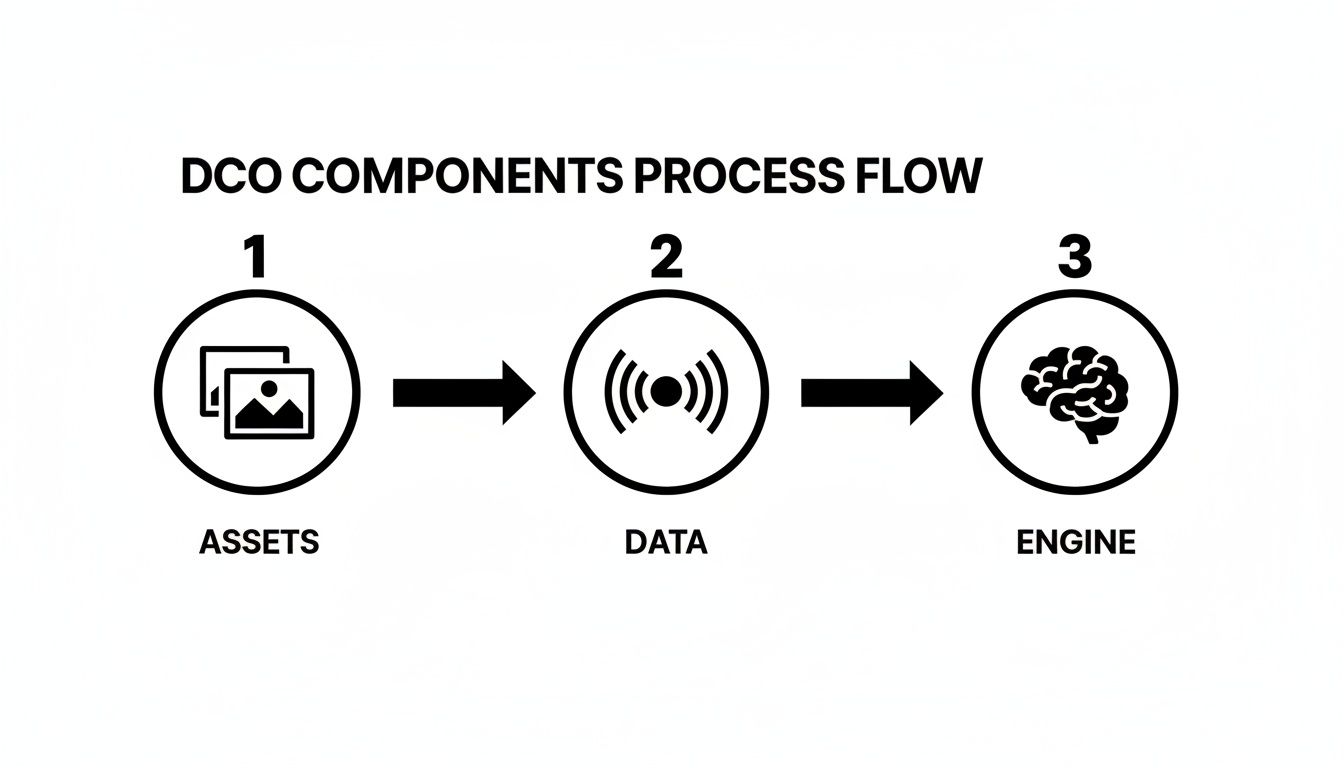
As you can see, your creative assets and the user data are constantly feeding the engine, which then generates the optimized ads.
Putting it all together, the AI instantly builds and serves an ad tailored for that one person. Someone browsing from a chilly city might see your ad for a winter coat, while another person who just abandoned their cart sees an ad for that exact item, but this time with a "Free Shipping" CTA. This granular approach is precisely why segmentation is important for getting the most out of DCO.
The Continuous Feedback Loop
But here’s the real secret sauce: DCO systems have a continuous feedback loop. They don't just assemble and serve ads; they learn from every single impression. This goes way beyond simple ad building. Gartner even describes this capability as an "orchestration hub for business agility"—a system that can sense, respond, and optimize in real time.
And that's more important than ever. After all, 77% of businesses are dealing with growing digital engagement needs, and 46% say better analytics is a key to improving customer loyalty.
Every click, conversion, or even a simple scroll-past is a new data point. The DCO engine crunches this performance feedback to figure out which creative combinations work best for which audiences. It then automatically refines its own strategy to get you better results over time.
How DCO Works on Meta and Google Ads

The theory behind Dynamic Creative Optimization is great, but what does it actually look like in the ad managers we use every day? It comes to life within the powerful, built-in tools on Meta and Google. While both platforms automate ad creation, they each have their own unique spin on how they get the job done.
Let's start with Meta. On Facebook and Instagram, DCO is built around a feature called Dynamic Creative. When you flip this switch in your campaign settings, you're basically giving Meta’s algorithm a box of creative Legos to play with. Instead of building one perfect, finished ad, you upload a library of individual components.
You can feed the system multiple versions of:
Images and Videos: Up to 10 different visuals.
Headlines: A handful of different hooks to see what grabs attention.
Primary Text: Various ways to frame your offer or tell your story.
Calls to Action (CTAs): Different buttons like “Shop Now,” “Learn More,” or “Sign Up.”
From there, Meta’s AI gets to work. It starts mixing and matching all those pieces, creating an almost endless number of ad variations. It then serves these different combinations to users, learning in real-time which ones drive the best results—whether that’s clicks, conversions, or another goal—for different parts of your audience.
Google Ads and Responsive Creatives
Google uses a similar philosophy, but its execution is centered on Responsive Search Ads (RSAs) and Responsive Display Ads (RDAs). These ad formats are the workhorses of DCO within the Google Ads ecosystem, designed not just to find the winning message but also to make sure your ad looks great wherever it shows up.
With Responsive Display Ads, for example, you provide a similar set of assets: multiple headlines, descriptions, logos, images, and videos. Google’s AI then shuffles these elements to build ads that automatically resize and reformat to fit perfectly across the millions of sites and apps in the Google Display Network. One minute it's a small banner ad on a news blog; the next it's a large native ad inside a mobile game. It's a fundamental tactic to improve Google Ads performance and achieve massive reach.
Responsive Search Ads do the same thing for the text ads you see on a search results page. You provide up to 15 different headlines and 4 descriptions. When someone searches for a relevant keyword, Google’s system instantly assembles the combination of your headlines and descriptions it believes will most closely match that user's intent.
The core idea is identical on both platforms: you supply the creative ingredients and the strategic goals, and the platform’s machine learning does the heavy lifting of figuring out what works best.
Key Differences in Approach
While both automate the testing process, they prioritize slightly different things.
Platform | Primary DCO Goal | Best For... |
|---|---|---|
Meta | Performance Optimization: Finding the creative mix that gets the most conversions from a specific audience. | Driving direct response and engagement from users scrolling through social feeds. |
Adaptability and Relevance: Making sure ads fit any ad space and perfectly match a user's search query. | Getting broad reach across the web and capturing traffic from people with high purchase intent. |
At the end of the day, Meta’s Dynamic Creative and Google's Responsive Ads are two sides of the same coin. They represent a shift away from making a few static ads toward managing a flexible, intelligent system that is always learning and optimizing itself for better results.
Real-World Benefits of Using DCO
So, we've covered the "what" and "how" of Dynamic Creative Optimization. But the real question every marketer asks is, "Why should I use this?" The theory is great, but what are the actual, on-the-ground advantages?
It all comes down to delivering true, one-to-one personalization at a scale that's impossible for any human team to manage manually. You stop guessing which ad might resonate with a huge, monolithic audience and instead let the technology find the perfect message for each individual, in that specific moment. That kind of relevance is what drives real business results.
Increased Conversions and Stronger ROAS
When your ads feel like they were made just for the person seeing them, they’re naturally more likely to click and, ultimately, convert. It just makes sense. A customer who abandoned a specific pair of shoes in their cart is far more likely to come back if they see an ad for those exact shoes, especially if it's paired with a new "Free Shipping" banner.
This isn't just a nice-to-have anymore; it's a customer expectation. In fact, a staggering 33% of consumers have walked away from a brand simply because the experience wasn't personalized. It’s why 44% of companies are shifting to a digital-first strategy, recognizing that personalization is what keeps customers coming back. You can find more data on how digital transformation is impacting customer experience to see just how deep this trend runs. For your campaigns, this means better conversion rates and a much healthier Return on Ad Spend (ROAS).
Smarter Automation and Reduced Creative Fatigue
One of the biggest operational wins with DCO is waving goodbye to the mind-numbing grind of manual A/B testing. Forget the painstaking process of setting up dozens of ad sets to test one headline against another. DCO lets you feed the algorithm your creative ingredients, and it tests thousands of combinations on the fly.
DCO takes on the tedious optimization work, freeing up your team from the hamster wheel of manual ad testing. This gives them the breathing room to focus on what they do best—big-picture strategy and coming up with killer creative ideas.
This constant mixing and matching of assets also solves a huge problem: creative fatigue. Audiences get tired of seeing the same ad over and over, and performance inevitably tanks. DCO keeps things fresh by constantly cycling through new combinations of images, copy, and calls-to-action, extending the life and effectiveness of your campaigns.
To put it all into perspective, let’s look at how the old way of doing things stacks up against a DCO-powered approach.
Static Ads vs. Dynamic Creative Optimization (DCO)
This table offers a direct comparison of the key operational and performance differences between traditional static advertising and a DCO strategy.
Attribute | Static Ads | Dynamic Creative Optimization (DCO) |
|---|---|---|
Personalization | One-size-fits-all message for a broad audience. | Hyper-personalized ads tailored to each individual user. |
Testing Process | Manual and slow A/B or multivariate testing. | Automated, continuous testing of thousands of creative combinations. |
Creative Fatigue | High risk; ads quickly become stale and performance drops. | Low risk; constant rotation of creative elements keeps ads fresh. |
Efficiency | Labor-intensive; requires constant monitoring and manual updates. | Highly efficient; frees up marketing teams for strategic work. |
Ultimately, adopting a DCO strategy isn’t just about making better ads. You're building a smarter, more resilient advertising engine that learns and adapts to your audience in real time.
Common DCO Mistakes and How to Avoid Them
It's easy to think of Dynamic Creative Optimization as a magic "set it and forget it" button, but that's a surefire way to waste your ad budget. While DCO is incredibly powerful, it's a tool that requires a skilled hand. A few classic missteps can quickly turn a promising campaign into a very expensive lesson.
The most common mistake I see is a simple one: garbage in, garbage out. DCO can't create amazing ads out of a messy library of low-quality, mismatched, or off-brand assets. The algorithm is built to find the best combinations, but it’s entirely limited by the quality of the ingredients you give it.
A DCO algorithm is an optimizer, not a magician. It needs high-quality, varied creative assets to discover what truly resonates with your audience. Poor inputs will always lead to poor outputs.
Another major pitfall is launching a campaign without enough audience data to work with. DCO feeds on information. If you don't have enough data on user behavior, interests, and context, the algorithm is basically flying blind. It simply won't have the signals it needs to make smart personalization choices, so it's left guessing which ad variation to serve.
Over-Reliance on Automation
Finally, a lot of marketers get this wrong: they assume DCO makes creative strategy obsolete. This couldn't be further from the truth. The machine is brilliant at finding the winning combinations of your assets, but it can't invent your brand's core message or strategic point of view.
To sidestep these traps and get the most out of your DCO campaigns, here’s what you need to focus on:
Build a High-Quality Asset Library: Before you even think about launching, take the time to create a diverse and well-crafted collection of headlines, images, descriptions, and CTAs. Make sure every piece is on-brand, but give the algorithm enough variety to test meaningful differences.
Check Your Data and Audience Size: Only use DCO for campaigns targeting audiences large enough to produce statistically significant results. For smaller or newer audience segments, you're often better off starting with simpler A/B tests before graduating to full-blown DCO.
Let Strategy Guide the Machine: Your creative team’s role becomes even more critical with DCO. They need to define the overall story, the emotional hooks, and the key value propositions. DCO is the tool that executes that strategy at an immense scale—it doesn't create the strategy from thin air.
Adding Human Strategy to DCO Automation

Dynamic Creative Optimization is fantastic at crunching the numbers and figuring out which creative combination gets the most clicks. But that’s where its job ends. It’s a master of micro-level testing, but it simply can’t see the forest for the trees.
DCO is built to optimize within the box you give it. It will work tirelessly to find the ad with the highest click-through rate, but it won't raise a flag if your entire audience is getting tired of your ads or if your budget is being misspent. This is why the real magic happens when you pair DCO’s raw automation with smart, human-led strategy.
The Role of a Strategic Co-Pilot
Think of DCO as an incredibly skilled pilot who is hyper-focused on flying the plane. A human-guided system, like SpendOwlAI, is the co-pilot sitting right beside them. The co-pilot isn’t flying moment-to-moment; they're managing the bigger picture—monitoring fuel consumption, watching the weather radar, and talking to air traffic control.
This strategic oversight is what answers the crucial questions that DCO, by its very nature, can't:
Is an entire audience showing signs of creative fatigue?
Is my campaign budget still working hard, or have we hit a point of diminishing returns?
Is that sudden dip in performance a real issue or just the algorithm having a noisy day?
Getting this right has never been more important. A Salesforce study revealed that 74% of customers now expect to do anything online as easily as they could in person. With people bouncing between an average of eight different channels, your digital operations need to be sharp. This is where that strategic co-pilot becomes essential.
Guiding the Automation for Better Results
A daily execution system works alongside DCO, giving it the direction it needs to perform. For instance, it can spot performance trends that point to creative fatigue—something DCO would miss entirely—so you can get ahead of the problem and refresh your asset library.
DCO is an engine that needs a skilled driver. Without strategic oversight, you risk letting the machine optimize its way toward a dead end, burning budget on a fatigued audience or a flawed strategy.
This kind of system also stops you from making knee-jerk reactions that mess with the algorithm's learning process. By setting up guardrails and interpreting performance data with real context, it helps you make confident decisions backed by solid data.
It’s this partnership—DCO’s tactical muscle combined with human-led strategic intelligence—that truly gets the most out of your ad spend. By focusing on the right metrics, you can get much more out of your campaigns. To dig deeper into this, check out our guide on how to improve click-through rate.
Answering Your Top DCO Questions
Diving into any new ad technology can feel a bit overwhelming, and it's natural to have questions. We hear a few of the same ones all the time, so let's clear up some of the common sticking points around Dynamic Creative Optimization.
Is DCO Only for Big Enterprise Companies?
Not anymore. While DCO definitely started out as a high-end tool for massive corporations, that's changed. Today, the core functions are built right into platforms like Meta and Google Ads through features like Dynamic Creative and Responsive Ads.
The real question isn't about company size—it's about resources. To get real results from DCO, you need two things: a solid library of quality creative assets and a large enough audience to feed the algorithm meaningful data.
How Is DCO Different from A/B Testing?
Think of it this way: A/B testing is a manual, one-on-one comparison. You pit Headline A against Headline B to see which one wins. It’s a classic marketing tactic, but it’s slow and can only test one change at a time.
DCO takes that same principle and puts it on steroids. Instead of a simple one-vs-one test, DCO is simultaneously testing thousands of combinations of all your creative components—headlines, images, CTAs, you name it. It's constantly learning and optimizing in real time, far beyond what any human could manage manually.
Does DCO Replace the Need for a Creative Team?
Absolutely not. In fact, DCO makes your creative team even more critical to your success. The AI is only as smart as the ingredients you give it.
The team's role just evolves. Instead of grinding out hundreds of individual, static ads, they now focus on building a strategic library of high-quality components. Their job shifts to creating the best possible "raw materials"—the most compelling images, the sharpest copy, the most enticing offers—that the DCO engine can then assemble into thousands of winning combinations. A great creative strategy is the bedrock of powerful DCO.
Ready to pair DCO's automation with strategic oversight? SpendOwlAI provides the clear, daily actions you need to manage budgets, spot creative fatigue, and make smarter decisions. Stop guessing what to do next and start executing with confidence. Explore the free 7-day trial.