The 12 Top Ad Networks for Advertisers in 2026
Choosing where to invest your ad budget is one of the most critical decisions a performance marketer or DTC operator makes. The landscape is a complex mix of walled gardens, open-web platforms, and niche networks, each with its own auction dynamics, creative demands, and operational quirks. A misstep can lead to wasted spend and stalled growth, while the right platform choice can unlock scalable, profitable customer acquisition.
This guide cuts through the noise to provide an actionable breakdown of the top ad networks for advertisers, focusing on what truly matters: audience, cost, scale, and the practical realities of daily management. We move beyond generic feature lists to give you the specific insights needed to match the right network to your budget, goals, and team's capabilities. Whether you're a DTC founder managing your first campaigns or an agency overseeing millions in ad spend, this resource is designed to help you make more informed decisions.
Inside, you'll find a comprehensive analysis of each major ad network, from Google and Meta to TikTok and The Trade Desk. We'll examine the core strengths and weaknesses of each platform, detailing best-fit use cases, typical budget requirements, and crucial integration considerations. Each entry includes direct links and screenshots to give you a clear view of the platform. Our goal is simple: to equip you with the strategic clarity needed to confidently select and optimize the best advertising channels for your business, ensuring every dollar works harder to drive measurable results.
1. Google Ads
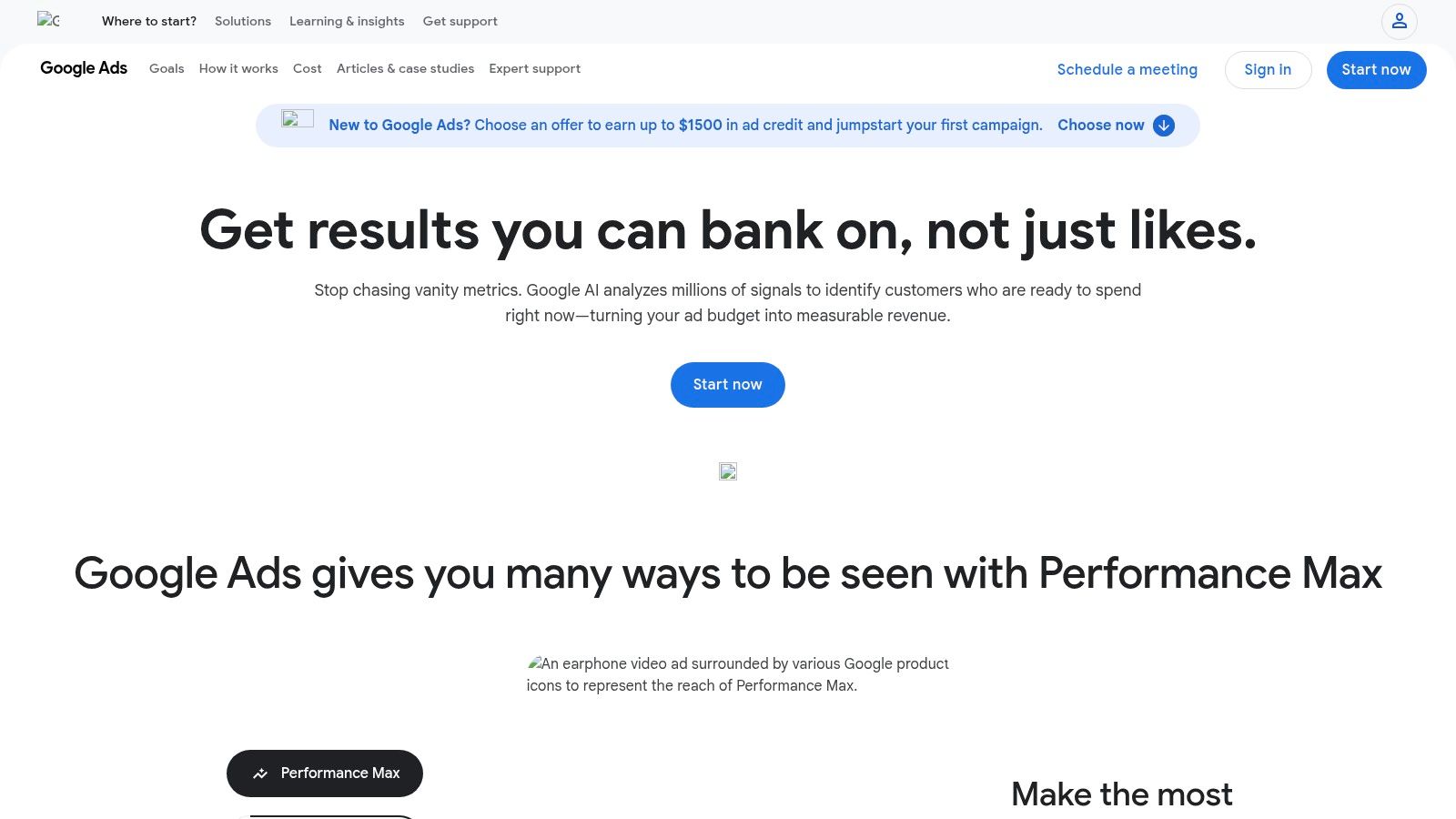
Google Ads is the undisputed leader among top ad networks for advertisers, offering unparalleled access to users at the moment of highest intent. Its self-serve platform allows businesses to connect with customers across a vast ecosystem, including Google Search, YouTube, Maps, and the Google Display Network. This makes it an essential tool for capturing demand, from a user actively searching for a product to someone watching a relevant product review on YouTube.
The platform's strength lies in its ability to target users based on their explicit search queries, providing a direct line to consumers actively looking to make a purchase. This keyword-based targeting, combined with powerful audience layering, allows for highly efficient campaign structures. While the interface can be complex for newcomers, its depth provides seasoned performance marketers with granular control over every aspect of their campaigns.
Key Features & Use Cases
Best For: Capturing high-intent search traffic, remarketing across the web, and driving sales with video and shopping ads.
Pricing Model: Primarily auction-based Pay-Per-Click (PPC), with options for CPM and CPA bidding. Budgets are highly flexible, starting from a few dollars per day.
Ad Formats: Search, Display, Shopping, Video (YouTube), App, and Performance Max.
Practical Tip: Start with a tightly-themed Search campaign focused on exact-match keywords that have strong commercial intent. As you gather data, you can expand to broader terms and other campaign types. For a deeper dive into optimization, you can find proven strategies to improve your Google Ads performance.
Pros | Cons |
|---|---|
Massive reach at high-intent moments (search, YouTube) | Competitive auctions can drive up costs in popular verticals |
Mature tools, integrations, and extensive support content | Steep learning curve and requires ongoing, active optimization |
Granular control over bids, budgets, and attribution | Automation features can sometimes obscure performance insights |
Website: https://ads.google.com
2. Meta Ads (Facebook & Instagram)
Meta Ads is a powerhouse among top ad networks for advertisers, specializing in demand generation and visual storytelling. Its self-serve platform gives businesses access to a massive user base across Facebook, Instagram, Messenger, and the Audience Network. This makes it an ideal environment for introducing brands to new audiences, nurturing interest with engaging creative, and driving conversions for e-commerce and lead-generation businesses.
The platform's core strength is its sophisticated audience targeting and optimization engine. Advertisers can leverage detailed demographic, interest, and behavioral data to build precise audiences or use Lookalike Audiences to find new customers similar to their best existing ones. The system's machine learning, particularly with Advantage+ campaigns, excels at finding users most likely to convert, making it a go-to for direct-to-consumer (DTC) brands focused on performance.
Key Features & Use Cases
Best For: E-commerce prospecting, lead generation, app installs, and building brand awareness with highly visual ad formats.
Pricing Model: Auction-based, primarily optimized for impressions (CPM), with objectives for link clicks (CPC) and conversions (CPA). Budgets are flexible, with options for daily or lifetime spending.
Ad Formats: Image, Video, Carousel, Collection, Stories, Reels, and Instant Experience.
Practical Tip: Leverage Advantage+ Shopping Campaigns to simplify campaign structure and give Meta's algorithm maximum flexibility to find conversions. Pair this with a strong creative testing process, refreshing your ads every 2-3 weeks to avoid creative fatigue. To learn more about growing your presence on the platform, discover these tips on how to scale Facebook Ads.
Pros | Cons |
|---|---|
Sophisticated targeting and conversion optimization for DTC | Signal loss post-iOS 14 can impact attribution and audience accuracy |
Vast reach with visual formats well-suited for creative testing | Delivery can fluctuate during the initial learning phase |
Flexible budget controls and powerful Advantage+ automation | Creative fatigue is common and requires a constant refresh of ad assets |
Website: https://www.facebook.com/business/ads
3. Amazon Ads
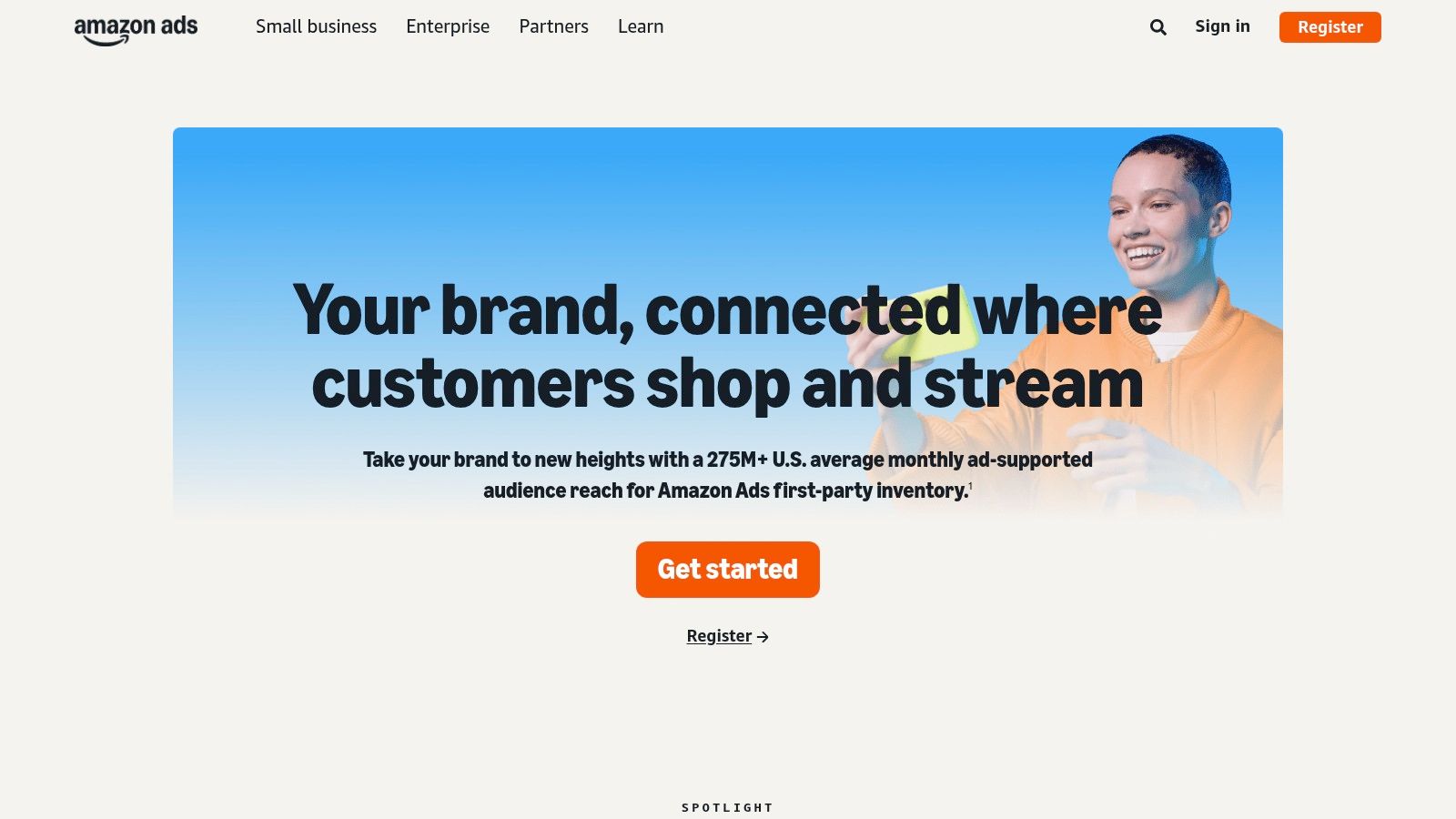
Amazon Ads has become one of the top ad networks for advertisers, particularly for e-commerce and retail brands. It offers a unique advantage by placing products directly in front of shoppers at the final stages of the buying journey. The platform enables sellers and brands to leverage Amazon’s massive marketplace, connecting with customers actively searching for products with high purchase intent on the world’s largest retail site.
The core strength of Amazon Ads lies in its retail-aware targeting capabilities. Advertisers can target users based on specific keywords and product searches (ASINs), ensuring ads are shown to a highly relevant audience. This direct link between ad spend and SKU-level sales provides unparalleled visibility into campaign performance, making it an essential channel for brands selling on the platform.
Key Features & Use Cases
Best For: E-commerce brands selling directly on Amazon, driving product discovery, and defending brand space against competitors.
Pricing Model: Primarily auction-based Cost-Per-Click (CPC). Budgets are flexible, with daily minimums allowing for small-scale tests.
Ad Formats: Sponsored Products, Sponsored Brands, Sponsored Display, and Amazon DSP for programmatic reach.
Practical Tip: Start with Sponsored Products using automatic targeting to gather valuable keyword and ASIN data. Once you identify high-performing search terms, move them into a manual campaign for greater control and bid optimization. This helps you understand what Return on Ad Spend is and how to maximize it for each product.
Pros | Cons |
|---|---|
High shopper intent with a clear path to SKU-level sales | Requires Professional Seller or vendor status for most ad formats |
Strong retail analytics tied directly to product listings | Highly competitive categories can significantly raise CPCs |
Scales from single-SKU tests to large product catalogs | Buy-box eligibility is a critical factor for ad visibility and success |
Website: https://advertising.amazon.com
4. Microsoft Advertising
Microsoft Advertising provides a valuable, and often untapped, opportunity for advertisers to reach a unique audience. As one of the top ad networks for advertisers, it extends your reach beyond Google to users on the Microsoft Search Network (including Bing, Yahoo, and DuckDuckGo) and the Microsoft Audience Network. This network often attracts an older, more affluent, and desktop-heavy user base, providing incremental traffic that might be missed otherwise.
The platform's key advantage is its ability to complement existing search strategies, frequently at a lower cost-per-click (CPC) than more competitive auctions on Google. For advertisers already running campaigns on Google Ads, Microsoft offers a seamless import tool that makes it incredibly simple to mirror campaigns and get started quickly. This allows performance teams to test a new high-intent channel with minimal setup effort.
Key Features & Use Cases
Best For: Reaching an older, higher-income demographic, capturing incremental search volume, and diversifying ad spend beyond Google.
Pricing Model: Primarily auction-based Pay-Per-Click (PPC), with options for CPM bidding on the Audience Network. Budgets are flexible with daily and lifetime options.
Ad Formats: Search, Shopping, Native (Audience Network), Vertical Ads (Automotive, Credit Card, etc.), and Multimedia Ads.
Practical Tip: Use the Google Ads import tool to quickly get your best-performing search and shopping campaigns running on Microsoft. Start with a conservative budget and monitor CPCs and conversion rates; you will often find more efficient performance for identical keywords.
Pros | Cons |
|---|---|
Incremental reach with often lower, more favorable CPCs | Lower overall search volume and scale compared to Google |
Easy migration and campaign imports from Google Ads | New features and ad formats tend to roll out later |
Access to a unique, high-value user demographic | The user interface can feel less intuitive than competitors |
Website: https://ads.microsoft.com
5. TikTok Ads
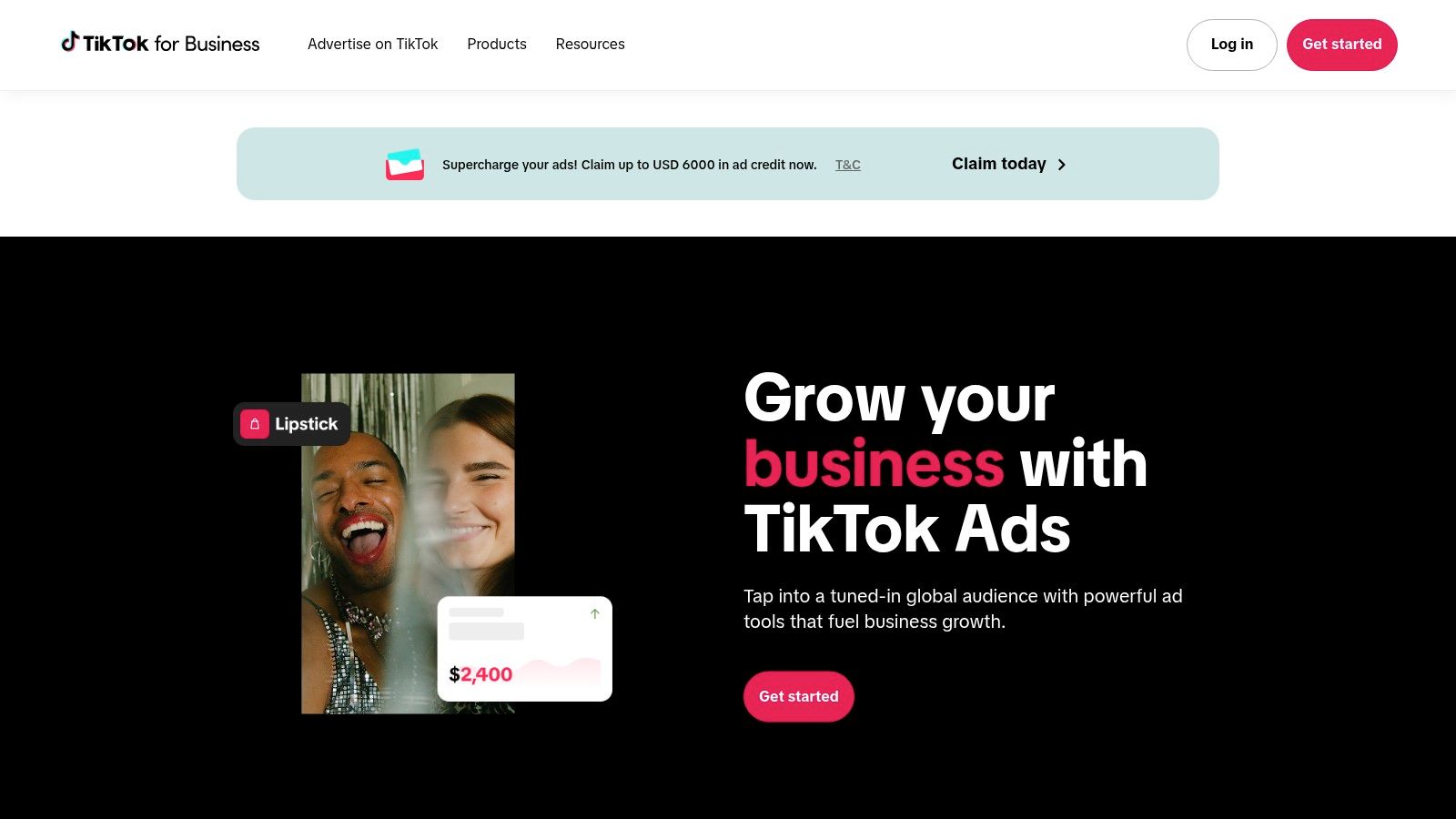
TikTok Ads has rapidly emerged as one of the top ad networks for advertisers, leveraging its highly engaging, short-form video feed to drive massive discovery and performance. The platform’s unique, sound-on environment provides a powerful canvas for brands to connect with audiences through authentic, trend-driven content. Its algorithm excels at placing the right creative in front of the right user, making it a prime channel for scalable creative testing and reaching new customer segments.
The strength of TikTok Ads lies in its creative-first approach. Success hinges on creating ads that feel native to the platform rather than like traditional advertisements. While this demands a higher creative production cadence, the platform's Ads Manager offers clear guidance and budget guardrails to help advertisers navigate the learning phase effectively and find winning formulas for performance campaigns.
Key Features & Use Cases
Best For: Brand awareness, direct-response campaigns for e-commerce, and scalable creative testing to find winning video concepts.
Pricing Model: Auction-based model supporting CPC, oCPC, CPM, and CPV bidding. Requires campaign and ad-group level minimum daily or lifetime budgets to ensure stable delivery.
Ad Formats: In-Feed Ads, TopView, Branded Hashtag Challenge, and Branded Effects.
Practical Tip: Lean into user-generated content (UGC) style creative. Start with a clear hook in the first 1-2 seconds and use trending sounds or music to feel native. Test multiple creative variations (at least 3-5 per ad group) to feed the algorithm and quickly identify top performers.
Pros | Cons |
|---|---|
Scalable creative testing in a high-engagement feed | High creative production demand and rapid creative fatigue |
Clear minimum-budget guidelines to stabilize delivery | Requires budget discipline to exit the learning phase profitably |
Strong video formats and inherent sound-on behavior | Performance can be volatile if creatives don't align with trends |
Website: https://ads.tiktok.com
6. LinkedIn Ads
LinkedIn Ads carves out a unique and powerful niche among top ad networks for advertisers by offering unparalleled access to a professional audience. It is the go-to platform for B2B marketing, high-ticket B2C products, and recruitment, allowing advertisers to connect with users in a business-oriented mindset. Where other platforms target based on interests, LinkedIn allows for precise segmentation by job title, industry, company size, and seniority.
The platform's core strength is its high-quality, professional user data, which enables hyper-specific targeting that is impossible to replicate elsewhere. This leads to higher quality leads and engagement from decision-makers and influential professionals. While the cost-per-click can be higher than on other social networks, the value of reaching a specific, affluent, and professionally motivated audience often justifies the investment for advertisers with the right product or service.
Key Features & Use Cases
Best For: B2B lead generation, promoting high-AOV DTC products, account-based marketing (ABM), and professional recruitment.
Pricing Model: Auction-based, primarily using CPC (Cost-Per-Click) and CPM (Cost-Per-Thousand-Impressions). Budgets are flexible with daily and lifetime options.
Ad Formats: Sponsored Content (in-feed ads), Sponsored Messaging (inMail), Dynamic Ads, and Text Ads.
Practical Tip: Use LinkedIn's Matched Audiences feature by uploading a list of target companies for a focused ABM campaign. Layer this with job function and seniority filters to ensure your ads reach the key decision-makers within those specific accounts.
Pros | Cons |
|---|---|
Unmatched B2B targeting by job title, industry, and company attributes | CPMs and CPCs are typically higher than most other social platforms |
High-quality leads and access to professional decision-makers | Creative fatigue can occur quickly in narrowly targeted audiences |
Multiple ad formats that integrate natively into the user experience | Requires careful frequency management to avoid over-saturating users |
Website: https://business.linkedin.com/marketing-solutions/ads
7. X Ads (formerly Twitter)
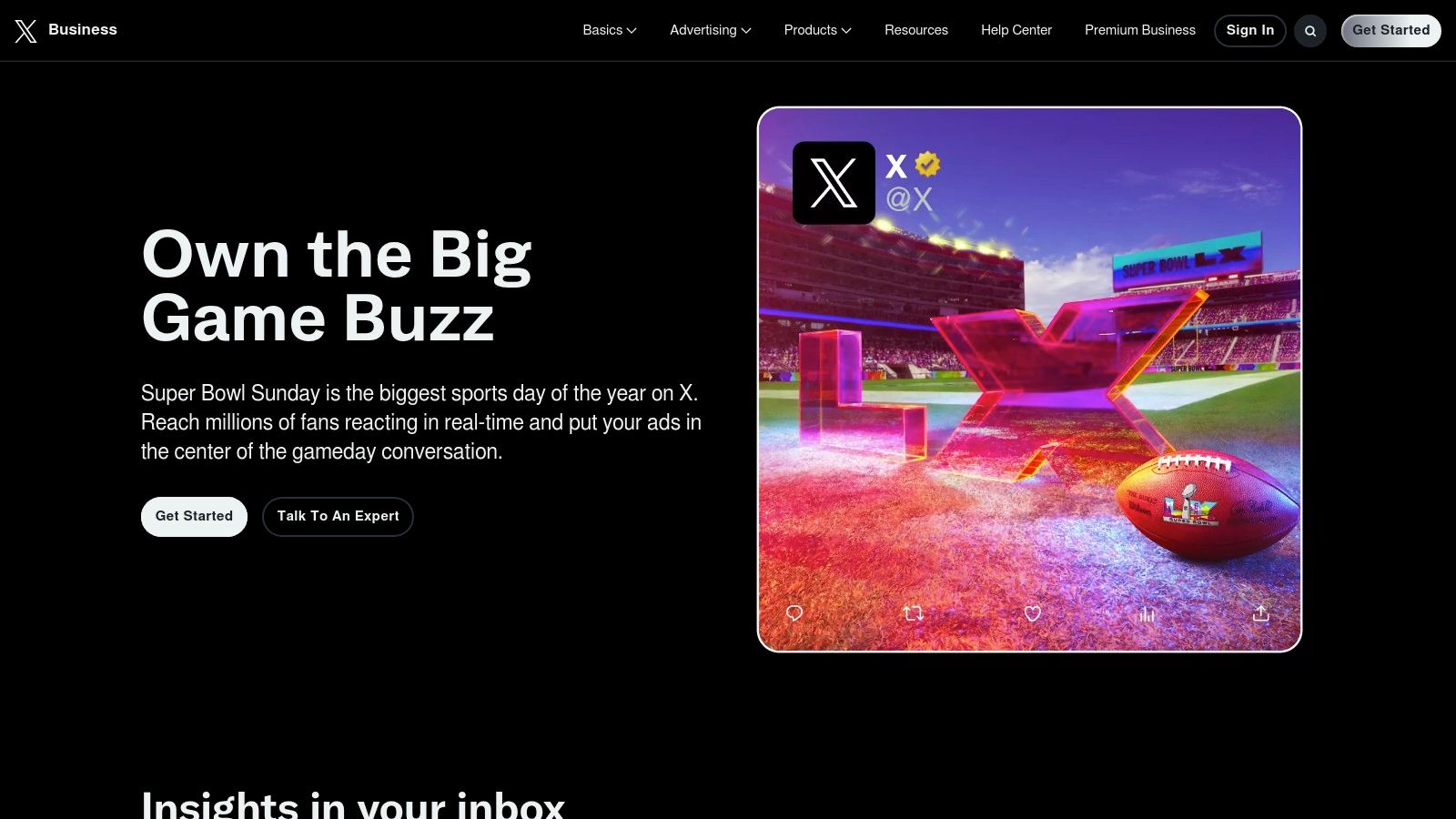
X Ads (formerly Twitter) offers advertisers a unique opportunity to engage with audiences in a real-time, conversation-driven environment. The self-serve platform is designed to inject brands into the cultural zeitgeist, making it a powerful tool for building awareness, launching products, or connecting with major live events. Its strength lies in its ability to target users based on their conversations, interests, and the accounts they follow, allowing brands to reach highly engaged communities.
The platform provides a direct line to what’s happening now, enabling advertisers to align their messaging with current trends and discussions. This makes it distinct from other top ad networks for advertisers that focus primarily on search intent or demographic profiles. While brand safety concerns and performance variability require careful management, the platform’s straightforward setup and flexible budgeting make it an accessible option for driving reach and video views.
Key Features & Use Cases
Best For: Brand awareness campaigns, product launches, event promotions, and driving conversations around cultural moments.
Pricing Model: Auction-based bidding across various objectives (e.g., reach, video views, clicks). No minimum spend and flexible daily budget controls.
Ad Formats: Promoted Ads (text, image, video), video formats, and conversation-starting placements designed for engagement.
Practical Tip: Use conversation and follower look-alike targeting to find audiences similar to those of your competitors or key industry influencers. Align your creative and copy with trending topics to maximize relevance and organic engagement.
Pros | Cons |
|---|---|
Real-time environment ideal for timely, relevant ads | Brand-safety perceptions can be a concern for some advertisers |
Simple budget controls and no minimum campaign spend | Performance can be less predictable than intent-based networks |
Strong support for short-form video and mobile-first ads | Requires active monitoring to manage brand-adjacent conversations |
Website: https://business.x.com
8. Pinterest Ads
Pinterest Ads carves out a unique space among top ad networks for advertisers by targeting users in a discovery mindset. It's less of a social network and more of a visual search engine for inspiration, making it a powerful platform for brands in lifestyle, home décor, fashion, and beauty to connect with consumers early in their planning and purchasing journey. Advertisers can capture demand before it solidifies into a specific brand search on other platforms.
The platform excels at driving mid-funnel consideration and purchases by integrating ads natively into the user's browsing experience. Its strength is in its visual, evergreen content; a well-performing Pin can continue to drive traffic and sales for months, offering a compounding return that differs from the ephemeral nature of feeds on other social networks. This makes it an ideal channel for building long-term brand presence while still hitting performance goals.
Key Features & Use Cases
Best For: E-commerce brands with strong visual appeal, driving mid-funnel traffic and conversions, and building an evergreen content engine.
Pricing Model: Auction-based, supporting objectives like brand awareness (CPM), consideration (CPC), and conversions (CPA). Budgets can be set at a daily or lifetime level.
Ad Formats: Standard Pins, Video Pins, Carousel Pins, Shopping Ads, and Collections.
Practical Tip: Leverage your product catalog to run dynamic Shopping Ads. Tag products in your lifestyle Pins to create a seamless path from inspiration to purchase, turning visual discovery into direct sales.
Pros | Cons |
|---|---|
High-intent audience in a planning and discovery mindset | Conversion volume may be lower than Meta or Google for certain product categories |
Ad content is evergreen and can compound in value over time | The Performance+ budget can flex significantly day-to-day, which may be jarring for those used to hard caps |
Strong visual format is ideal for showcasing products contextually | Requires high-quality, aesthetically pleasing creative to perform well |
Website: https://business.pinterest.com/advertise
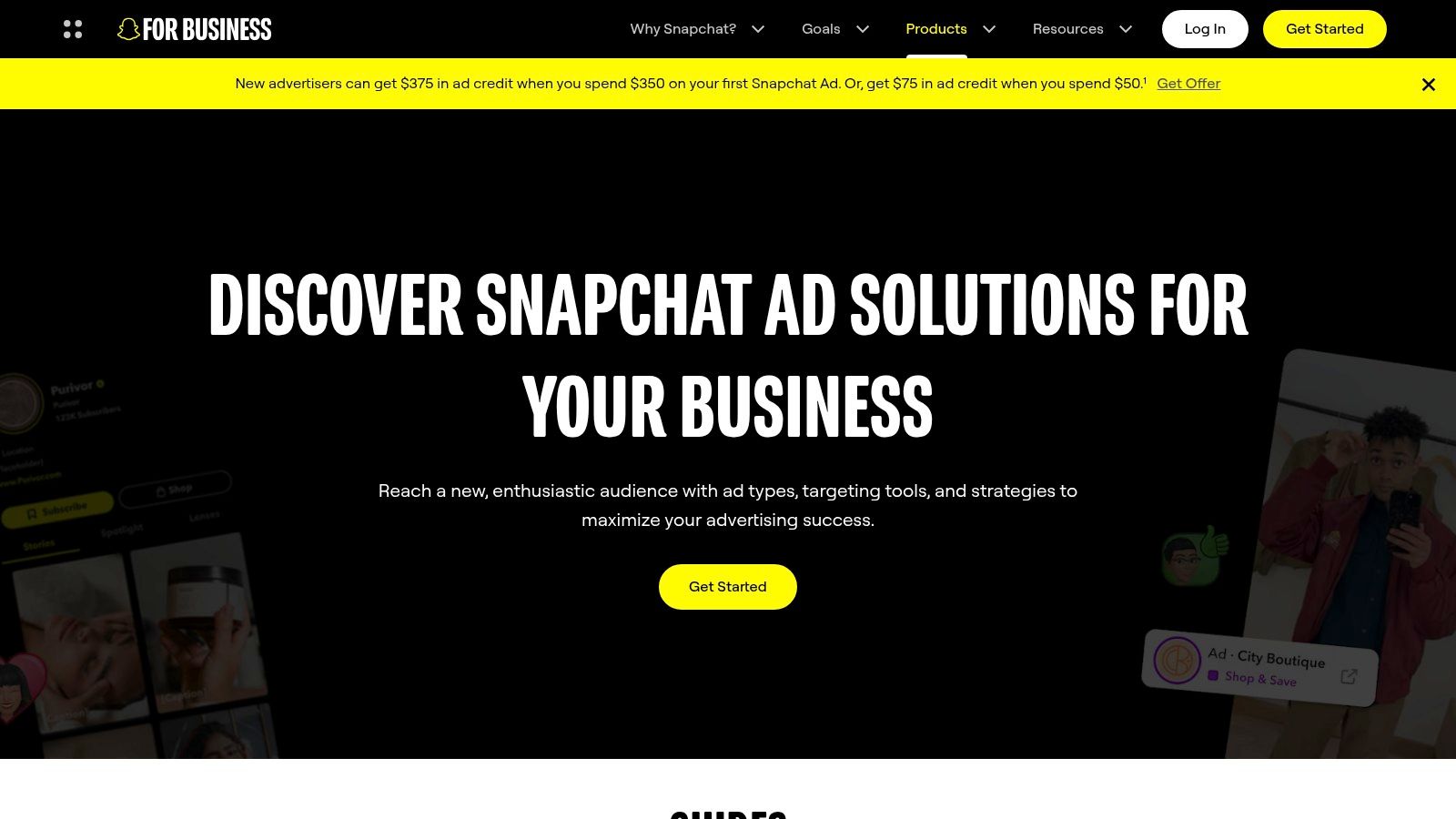
9. Snapchat Ads
Snapchat Ads has carved out a unique space among top ad networks for advertisers by offering direct access to a highly engaged, younger demographic. The platform excels with its full-screen, vertical video format that feels native to the user experience, making it ideal for brands utilizing user-generated content (UGC) or short, impactful video creatives. Its self-serve Ads Manager provides a surprisingly intuitive interface for building campaigns that feel both authentic and immersive.
The platform's strength lies in its creative tools, particularly its innovative Augmented Reality (AR) Lenses and Filters, which allow for interactive ad experiences that can go viral. For brands targeting Gen Z and younger millennials, Snapchat provides an environment where creative, less-polished ads often outperform high-production commercials. This makes it a valuable channel for testing new creative angles and connecting with an audience that is often harder to reach on more traditional networks.
Key Features & Use Cases
Best For: Brands targeting users under 35, e-commerce, app installs, and campaigns leveraging authentic, short-form video or AR experiences.
Pricing Model: Auction-based, supporting objectives like CPM, CPC, and Cost Per Install. The low minimum daily spend of just $5 makes it highly accessible for testing.
Ad Formats: Snap Ads (single image or video), Story Ads, Collection Ads, AR Lenses, and Commercials.
Practical Tip: Use authentic, UGC-style video creative with a strong hook in the first two seconds. Start with a broader audience and let the pixel gather conversion data before narrowing your targeting or creating lookalike audiences for better performance.
Pros | Cons |
|---|---|
Highly engaged audience and less ad saturation than rivals | Audience heavily skews younger, which may not suit every brand |
Low barrier to entry and accessible daily minimum budgets | Learning phase can stall and struggle with very small budgets |
Innovative ad formats like AR Lenses drive high engagement | Creative needs to be highly tailored to the platform to succeed |
Website: https://forbusiness.snapchat.com/advertising
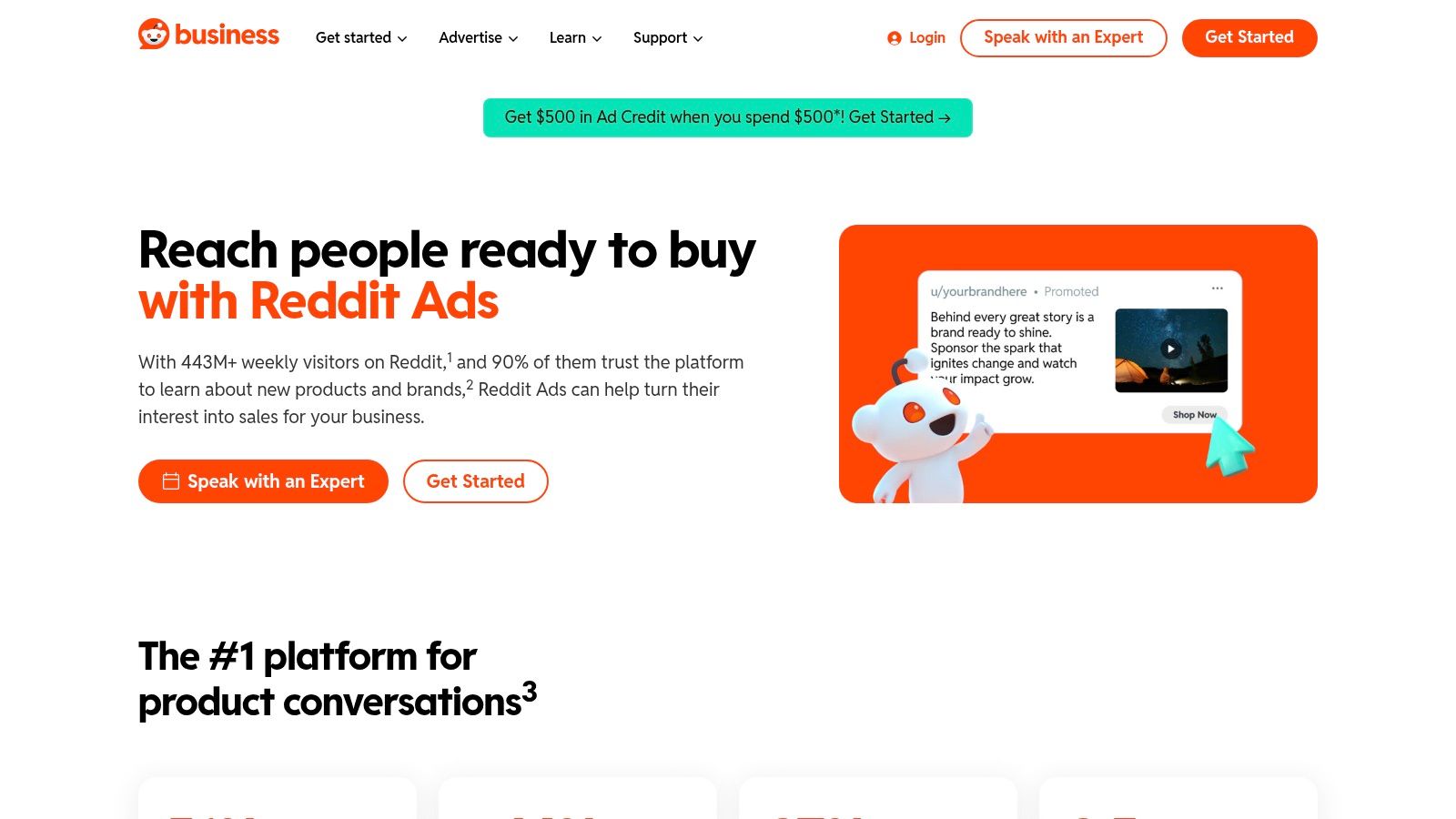
10. Reddit Ads
Reddit Ads offers a unique opportunity to connect with highly engaged, niche communities that are often hard to reach on other platforms. It stands out as one of the top ad networks for advertisers looking to engage in authentic, conversation-driven marketing. Instead of broad demographic targeting, Reddit’s power lies in its ability to place ads within specific subreddits (communities) dedicated to virtually any topic imaginable, from vintage audio equipment to sustainable fashion.
This community-centric approach allows brands to tap into conversations with users who are deeply passionate and knowledgeable about specific interests. Success on the platform requires creative that feels native and authentic to Reddit's distinct culture, often rewarding advertisers who engage directly with user comments. For brands that can align their message with the right community, the platform can be a powerful tool for building brand affinity and reaching early adopters.
Key Features & Use Cases
Best For: Reaching niche hobbyist and enthusiast audiences, generating community discussion, and driving brand awareness with early adopters.
Pricing Model: Auction-based buying with CPC, CPM, and CPV objectives. Budgets are flexible, and automated bidding is available.
Ad Formats: Promoted Posts (image, video, text, carousel), Conversation Placement, and Takeovers.
Practical Tip: Spend time researching relevant subreddits before launching a campaign. Tailor your ad copy and creative to mimic the tone and style of organic posts within that community to improve reception and performance.
Pros | Cons |
|---|---|
Access to deep, topic-specific communities and high authenticity | Performance can vary and creative must match the Reddit tone |
Lower CPMs possible in some niches with flexible budgets | Fewer native commerce tools compared to Meta or Google |
New automated bidding tools for Brand Awareness | Requires active community management on ad comment threads |
Website: https://www.business.reddit.com
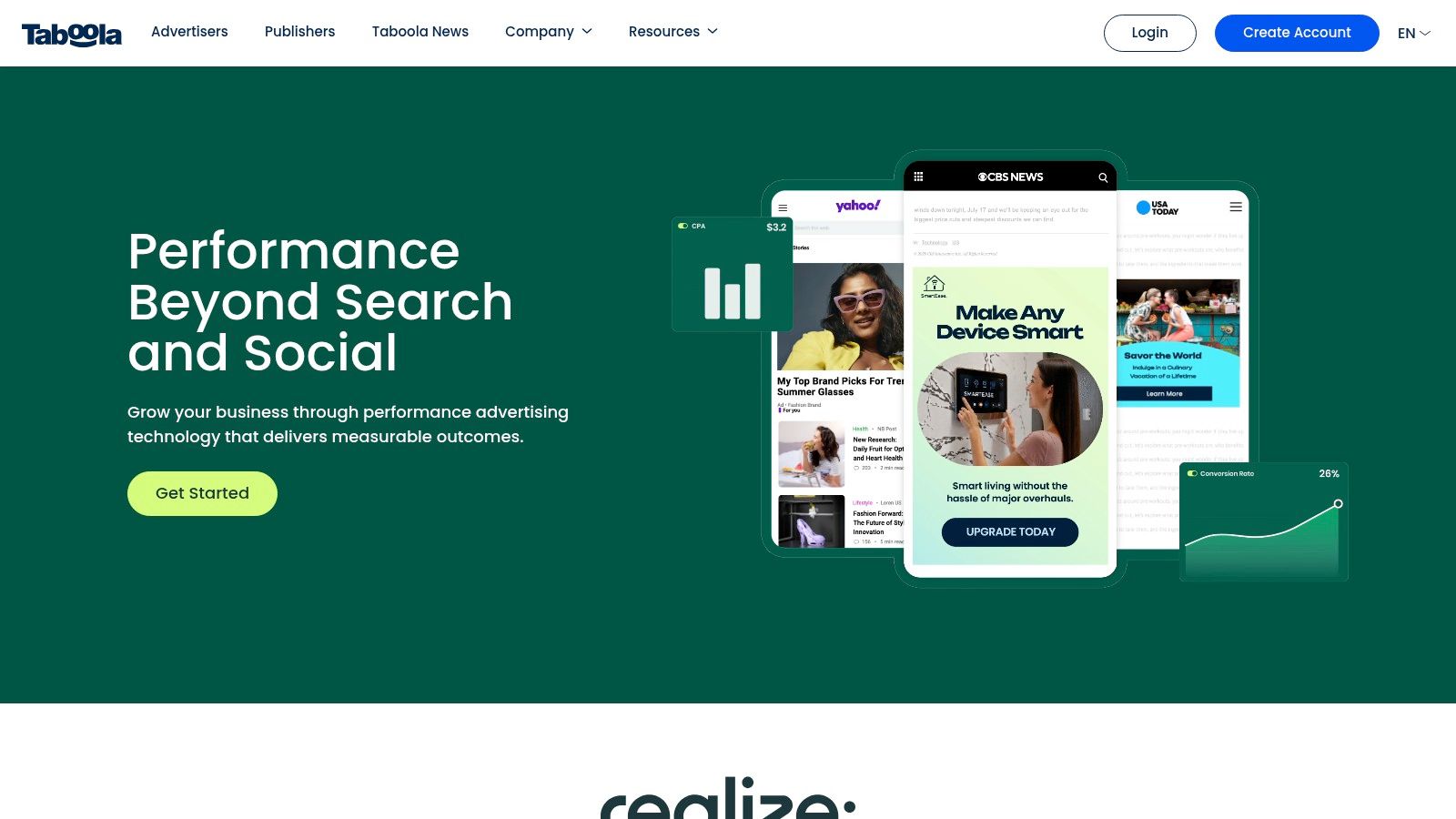
11. Taboola
Taboola is a leading native advertising network that enables advertisers to reach users across a vast network of open-web publisher sites. It specializes in placing sponsored content, often in the form of articles or videos, within editorial feeds. This makes it an ideal platform for top-of-funnel brand awareness, content amplification, and engaging potential customers before they actively begin a product search.
The platform excels at driving scalable traffic for content-led marketing strategies, allowing brands to capture user attention in a less intrusive, more discovery-oriented context. By promoting content like blog posts, listicles, or user-generated content (UGC), advertisers can build audiences and nurture leads outside the highly competitive walled gardens of search and social media. Careful management of publisher placements is key to maximizing performance.
Key Features & Use Cases
Best For: Driving top- and mid-funnel traffic, content amplification, prospecting new audiences, and large-scale retargeting.
Pricing Model: Primarily CPC and CPM bidding, with daily, monthly, or lifetime budget caps. Automated bidding options like Maximize Conversions are available.
Ad Formats: Native in-feed ads (image and video), homepage placements, and mid-article placements.
Practical Tip: Start by promoting your highest-performing blog content or customer testimonials with compelling, curiosity-driven headlines. Closely monitor publisher-level performance reports and proactively exclude sites that do not align with your target audience or performance goals.
Pros | Cons |
|---|---|
Large open-web reach for incremental scale | Lower-funnel ROAS can be variable; requires strong attribution |
Works well for content-led funnels and UGC-style creative | Careful optimization is needed to avoid low-quality placements |
Flexible billing thresholds and budget controls | Creative fatigue can set in quickly, requiring frequent refreshes |
Website: https://www.taboola.com
12. The Trade Desk
The Trade Desk is an enterprise-grade demand-side platform (DSP) that empowers sophisticated advertisers and agencies to execute programmatic campaigns across the open internet. It provides a centralized hub for buying and managing digital advertising across a vast omnichannel landscape, including connected TV (CTV), audio, display, and native formats. Its core strength lies in providing unparalleled transparency and control over the media buying process.
Unlike self-serve platforms aimed at small businesses, The Trade Desk is built for scale, offering advanced data-driven targeting, powerful decisioning tools, and robust supply-path optimization. It enables advertisers to leverage first-party and third-party data for precise audience segmentation, making it a cornerstone for brands focused on data-centric growth strategies. The platform's commitment to a more transparent and interoperable ad ecosystem is evident in its development of identity solutions like Unified ID 2.0.
Key Features & Use Cases
Best For: Large advertisers, agencies, and in-house teams requiring granular control for omnichannel programmatic campaigns, especially in CTV and audio.
Pricing Model: Typically a percentage of media spend, requiring significant budget commitments. Access is generally through a direct sales agreement or an agency partner, not a self-serve signup.
Ad Formats: Display, Video (including CTV/OTT), Audio, Native, and Digital Out-of-Home (DOOH).
Practical Tip: Leverage the platform's robust reporting to identify high-performing inventory sources and build inclusion lists. This helps focus your spend on publishers that consistently drive results, improving efficiency and preventing waste on lower-quality placements.
Pros | Cons |
|---|---|
Broadest open-internet reach and advanced tooling in one platform | Not a self-serve platform for SMBs; access requires a direct contract or agency partner |
Enterprise controls for data, transparency, and inventory curation | High operational complexity requires experienced programmatic buyers |
Strong CTV, audio, and retail media extensions via partner integrations | Significant setup time and minimum spend commitments may be required |
Website: https://www.thetradedesk.com
Top 12 Ad Networks: Advertiser Comparison
Platform | Core features ✨ | Value / USP 🏆 | Quality ★ | Target 👥 | Pricing 💰 |
|---|---|---|---|---|---|
Google Ads | Search, YouTube, Shopping, PMax, keyword & bid controls | Massive high‑intent scale & granular control | ★★★★★ Mature tooling; competitive auctions | Performance marketers, retailers, large advertisers | 💰 Auction CPC/CPM — can be costly in competitive verticals |
Meta Ads (Facebook & Instagram) | Rich creative formats, Advantage+, catalogs & pixel | Best for creative testing & DTC conversion | ★★★★ Strong scale; signal loss risk | DTC brands, commerce, creative-first teams | 💰 Flexible budgets; ROAS varies with signal |
Amazon Ads | Sponsored Products/Brands, ASIN targeting, SKU-level signals | Direct shopper intent + clear SKU sales visibility | ★★★★ Retail-focused; buy-box & category competition | Sellers, brand-led retailers, catalog advertisers | 💰 CPC/CPM; Brand Registry/Pro Seller often required |
Microsoft Advertising | Search + Audience Network, Google import, native placements | Incremental search reach with often lower CPCs | ★★★ Good alternative to Google; lower volume | Desktop-skewed audiences, Google migrants | 💰 Generally lower CPCs; smaller overall volume |
TikTok Ads | Short-form video, creative guidance, commerce integrations | High engagement & scalable creative testing | ★★★ Rapid creative fatigue; high production demand | Brands with strong video creatives, younger demos | 💰 Min budgets + disciplined spend to exit learning |
LinkedIn Ads | Job/company/seniority targeting, Sponsored Content/Messaging | Unmatched B2B targeting & lead quality | ★★★★ High-quality leads; higher CPMs | B2B, recruiting, high-AOV advertisers | 💰 Premium CPM/CPC — suited for ROI-focused B2B |
X Ads (formerly Twitter) | Real-time feed, promoted tweets/video, auction bidding | Timely cultural reach & conversational amplification | ★★★ Variable performance; brand-safety varies | Brands leveraging cultural moments, small budgets | 💰 Flexible budgets; no minimum spend |
Pinterest Ads | Visual discovery, Performance+, shopping feed support | Planning moments & mid-funnel visual commerce | ★★★ Evergreen creative compounds over time | Lifestyle, home, fashion, beauty advertisers | 💰 Flexible; Performance+ may flex spend above daily |
Snapchat Ads | Full-screen vertical video, AR Lenses, low entry budgets | Strong for UGC-style short video & Gen Z reach | ★★★ Good short-video performance; small-budget limits | Brands targeting Gen Z / younger audiences | 💰 Low min (≈$5) but higher recommended to scale |
Reddit Ads | Community & interest targeting, CPC/CPM/CPV auctions | Access to niche, authentic communities | ★★★ Performance varies; creative must match tone | Niche products, early adopters, community-led campaigns | 💰 Flexible; lower CPMs possible in tight niches |
Taboola | Native open-web placements, CPC/CPM, publisher controls | Large open-web reach for content amplification | ★★★ Placement quality varies; needs curation | Content-led funnels, publishers, prospecting teams | 💰 CPC/CPM — ROI depends on placement hygiene |
The Trade Desk | Omnichannel DSP (CTV/OTT, audio, display), advanced decisioning | Enterprise programmatic controls & supply-path transparency | ★★★★ Enterprise-grade; operationally complex | Agencies, enterprise advertisers, data-driven teams | 💰 Enterprise pricing via sales/partners |
Final Thoughts
Navigating the expansive landscape of digital advertising can feel overwhelming. We've journeyed through a comprehensive list of the top ad networks for advertisers, from the foundational giants like Google and Meta to specialized platforms such as LinkedIn and emerging powerhouses like TikTok. Each network presents a unique combination of audience, ad formats, targeting capabilities, and cost structures, making the "best" choice entirely dependent on your specific business goals.
The central takeaway is that a one-size-fits-all strategy no longer exists. A high-growth DTC brand might find its ideal customer on Pinterest's visual discovery engine, while a B2B SaaS company will likely achieve better results by investing in the professional targeting of LinkedIn Ads. The key is to move beyond the question of "which network is best?" and instead ask, "which network is right for this specific campaign objective?"
Your Strategic Next Steps
As you move forward, your selection process should be a deliberate, strategic exercise rather than a simple reaction to industry trends. Your budget, target audience, and creative assets are the primary pillars that should guide your decision. Don't be afraid to test smaller, more niche platforms like Reddit Ads if your audience demographics align perfectly; the potential for high engagement and lower CPCs can be significant.
Before committing significant budget, consider these crucial implementation factors:
Attribution Modeling: How will you measure success? Ensure your analytics and attribution tools are correctly configured to track conversions across multiple touchpoints. A last-click model might undervalue top-of-funnel networks like Taboola or TikTok.
Creative Resourcing: Do you have the internal team or agency partners to create platform-native content? A video-first strategy for TikTok and Snapchat requires a different workflow than creating static image ads for the Google Display Network.
Fraud Prevention & Brand Safety: Actively use the tools provided by each network to control where your ads appear. Set up exclusion lists and monitor placement reports diligently, especially on programmatic platforms like The Trade Desk or broad content networks.
Choosing Your Ad Network Portfolio
Ultimately, building a resilient advertising strategy is about portfolio diversification. Relying solely on one or two of the top ad networks for advertisers exposes your business to algorithm changes, rising costs, and platform-specific risks. The most successful performance marketing teams build a balanced mix, using different networks to achieve distinct goals along the customer journey.
Start by anchoring your strategy in a core platform where you have proven performance, like Google or Meta Ads. Then, methodically experiment with a second or third network, allocating a controlled test budget to validate its potential. Use the detailed insights and practical tips from this guide to inform your hypotheses and structure your tests for clear, actionable learnings. Your goal is to build a robust, multi-channel engine that drives sustainable growth, not just short-term wins. This methodical approach will empower you to scale efficiently, mitigate risk, and consistently find new pockets of profitable customer acquisition.
Managing budgets and optimizing performance across this diverse set of ad networks can be complex and time-consuming. SpendOwlAI automates the tedious work of spend monitoring and budget pacing, giving you real-time insights and alerts to prevent overspending and maximize your ROI. Connect your ad accounts in minutes and let our AI-powered platform provide the clarity you need to make smarter, data-driven decisions across your entire advertising portfolio.