10 Practical Segmenting Customers Examples for E-commerce in 2026
Customer segmentation is more than just an academic exercise in grouping users; it's the core of efficient performance marketing. Moving beyond generic demographics unlocks higher return on ad spend (ROAS), cuts wasted budget, and builds a more durable marketing operation. The real question is, which segments actually drive performance?
This article breaks down 10 powerful, data-driven segmenting customers examples that top-tier DTC brands and agencies use to gain a competitive edge. Each example is a complete roadmap. You will get the segment definition, the exact data signals to monitor, and tactical execution steps for Meta, Google, and Shopify. We will also cover the key performance indicators (KPIs) to track for success.
This is a practical playbook, not a theoretical guide. It's designed to help you identify your most valuable audiences, diagnose critical issues like ad fatigue, and make smarter, data-backed decisions. While platforms can automate the discovery of these insights, understanding the fundamental strategy behind the data is what separates average marketers from exceptional ones. Let's explore the segments that are critical for e-commerce growth.
1. Behavioral Segmentation by Ad Performance Metrics
Behavioral segmentation using ad performance metrics groups audiences based on how they interact with your advertising campaigns. This approach moves beyond simple demographics to analyze direct responses, such as click-through rates (CTR), return on ad spend (ROAS), and cost per acquisition (CPA). By monitoring these key indicators across platforms like Meta and Google, marketing teams can pinpoint which user groups are most responsive, which are experiencing ad fatigue, and which represent untapped opportunities.

This method provides clear, actionable data for optimizing campaigns. It is one of the most direct segmenting customers examples because it ties audience behavior directly to financial outcomes and campaign efficiency.
Strategic Breakdown & Execution
Segment Definition: Create audience segments based on their measured response. Examples include "High-CTR, Low-CPA Responders," "Video Ad Converters," or "Ad-Fatigued iOS Users" (those with declining engagement after multiple impressions).
Data Sources: Pull performance data directly from your ad platforms (Meta Ads Manager, Google Ads) and connect it with your e-commerce backend (Shopify Analytics) to get a full-funnel view.
Targeting Tactics:
Meta/Google: Build retargeting campaigns for high-engagement segments with tailored creative. Create lookalike audiences from your top-performing ROAS groups.
Exclusion: Exclude ad-fatigued segments from always-on campaigns for a cool-down period to prevent wasted spend and negative brand perception.
Bids & Budgets: Allocate a larger portion of your budget to segments delivering the highest ROAS. For segments with high CTR but low conversions, test lower bids or different landing page offers.
Key Insight: A common mistake is treating all engaged users the same. Segmenting by how they engage (e.g., video view vs. link click) lets you serve more relevant creative, improving conversion rates and efficiency.
Actionable Checklist
Analyze Campaign Data: Export performance reports from Meta and Google, breaking down results by audience, placement, and creative type.
Define Segments: Identify at least three distinct performance-based segments (e.g., top 10% ROAS, bottom 25% CTR, high frequency/low engagement).
Build Audiences: Create custom audiences in your ad platforms based on these definitions.
Launch Segment-Specific Campaigns: Test unique offers, creative, or messaging tailored to each group.
Monitor KPIs: Track ROAS, CPA, and frequency for each segment to validate your strategy and adjust as needed. For deeper insights and to avoid reacting to random data fluctuations, consider tools like SpendOwlAI for setting performance guardrails.
2. RFM Segmentation (Recency, Frequency, Monetary Value)
RFM segmentation is a classic, data-driven model that categorizes customers based on three key purchase behaviors: how recently they bought (Recency), how often they buy (Frequency), and how much they spend (Monetary). This method is especially powerful for e-commerce and direct-to-consumer brands looking to boost customer lifetime value and manage repeat purchase cycles effectively. It turns raw transaction data into actionable audience groups.
By analyzing these three dimensions, marketing teams can identify their most valuable customers, those at risk of churning, and new customers with high potential. This makes RFM one of the most practical segmenting customers examples for creating personalized retention and upsell campaigns.
Strategic Breakdown & Execution
Segment Definition: Group customers into segments like "Champions" (high R, F, M), "At-Risk Customers" (low recency, high F & M), or "New Customers" (high recency, low F & M). For instance, a DTC brand might create a "Needs Attention" segment for customers who haven't purchased in 60+ days but were previously frequent buyers.
Data Sources: Your primary data source is your e-commerce platform's order history (e.g., Shopify, BigCommerce). This data can be exported and analyzed in a spreadsheet or through a dedicated customer data platform.
Targeting Tactics:
Meta/Google: Upload your "Champions" segment as a custom audience for exclusive offers or new product launches. Create a lookalike audience from this group to find new, high-value prospects.
Exclusion: Exclude "Lost Customers" (very low recency) from top-of-funnel campaigns to avoid paying to re-acquire users who are unlikely to return. Instead, target them with specific win-back email flows or ads.
Bids & Budgets: Allocate higher ad spend to retain and upsell your "Champions" and other high-value segments. For "At-Risk" groups, use a smaller, test-focused budget for re-engagement campaigns to see if they can be won back profitably.
Key Insight: RFM becomes even more powerful when combined with product data. Knowing what your "Champions" buy allows you to build product-led acquisition campaigns that attract customers with a higher probability of becoming top-tier spenders.
Actionable Checklist
Export & Score Data: Export your customer order history and assign each customer a score (e.g., 1-5) for Recency, Frequency, and Monetary value.
Define RFM Segments: Create at least three core segments based on these scores (e.g., Champions, At-Risk, New Customers).
Create Custom Audiences: Upload your segmented customer lists into Meta Ads Manager and Google Ads.
Launch Targeted Campaigns: Deploy tailored campaigns: early access for Champions, a "We Miss You" offer for At-Risk customers, and an onboarding sequence for New Customers.
Monitor KPIs: Track Customer Lifetime Value (LTV), repurchase rate, and churn rate for each RFM segment to measure the impact of your campaigns and refine your strategy.
3. Demographic Segmentation by Platform and Device
Demographic segmentation by platform and device groups audiences based on observable characteristics like their device type (mobile vs. desktop), operating system (iOS vs. Android), and the platform where they are active (Meta, Google, etc.). This approach is critical for performance marketers because user behavior, ad costs, and conversion rates often differ significantly across these technical and platform-specific environments. For instance, a user searching on Google from a desktop may have a different intent and higher average order value than one scrolling through video ads on Meta's mobile app.
Analyzing performance through this lens allows for precise budget allocation and creative optimization. It stands as a fundamental example of segmenting customers because it addresses the technical context of the user journey, which directly impacts campaign efficiency and return on investment.
Strategic Breakdown & Execution
Segment Definition: Create distinct audience segments such as "Mobile iOS Meta Users," "Desktop Google Search Converters," or "Android In-App Shoppers." These definitions help isolate performance variations.
Data Sources: Use your ad platform's built-in reporting (Meta Ads and Google Ads) broken down by device, platform, and placement. Cross-reference this with analytics from your e-commerce platform (e.g., Shopify) to connect device-specific traffic to actual sales data.
Targeting Tactics:
Meta/Google: If data shows mobile outperforms desktop by a significant margin (e.g., 40% better CPA), create mobile-only campaigns or adjust placement bids to favor mobile. Use different creative assets for iOS users to account for tracking limitations.
Exclusion: If desktop traffic from a specific platform yields high costs and low conversions, consider excluding it from certain campaigns or allocating minimal budget to it.
Bids & Budgets: Allocate budget proportionally to the platforms and devices that drive the best results. For example, if Google Search on desktop drives a higher AOV, you might set a higher target ROAS for that specific segment.
Key Insight: Don't assume uniform performance across devices. A common scenario is seeing high mobile engagement on Meta but higher AOV from desktop on Google Search. Splitting budgets and creative by device and platform prevents you from averaging out these important differences.
Actionable Checklist
Review Platform Breakdowns: In Meta and Google Ads, analyze your campaign reports by "Device" and "Placement" to identify performance disparities.
Define Core Segments: Identify your primary device and OS segments (e.g., iOS Mobile, Android Mobile, Desktop).
Set Up Segmented Campaigns: Duplicate your top-performing campaigns and set them to target specific devices or operating systems.
Tailor Creative & Bids: Adjust your ad creative (e.g., vertical video for mobile) and bidding strategies based on the historical performance of each segment.
Establish Performance Guardrails: Use tools to monitor delivery patterns and flag when a specific device segment is consistently underperforming, which helps avoid reactive, data-volatile edits.
4. Psychographic Segmentation by Brand Affinity and Intent
Psychographic segmentation groups customers based on their values, interests, lifestyle, and purchase intent. This method moves beyond what customers do (behavioral) to understand why they do it, targeting the intrinsic motivations that drive purchasing decisions. For DTC brands, especially those in niche or premium markets, this approach is critical for connecting with audiences who share their core brand ethos.
This strategy allows you to find people who are not just potential buyers but potential advocates. It's one of the most powerful segmenting customers examples for building a loyal community around shared values, rather than just transactional relationships.
Strategic Breakdown & Execution
Segment Definition: Create audiences based on their alignment with your brand's core values. Examples include "Eco-Conscious Consumers" (for sustainable brands), "High-Intent Health Enthusiasts" (for fitness products), or "Aspiring Luxury Shoppers."
Data Sources: Use Meta's detailed interest targeting and behavioral categories. For lookalikes, use your CRM or Shopify data to identify customers with the highest lifetime value or return on ad spend, not just high average order value.
Targeting Tactics:
Meta/Google: Build lookalike audiences from your top 5% of customers based on ROAS. Target users based on interests like "sustainable fashion" or "organic products." On Google, target in-market audiences searching for related premium or niche products.
Exclusion: Exclude broad, low-intent interest groups that may drive clicks but have historically low conversion rates for your brand.
Bids & Budgets: Allocate test budgets to new interest-based audiences to gauge alignment. Prioritize spending on high-performing lookalikes that consistently deliver strong ROAS.
Key Insight: Building a lookalike from your highest AOV customers can be a trap. Instead, create seed audiences from your top 5% ROAS segment to find more users who are both valuable and efficient to acquire.
Actionable Checklist
Identify Core Values: List the top three values or interests your ideal customer embodies.
Create Seed Audience: Export a list of customers from your top ROAS segment to build a value-based lookalike audience.
Launch Interest-Based Tests: In Meta, create ad sets targeting specific interests that align with your brand values (e.g., "veganism," "minimalism").
Tailor Creative: Develop messaging and visuals that speak directly to the psychographic profile of each segment.
Monitor Saturation: Keep a close eye on audience saturation and ad fatigue, as psychographic segments are often smaller and can burn out faster. Tools can help you track audience performance decay.
5. Segment-by-Campaign-Performance (Creative and Messaging Variants)
This segmentation strategy groups customers based on which creative assets, ad copy, or messaging themes they respond to most favorably. It involves analyzing performance across different creative styles, such as User-Generated Content (UGC) versus branded assets, video versus static images, or pain-point versus benefit-driven copy. Tracking these preferences allows marketing teams to rapidly iterate on winning concepts and manage creative fatigue effectively.

This method is one of the most powerful segmenting customers examples for scaling ad accounts, as it moves beyond audience characteristics to focus on the specific content that drives action. For instance, a DTC brand might find that UGC converts 25% better with cold audiences, while branded lifestyle content excels in retargeting campaigns.
Strategic Breakdown & Execution
Segment Definition: Create audience groups based on creative affinity. Examples include "UGC Responders" (users who click and convert from UGC ads), "Video Ad Viewers" (those who watch over 75% of video ads), or "Benefit-Driven Copy Converters" (customers who respond to positive, outcome-focused messaging).
Data Sources: Use ad platform data (Meta Ads Manager, Google Ads) by tagging campaigns and ads with clear naming conventions for creative type, angle, and format.
Targeting Tactics:
Meta/Google: Build retargeting audiences of users who engaged with a specific creative style. Serve them more of what they liked or test a lookalike audience built from high-performing creative converters.
Exclusion: Prevent creative burnout by excluding audiences who have seen a specific ad multiple times with declining engagement. Rotate in fresh creative to re-engage them.
Bids & Budgets: Allocate more budget to the creative-audience pairings that deliver the best CPA or ROAS. Test different creative formats for segments that show signs of fatigue.
Key Insight: Creative fatigue is not universal. A top-performing ad for your prospecting audience may burn out quickly with your retargeting segment. Monitor performance at the segment level to know when to rotate assets for specific groups.
Actionable Checklist
Establish Naming Conventions: Create a clear system for naming campaigns and ads (e.g.,
UGC_Video_PainPoint_ColdProspecting).Define Creative Segments: Identify your primary creative pillars (e.g., UGC, branded, testimonials) and messaging angles.
Launch Structured Tests: Run A/B tests isolating one variable at a time (e.g., testing UGC vs. branded with the same copy and audience).
Build Engagement Audiences: In your ad platform, create custom audiences based on interactions with specific ads or video content.
Analyze and Rotate: Use performance data to identify winning combinations and rotate creatives for fatigued segments. Automate this process with tools like SpendOwlAI to detect performance dips before they waste budget.
6. Geographic and Geo-Climate Segmentation
Geographic and geo-climate segmentation involves dividing your customer base by location, such as country, region, or city, and factoring in climate or seasonal conditions. This method is critical for direct-to-consumer (DTC) brands whose product relevance is tied to weather, seasonality, or local economic factors. It allows marketers to align their messaging and budget allocation with on-the-ground realities, ensuring campaigns resonate with regional needs.
This strategy is one of the most practical segmenting customers examples because it directly impacts budget efficiency. For instance, a winter apparel brand can expect a 5x higher ROAS in northern regions during Q4, while a skincare company can adjust ad spend for humid versus dry climates to promote relevant products.
Strategic Breakdown & Execution
Segment Definition: Group audiences based on location and climate-driven needs. Examples include "Cold Climate Winter Shoppers," "Humid Region Skincare Buyers," or "Peak-Season Vacation Destinations."
Data Sources: Use Meta and Google Ads location reports, Shopify sales data by region, and third-party weather data APIs to map out sales trends against geographical and climate patterns.
Targeting Tactics:
Meta/Google: Create campaigns targeting specific regions, states, or cities with creative that reflects local seasons or events. Use location-based bid adjustments in Google Ads to prioritize high-performing areas.
Exclusion: Exclude regions where your product is out-of-season to prevent inefficient ad spend. For example, stop showing snow boot ads to customers in Florida in December.
Bids & Budgets: Allocate a majority of your budget to regions entering their peak season. Set location-specific ROAS or CPA targets that account for regional differences in purchasing power and demand.
Key Insight: Don't treat entire countries as a single market. A national campaign in the U.S. might fail if it ignores that customers in Texas and Vermont have completely different needs in October. Regional specificity is key to maximizing returns.
Actionable Checklist
Analyze Geographic Performance: Pull sales and ad performance reports from Shopify, Meta, and Google, breaking them down by country, state, or region.
Define Geo-Segments: Identify at least three distinct geographic segments based on sales volume, ROAS, and seasonality (e.g., "Top 5 U.S. States by ROAS," "Off-Season European Markets").
Build Location-Based Audiences: Create saved audiences in Meta Ads and set up location targeting in Google Ads for each segment.
Launch Geo-Targeted Campaigns: Test region-specific ad copy, imagery, and promotions (e.g., "Stay Warm, New England!" vs. "SoCal Winter Essentials").
Monitor & Adjust: Track regional ROAS monthly to catch seasonal shifts. Use performance monitoring tools to set guardrails that prevent over-scaling in anomalously high-performing months and maintain budget control.
7. Customer Lifecycle Stage Segmentation
Customer lifecycle stage segmentation organizes audiences based on where they are in their journey with your brand. This method moves from a one-size-fits-all approach to a more nuanced strategy, mapping communications to specific stages like awareness, consideration, conversion, loyalty, and advocacy. It allows marketers to allocate resources more effectively, as the goals and KPIs for each stage are distinct.
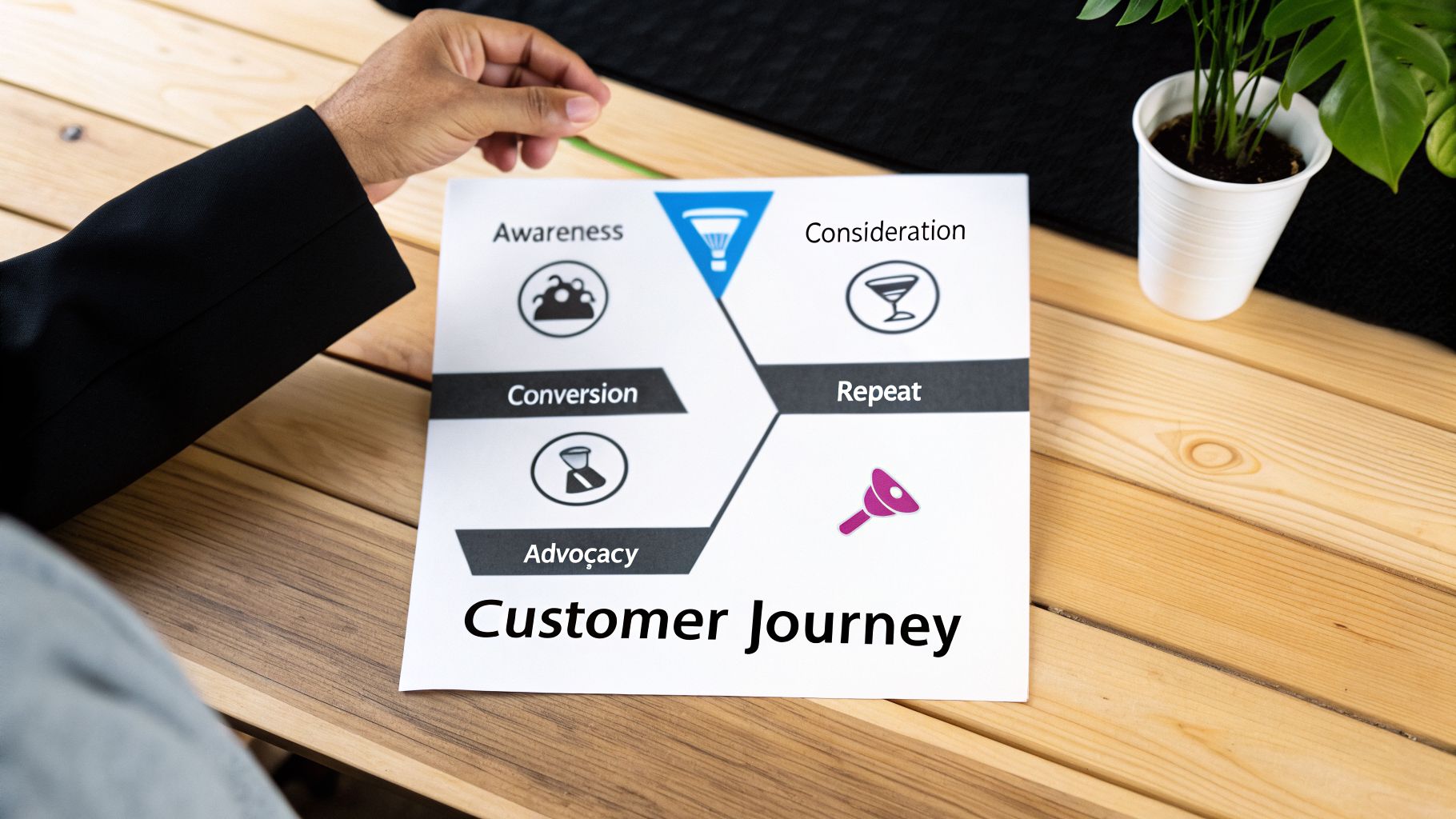
This is one of the most fundamental segmenting customers examples because it aligns marketing actions directly with the natural progression of the customer relationship. For instance, a subscription service might run post-purchase nurture campaigns to reduce month-two churn, while an e-commerce brand runs low-cost retention ads to existing customers.
Strategic Breakdown & Execution
Segment Definition: Group users by their journey stage. Examples include "Top-of-Funnel Prospects" (new site visitors, no purchase), "Mid-Funnel Engagers" (added to cart, viewed key product), "New Customers" (first 30 days), and "Loyal Advocates" (3+ purchases).
Data Sources: Combine website analytics (Google Analytics), ad platform engagement data (Meta/Google), and CRM/e-commerce data (Shopify, Klaviyo) to map user actions to lifecycle stages.
Targeting Tactics:
Meta/Google: Use broad targeting for awareness campaigns. Create custom audiences for retargeting at the consideration stage (e.g., cart abandoners). Build retention campaigns targeting past purchasers.
Exclusion: Exclude existing customers from top-of-funnel acquisition campaigns to avoid wasting ad spend and serving irrelevant messaging.
Bids & Budgets: Allocate higher CPA targets for acquiring new customers in the awareness stage. Set much lower CPA goals for retention and loyalty campaigns, which should be more efficient.
Key Insight: Don't measure all funnel stages with the same KPI. An awareness campaign might have a low ROAS but generate high-value customers down the line. Judge each stage by its own goals (e.g., reach for awareness, CPA for conversion, LTV for loyalty).
Actionable Checklist
Map Your Customer Journey: Define the key actions that move a user from one stage to the next (e.g., website visit -> product view -> add to cart -> purchase).
Create Stage-Based Audiences: Build custom audiences in your ad platforms for each defined stage (e.g., all visitors in last 30 days excluding purchasers).
Launch Funnel-Specific Campaigns: Develop unique messaging, creative, and offers for your awareness, consideration, and retention segments.
Set Stage-Specific KPIs: Assign different performance goals for each campaign based on its position in the funnel.
Monitor Performance by Stage: Use tools like SpendOwlAI to track cost and ROAS by funnel stage, helping you identify where your budget is most effective and which stages need optimization.
8. Purchase Intent and Engagement Level Segmentation
This method groups customers by their likelihood to buy, classifying them into high, medium, or low intent based on engagement signals. It analyzes user actions like website visits, add-to-cart events, time-on-site, repeat visits, and pixel activity. By predicting intent, marketers can focus their budgets on audiences closest to converting, maximizing efficiency and return.
Purchase intent is one of the most powerful segmenting customers examples because it aligns ad spend directly with the sales funnel. For instance, e-commerce brands often see an 8:1 ROAS on high-intent retargeting campaigns compared to a 1.5:1 ROAS on cold audiences, proving its direct impact on profitability.
Strategic Breakdown & Execution
Segment Definition: Classify audiences into tiers: High-Intent (added to cart, initiated checkout), Medium-Intent (viewed multiple products, spent significant time on site), and Low-Intent (visited homepage once).
Data Sources: Website analytics (Google Analytics), e-commerce platforms (Shopify), and ad platform pixels (Meta Pixel, Google Tag) are essential. Accurate event tracking via a Conversions API is critical for data integrity.
Targeting Tactics:
Meta/Google: Create custom audiences for each intent level. Run dynamic product ads (DPAs) for high-intent segments showing them the exact items they abandoned.
Exclusion: Exclude recent purchasers from high-intent campaigns to avoid ad waste and annoying loyal customers.
Bids & Budgets: Allocate a majority of your retargeting budget (e.g., 60-70%) to the high-intent segment. Use lower bids for medium-intent groups to nurture them without overspending.
Key Insight: High-intent audiences have shorter, more aggressive conversion windows. Setting a distinct, shorter learning phase for these campaigns in your ad platforms allows the algorithm to optimize faster and capitalize on immediate purchase signals before they go cold.
Actionable Checklist
Verify Event Tracking: Ensure your Meta Pixel and Conversions API are accurately tracking key events like
ViewContent,AddToCart, andInitiateCheckout.Define Intent Tiers: Set clear rules for each segment (e.g., "AddToCart in last 7 days" for High-Intent).
Build Custom Audiences: Create these audiences in Meta Ads Manager and Google Ads.
Launch Tiered Campaigns: Develop specific ad creative and offers for each intent level. For example, a small discount for cart abandoners.
Monitor Performance: Track CPA and ROAS for each segment. Use tools like SpendOwlAI to monitor audience saturation and know when it’s time to expand your targeting beyond high-intent groups.
9. Product Category and SKU-Level Segmentation
Segmenting customers by product category and individual SKU performance allows marketers to move beyond campaign-level metrics and focus on what truly drives profit. This method groups audiences and optimizes campaigns based on the specific products they buy, considering factors like price point, product margin, and inventory levels. For multi-product e-commerce brands, it provides a granular view of profitability, enabling smarter budget allocation and margin-aware scaling.
This is one of the most powerful segmenting customers examples for DTC operators because it connects ad spend directly to product-level profitability. It helps identify which SKUs are true "hero" products versus those that drain the ad budget with low margins.
Strategic Breakdown & Execution
Segment Definition: Create segments based on product attributes and purchase behavior. Examples include "High-Margin Hero Product Buyers," "Premium SKU Purchasers" (with AOV 3x higher than basics), or "Low-Margin, High-Volume Customers."
Data Sources: Combine e-commerce data from Shopify (SKU sales, margin, inventory) with ad platform data from Meta and Google to link specific ad performance to individual products.
Targeting Tactics:
Meta/Google: Build campaigns around your highest-margin product categories. Create lookalike audiences from customers who purchased your premium SKUs to find more high-value buyers.
Exclusion: Automatically pause ads for specific SKUs when inventory runs low to prevent spending on out-of-stock items and creating a poor customer experience.
Bids & Budgets: Allocate the majority of your budget to campaigns promoting hero products with high margins. Set lower bids for introductory or low-margin items, using them primarily for new customer acquisition rather than immediate profit.
Key Insight: Focusing only on ROAS can be misleading. A campaign with a 4x ROAS on a 20% margin product is less profitable than one with a 3x ROAS on a 60% margin product. Segmenting by SKU and margin ensures you scale the most profitable parts of your business.
Actionable Checklist
Map Product Margins: Calculate the profit margin for every SKU in your catalog.
Identify Hero SKUs: Pinpoint the top 20% of products that generate 80% of your profit.
Create Product-Specific Campaigns: Launch dedicated campaigns in Meta and Google for your hero product categories.
Set Up Inventory Sync: Use a tool to automatically pause ads for low-stock or out-of-stock SKUs.
Monitor SKU-Level KPIs: Track metrics like cost-per-purchase and ROAS for individual products, not just campaigns. Consider tools like SpendOwlAI to get SKU-level signals and set margin-based performance targets.
10. Saturation and Audience Fatigue Risk Segmentation
This proactive segmentation model groups audiences based on their risk of ad fatigue, monitoring saturation levels, performance volatility, and edit frequency. Instead of waiting for metrics like CTR or ROAS to collapse, this approach categorizes audiences into 'healthy,' 'fatiguing,' and 'saturated' tiers, allowing marketing teams to act preemptively to protect campaign performance and efficiency. It is a crucial example of segmenting customers for long-term account health.
By forecasting fatigue, teams can rotate creative, pause ad sets, or adjust budgets before wasting spend on unresponsive users, thereby maintaining more stable and predictable results over time.
Strategic Breakdown & Execution
Segment Definition: Create segments based on a fatigue risk score. Examples include "Healthy" (stable performance, low frequency), "Fatiguing" (declining CTR, rising frequency), or "Saturated" (high frequency, impression volume >20x audience size, volatile CPA).
Data Sources: Combine ad platform data (Meta Ads frequency, audience reach) with performance analytics from tools that can monitor volatility and edit frequency across campaigns.
Targeting Tactics:
Meta/Google: For "fatiguing" segments, introduce fresh creative or new ad angles. For "saturated" audiences, pause them for 1-2 weeks to cool down and reintroduce them later with a completely different offer.
Exclusion: Actively exclude "saturated" audiences from always-on prospecting campaigns to reallocate budget toward healthier, less-exposed user groups.
Bids & Budgets: Systematically reduce budgets for "fatiguing" segments while performance is still acceptable, rather than waiting for a total collapse. Reinvest that budget into testing new audiences or scaling "healthy" campaigns.
Key Insight: Many performance issues are self-inflicted. Frequent, minor campaign edits (more than three per week) can reset the learning phase and create performance volatility disguised as fatigue. Segmenting by edit frequency helps identify over-optimization.
Actionable Checklist
Analyze Saturation Metrics: Review your top audiences in Meta and calculate the impression-to-audience size ratio. Flag any above 20x.
Define Fatigue Segments: Categorize your main ad sets or audiences into "healthy," "fatiguing," or "saturated" based on frequency, CTR trends, and saturation scores.
Implement Creative Rotation: Set a schedule to introduce new creative to your "healthy" and "fatiguing" segments before performance dips.
Pause and Rest Saturated Audiences: Remove "saturated" audiences from active campaigns for a minimum of 14 days.
Set Optimization Guardrails: Use tools to monitor edit frequency and establish rules, such as a minimum time between budget adjustments, to prevent disruptive over-management.
Top 10 Customer Segmentation Methods Comparison
Segmentation Type | Implementation Complexity 🔄 | Resource Requirements ⚡ | Expected Outcomes 📊 | Ideal Use Cases 💡 | Key Advantages ⭐ |
|---|---|---|---|---|---|
Behavioral Segmentation by Ad Performance Metrics | Medium–High: continuous cross‑channel performance monitoring | Moderate: real‑time data feeds and optimization staff | Improved ROAS; early detection of performance drops | DTC/e‑commerce focused on ad-driven revenue and rapid ops | Direct revenue linkage; predictive interventions |
RFM Segmentation (Recency, Frequency, Monetary Value) | Low: simple scoring from transaction history | Low: purchase data and basic analytics tools | Better retention, identify high‑value and at‑risk customers | Retention, loyalty programs, repeat‑purchase optimization | Easy to implement; interpretable across categories |
Demographic Segmentation by Platform and Device | Medium: platform configs and privacy constraints | Moderate: platform analytics and device reporting expertise | Optimized budget by device/OS; improved targeting efficiency | Channel budgeting, device‑optimized creatives, regional allocation | Addresses platform differences; refines delivery by device |
Psychographic Segmentation by Brand Affinity and Intent | High: requires lookalike modeling and affinity signals | High: rich first‑party data, modeling, creative testing | Expanded relevant audiences; improved message relevance | Premium/niche DTC, brand positioning, long‑term acquisition | Better creative relevance; can lower CPC through relevance |
Segment-by-Campaign‑Performance (Creative & Messaging) | Medium–High: multiple creative tests and per‑segment tracking | High: creative production budgets and testing frameworks | Faster identification of winning creatives; higher CTRs | Creative optimization, format testing, agency creative scaling | Directly improves relevance; automates creative rotation |
Geographic and Geo‑Climate Segmentation | Medium: geo and seasonality modeling required | Moderate: regional data, market research, scheduling tools | Localized messaging increases ROAS; seasonal optimization | Seasonal products, multi‑region launches, localized offers | Aligns offers to local demand; optimizes seasonal spend |
Customer Lifecycle Stage Segmentation | Medium–High: attribution and funnel mapping needed | Moderate: funnel analytics, stage‑specific assets and budgets | Better budget allocation across funnel; improved LTV | Full‑funnel growth, SaaS freemium, retention programs | Tailors messaging by stage; enables predictable scaling |
Purchase Intent & Engagement Level Segmentation | High: precise event tracking and real‑time scoring | High: event/CAPI setup, dynamic ads, rapid response systems | Higher ROI by focusing on ready‑to‑buy users | Cart abandoners, high‑intent retargeting, dynamic product ads | Concentrates spend on high‑intent audiences; predictive |
Product Category & SKU‑Level Segmentation | High: SKU mapping and ERP/inventory integration | High: product data, margin calc, inventory feeds | Margin‑aware optimization; prevents scaling low‑margin SKUs | Multi‑SKU DTC, inventory‑driven campaigns, margin focus | Optimizes by margin/inventory; identifies star SKUs |
Saturation & Audience Fatigue Risk Segmentation | High: fatigue scoring and volatility detection algorithms | High: real‑time monitoring, rule engines, guardrails | Prevents performance cliffs; stabilizes long‑term ROAS | High‑frequency ad rotations, agencies managing many accounts | Proactive fatigue detection; reduces harmful over‑editing |
From Insight to Action: Making Your Segments Work Harder
The customer segmentation examples detailed in this article, from RFM analysis to audience fatigue signals, offer a strategic roadmap for modern e-commerce brands. We've moved beyond broad demographic buckets and into a more precise, data-driven approach where every dollar spent is accountable. The core principle is clear: your customers are not a monolith. They interact with your brand in distinct ways, and your marketing must reflect that reality. Recognizing this distinction is the first step toward building a more resilient and profitable advertising system.
The true power of segmentation is realized when it becomes an active, operational discipline rather than a passive, analytical exercise. It’s about building feedback loops where campaign performance informs segment refinement, which in turn guides creative development and budget allocation. The examples provided, such as segmenting by SKU-level purchase history or creative fatigue metrics, are designed to be immediately actionable. They give you the specific signals and tactical checklists needed to translate raw data from Meta, Google, and Shopify into intelligent, day-to-day decisions.
Key Takeaways for Execution
Mastering customer segmentation is less about finding a single "perfect" audience and more about building a portfolio of well-defined, adaptable segments. Here are the most critical takeaways to implement:
Start with Your Highest-Impact Data: Don't try to implement all ten strategies at once. Begin with the data you trust most. For many, that’s RFM analysis for retention or campaign-level performance metrics for acquisition. These provide quick wins and build momentum.
Connect Segments to Specific Goals: Every segment should have a job. Is it for reactivating lapsed customers? Finding new high-LTV prospects? Or excluding unprofitable audiences? Assigning a clear purpose to each segment ensures your actions are aligned with your business objectives.
Embrace Dynamic Segmentation: Static audiences go stale. Your segments must evolve as customer behavior changes. A "High-Intent Engager" who hasn't clicked in 30 days is no longer high-intent. A system that automatically refreshes audiences based on recent data is essential for maintaining performance.
Ultimately, the goal of these segmenting customers examples is to help you move from reactive ad management to proactive, strategic growth. The challenge for most operators isn't a lack of data; it's the difficulty of separating meaningful signals from the overwhelming noise. By focusing on a few of these proven segmentation models, you can create guardrails that protect your ad spend, surface hidden opportunities, and consistently drive more efficient outcomes. The result is a marketing engine that doesn't just spend money but intelligently invests it where it will generate the highest return.
Turning these complex data signals into a clear, prioritized list of daily actions is where many teams struggle. SpendOwlAI is designed to bridge that gap, analyzing your ad performance and customer data to give you specific, actionable recommendations for budget shifts, creative rotations, and audience adjustments. See how you can execute on these advanced segmentation strategies with more clarity and speed by visiting SpendOwlAI.